Dow Jones Industrial Average drops below 47,000 on AI concerns and Fed uncertainty
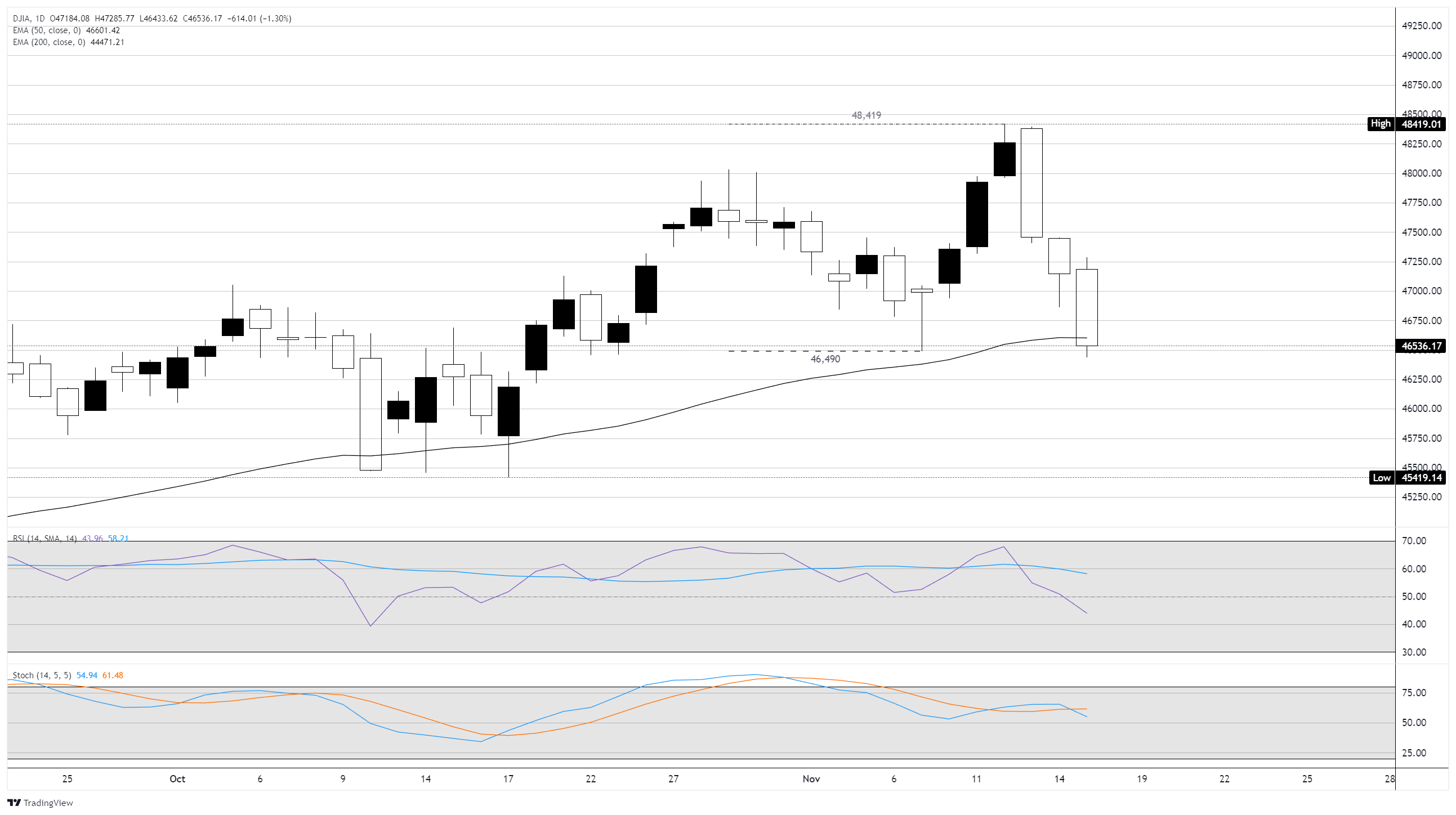
- The Dow Jones slipped another 600 points, falling below 47,000.
- Stocks are taking a further hit as questions about the AI sector continue to swirl.
- Backdated US data on labor and inflation comes this week as investors weigh Fed rate cut chances.

The Dow Jones Industrial Average (DJIA) hit another weak patch on Monday, backsliding 750 points at its lowest and slipping back below the 47,000 handle to start the new trading week with many of the same questions from last week going unanswered. The AI segment continues to see new challenges amid concerns about endpoint revenues, and investors are hoping that a kickstart to official data sources following the reopening of the federal government will help push the Federal Reserve (Fed) to deliver a third straight interest rate cut in December.
Alphabet shares supported by Berkshire investment
Shares in Google parent holding company Alphabet (GOOG) rose over 3% on the day after it was revealed that Warren Buffett’s Berkshire Hathaway (BRK) poured $4.3 billion into a stake in the Google search and YouTube giant at the end of September. Hyper-traditionalist investor Warren Buffett recently announced his retirement by the end of the year to Berkshire shareholders, leading to speculation that a play into Google properties is being spearheaded by more tech-friendly names in the Berkshire flagship.
Berkshire Hathaway continues to unwind its massive holdings of Apple (AAPL) stock, shedding another 15% of its total shares held as of the end of the third quarter. However, the Oracle of Omaha’s investment company’s holdings in Apple still sit at a lofty $60.7 billion.
Too-hot AI rally now faces tough questions about profitability
The AI trade continues to come under renewed pressure, with LLM computing services darling Nvidia (NVDA) falling another 1.8% on Monday. The chipmaker is slated to reveal its latest quarterly earnings after the closing bell on Wednesday, and investors are becoming concerned that the constantly-growing demand for AI-driven compute power still remains woefully outsized compared to revenues and return on investment on the actual deployment side.
US government back open... for now
The US government successfully passed a short-term funding resolution to restart federal operations last week, and investors are immediately pivoting into a wait-and-see stance as backdated labor and inflation data come down the chute. The Trump administration has preemptively warned that October’s labor and inflation data may be “lost forever”, but traders are hoping that September’s Nonfarm Payrolls (NFP) jobs report, while stale, will provide enough ammunition to pave the way to a third straight interest rate cut on December 10.
Fed Chair Jerome Powell signaled at the Fed’s last interest rate decision that a lack of official government data will force the Fed to stand pat until it receives further information on the US economy, battering broad-market expectations for a third straight rate cut in December.
Dow Jones daily chart
Nvidia FAQs
Nvidia is the leading fabless designer of graphics processing units or GPUs. These sophisticated devices allow computers to better process graphics for display interfaces by accelerating computer memory and RAM. This is especially true in the world of video games, where Nvidia graphics cards became a mainstay of the industry. Additionally, Nvidia is well-known as the creator of its CUDA API that allows developers to create software for a number of industries using its parallel computing platform. Nvidia chips are leading products in the data center, supercomputing and artificial intelligence industries. The company is also viewed as one of the inventors of the system-on-a-chip design.
Current CEO Jensen Huang founded Nvidia with Chris Malachowsky and Curtis Priem in 1993. All three founders were semiconductor engineers, who had previously worked at AMD, Sun Microsystems, IBM and Hewlett-Packard. The team set out to build more proficient GPUs than currently existed in the market and largely succeeded by late 1990s. The company was founded with $40,000 but secured $20 million in funding from Sequoia Capital venture fund early on. Nvidia went public in 1999 under the ticker NVDA. Nvidia became a leading designer of chips to the data center, PC, automotive and mobile markets through its close relationship with Taiwan Semiconductor.
In 2022, Nvidia released its ninth-generation data center GPU called the H100. This GPU is specifically designed with the needs of artificial intelligence applications in mind. For instance, OpenAI’s ChatGPT and GPT-4 large language models (LLMs) rely on the H100’s high efficiency in parallel processing to execute a high number of commands quickly. The chip is said to speed up networks by six times Nvidia’s previous A100 chip and is based on the new Hopper architecture. The H100 chip contains 80 billion transistors. Nvidia’s market cap reached $1 trillion in May 2023 largely on the promise of its H100 chip becoming the “picks and shovels” of the coming AI revolution. In June 2024, Nvidia's market capitalization crossed the $3 trillion mark.
Long-time CEO Jense Huang has a cult following in Silicon Valley and on Wall Street due to his strict loyalty and determination to build Nvidia into one of the world’s leading companies. Nvidia neary fell apart on several occasions, but each time Huang bet everything on a new technology that turned out to be the ticket to the company’s success. Huang is seen as a visionary in Silicon Valley, and his company is at the forefront of most major breakthroughs in computer processing. Huang is known for his enthusiastic keynote addresses at annual Nvidia GTC conferences, as well as his love of black leather jackets and Denny’s, the fast food chain where the company was founded.
Author

Joshua Gibson
FXStreet
Joshua joins the FXStreet team as an Economics and Finance double major from Vancouver Island University with twelve years' experience as an independent trader focusing on technical analysis.