Dow Jones Industrial Average rebounds, but dark tariff clouds gather
- The Dow Jones rose 1.12% on Monday as other indexes struggled.
- The Trump administration’s self-imposed April 2 deadline for tariffs looms large.
- A quiet start to the week gives way to fireworks with tariffs and NFP in the barrel.
The Dow Jones Industrial Average (DJIA) rebounded over 450 points on Monday, clawing back ground that was lost in last Friday’s stock rout. United States (US) President Donald Trump is poised to unleash his long-threatened yet still-ambiguous tariff packages on April 2, crimping investor sentiment throughout the market.
The Dow Jones climbed one and one-tenth of a percent, jumping back over the 42,000 level to kick off the new trading week. However, the rest of the major equity indexes continued to struggle. The Standard & Poor’s 500 eased by throughout the day before a late rebound to gain a meager half-percent, while the tech-heavy Nasdaq Composite remained in the red, struggling back to nearly flat after a brief plunge below 17,300.
The Trump administration is barreling toward its self-styled deadline to kick off a wide swath of tariffs against most of the US’s trading partners. US President Donald Trump continues to brand April 2 as “Liberation Day”, and continues to insist that his administration’s plans to impose, among other various tariff threats, a 25% tariff on functionally all vehicles sold in the US and sweeping “reciprocal” tariffs on any country that has its own import restrictions on US goods. Additional tariffs are expected on the European Union (EU) and Canada, as well as any country that purchases Venezuelan Crude Oil.
US Nonfarm Payrolls (NFP) loom large later this week, slated to release on Friday. This week’s NFP could draw significant investor attention as the US economy grapples with signs of an economic slowdown, and will also serve as a bellwether labor print for after the US administration’s tariffs come into place.
Read more stock news: Apple readies large-scale revamp of health offerings
Dow Jones price forecast
The Dow Jones’ Monday recovery has snapped a three-day losing streak, pumping the brakes on near-term bearish flows. However, things aren’t exactly rosy in the viewfinder: the DJIA is still trading south of the 200-day Exponential Moving Average (EMA) near 42,080, and the major equity index is still down nearly 3% from the last swing high into 42,800.
Dow Jones daily chart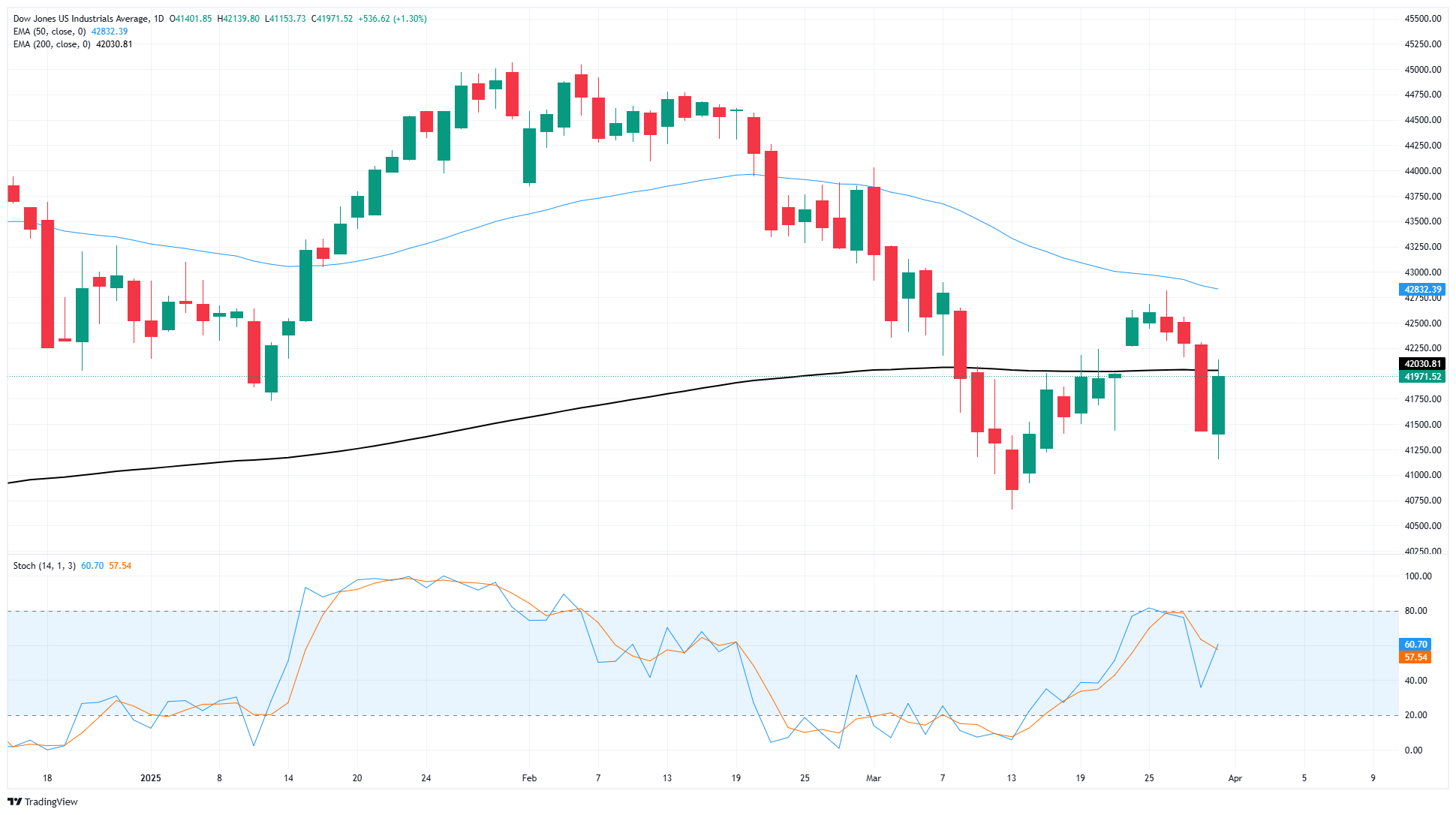
Tariffs FAQs
Tariffs are customs duties levied on certain merchandise imports or a category of products. Tariffs are designed to help local producers and manufacturers be more competitive in the market by providing a price advantage over similar goods that can be imported. Tariffs are widely used as tools of protectionism, along with trade barriers and import quotas.
Although tariffs and taxes both generate government revenue to fund public goods and services, they have several distinctions. Tariffs are prepaid at the port of entry, while taxes are paid at the time of purchase. Taxes are imposed on individual taxpayers and businesses, while tariffs are paid by importers.
There are two schools of thought among economists regarding the usage of tariffs. While some argue that tariffs are necessary to protect domestic industries and address trade imbalances, others see them as a harmful tool that could potentially drive prices higher over the long term and lead to a damaging trade war by encouraging tit-for-tat tariffs.
During the run-up to the presidential election in November 2024, Donald Trump made it clear that he intends to use tariffs to support the US economy and American producers. In 2024, Mexico, China and Canada accounted for 42% of total US imports. In this period, Mexico stood out as the top exporter with $466.6 billion, according to the US Census Bureau. Hence, Trump wants to focus on these three nations when imposing tariffs. He also plans to use the revenue generated through tariffs to lower personal income taxes.
Author

Joshua Gibson
FXStreet
Joshua joins the FXStreet team as an Economics and Finance double major from Vancouver Island University with twelve years' experience as an independent trader focusing on technical analysis.