Dow Jones Industrial Average gains ground despite fresh downside in tech stocks
- The Dow Jones soared on Tuesday, climbing into multi-month highs.
- The Dow is getting a boost from a reversal out of tech stocks.
- Budget watchers remain leery of details in Trump’s spend-heavy funding bill.

The Dow Jones Industrial Average (DJIA) rose to its highest levels in around five months on Tuesday, testing above 44,500 for the first time since early February. Equity markets were overall mixed, with declines in tech stocks keeping other major indexes under wraps. Health stocks are leading the charge higher on the Dow Jones, while tech giants including Nvidia (NVDA) and Tesla (TSLA) are struggling under the weight of their unique battles.
The Trump administration is inching toward finally passing its “big, beautiful budget bill” after weeks of political grappling over different sections of the rapidly changing government spending bill. However, one thing is certain to investors: Trump’s spend-heavy budget will be adding trillions of dollars of debt to the already heavily laden federal deficit for years to come.
Healthcare up, tech stocks down
Health sector stocks are catching a windfall as investors pull back from tech giants heading into the midweek. Ongoing trade and tariff uncertainty, political strife, and insider selling are all beginning to weigh on both hardware giant Nvidia and electric vehicle maker Tesla.
Tesla CEO Elon Musk, who until recently was President Trump’s right-hand hatchetman responsible for cutting federal workers and entire departments without congressional oversight, has crashed out of Trump’s inner circle. Musk has stepped up his antagonism of President Trump’s budget, and is threatening to fund the opponents of Republicans who support the bill.
Nvidia is struggling to continue delivering triple-digit revenue growth that has become the new baseline expectation for tech investors. The dizzying fervor over Nvidia shares, which have risen nearly 1,400% from a low of $10.81 in October of 2022 and peaked at $158.83 per share in June, could be seeing a flattening as the Trump administration continues to use US tech access as a bargaining chip in trade talks with China. Also on Nvidia's investor radar is a growing list of insider stockholders who have been slowly releasing their shares this year, even as share prices reach meteoric highs. Nvidia insiders have released upwards of a billion dollars’ worth of Nvidia stock over the past year, prompting some NVDA traders to wonder if the top on the AI craze is already priced in.
US data improves, but trade overhang remains
US ISM Manufacturing Purchasing Managers Index (PMI) figures for June came in stronger than expected on Tuesday, rising to 49.0 from last month’s 48.5. Despite the improvement, aggregated investor sentiment is still stuck in contraction territory as business operators continue to worry about growth prospects in the face of tumultuous trade and tariff conditions.
Dow Jones price forecast
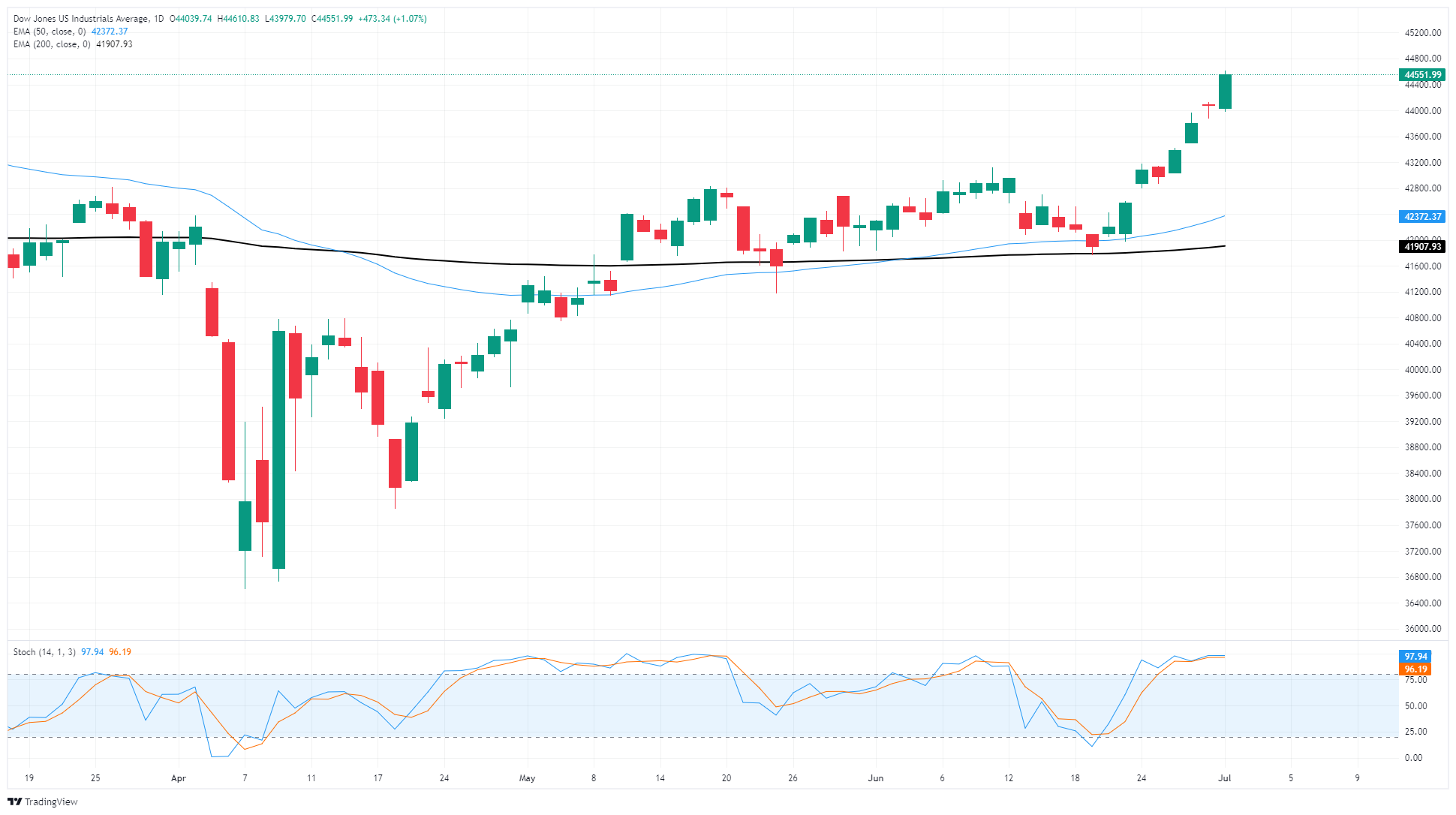
The Dow Jones surged around a full percent on Tuesday, climbing above 44,500 for the first time in several months. The major equity index is now on pace to take a fresh run at all-time highs north of 45,000, but bidders will have to contend with overbought conditions and a possible relief pullback first. Technical oscillators are pinned deep in overbought territory, and intraday bids have reached their highest differential from the 50-day Exponential Moving Average (EMA) since late 2024, with the medium-term moving average rising into 42,380.
Dow Jones daily chart
Nvidia FAQs
Nvidia is the leading fabless designer of graphics processing units or GPUs. These sophisticated devices allow computers to better process graphics for display interfaces by accelerating computer memory and RAM. This is especially true in the world of video games, where Nvidia graphics cards became a mainstay of the industry. Additionally, Nvidia is well-known as the creator of its CUDA API that allows developers to create software for a number of industries using its parallel computing platform. Nvidia chips are leading products in the data center, supercomputing and artificial intelligence industries. The company is also viewed as one of the inventors of the system-on-a-chip design.
Current CEO Jensen Huang founded Nvidia with Chris Malachowsky and Curtis Priem in 1993. All three founders were semiconductor engineers, who had previously worked at AMD, Sun Microsystems, IBM and Hewlett-Packard. The team set out to build more proficient GPUs than currently existed in the market and largely succeeded by late 1990s. The company was founded with $40,000 but secured $20 million in funding from Sequoia Capital venture fund early on. Nvidia went public in 1999 under the ticker NVDA. Nvidia became a leading designer of chips to the data center, PC, automotive and mobile markets through its close relationship with Taiwan Semiconductor.
In 2022, Nvidia released its ninth-generation data center GPU called the H100. This GPU is specifically designed with the needs of artificial intelligence applications in mind. For instance, OpenAI’s ChatGPT and GPT-4 large language models (LLMs) rely on the H100’s high efficiency in parallel processing to execute a high number of commands quickly. The chip is said to speed up networks by six times Nvidia’s previous A100 chip and is based on the new Hopper architecture. The H100 chip contains 80 billion transistors. Nvidia’s market cap reached $1 trillion in May 2023 largely on the promise of its H100 chip becoming the “picks and shovels” of the coming AI revolution. In June 2024, Nvidia's market capitalization crossed the $3 trillion mark.
Long-time CEO Jense Huang has a cult following in Silicon Valley and on Wall Street due to his strict loyalty and determination to build Nvidia into one of the world’s leading companies. Nvidia neary fell apart on several occasions, but each time Huang bet everything on a new technology that turned out to be the ticket to the company’s success. Huang is seen as a visionary in Silicon Valley, and his company is at the forefront of most major breakthroughs in computer processing. Huang is known for his enthusiastic keynote addresses at annual Nvidia GTC conferences, as well as his love of black leather jackets and Denny’s, the fast food chain where the company was founded.
Author

Joshua Gibson
FXStreet
Joshua joins the FXStreet team as an Economics and Finance double major from Vancouver Island University with twelve years' experience as an independent trader focusing on technical analysis.

















