Dow Jones Industrial Average finds thin gains on overall tepid Monday
- The Dow Jones found thin gains on Monday ahead of trade war headlines.
- Tech rally has stalled after last batch of earnings came in mixed.
- Fed Chair Powell back on the calendar, as well as US inflation data.

The Dow Jones Industrial Average (DJIA) found a slim foothold on Monday despite some volatility in the pre-market. The Dow rose around 150 points, adding one-third of one percent on the day. The United States (US) Federal Reserve (Fed) is back in news circulation this week, with Fed Chair Jerome Powell set to testify before the US Senate Banking Committee on Tuesday. US Consumer Price Index (CPI) and Producer Price Index (PPI) inflation metrics are slated for Wednesday and Thursday, respectively.
US President Donald Trump is expected to sign another batch of sweeping executive orders on Monday afternoon. Some of those orders are expected to focus on a fresh batch of tariff threats, this time focusing on a flat import tax on all foreign-sourced steel and aluminum into the US. While a threat to US market stability, investors are largely brushing off the trade war rhetoric after President Trump functionally waffled on nearly all of his trade war threats just last week, though a tit-for-tat spat of tariffs on Chinese goods are still in place.
Fed Chair Powell’s testimony this Tuesday will be the Fed head’s first appearance before the Senate since Donald Trump took office, and questions are expected to largely focus on Trump’s tariff policies and how they impact the Fed’s decision framework. Multiple iterations of whether Fed Chair Powell will acquiesce to requests from the Trump administration, ranging from arbitrary rate adjustments at the behest of the President to whether Powell would vacate his position if asked by Donald Trump, are expected.
Key US inflation data is due this week, with US CPI inflation on Wednesday and PPI producer-level inflation slated for Thursday. The New York Fed noted on Monday that consumer inflation expectations have become anchored around the 3% level, frustratingly higher than the central bank’s 2% target. The NY Fed also highlighted an overall decline in consumer expectations of increased spending going forward, though debt-laden consumers did acknowledge an overall easing in credit access.
Dow Jones news
The Dow Jones was relatively even-keeled on Monday, with about half of the equity board in the green. American Express (AXP) fell around 3% to $307 per share after the credit company softened its earnings growth outlook for the first quarter. McDonald’s (MCD) rose nearly 4% to $306 per share on Monday despite a miss in quarterly earnings, with investors noting that the overall pace of new locations has been on the rise and is expected to contribute to aggregate earnings in 2025.
Dow Jones price forecast
The Dow Jones remains pinned near 44,350 after last week’s late bearish push. Price action remains crimped below the 45,000 handle, and momentum is getting squeezed into a middling congestion pattern.
A near-term technical floor is getting priced in at the 50-day Exponential Moving Average (EMA) near 43,750. Both bulls and bears appear to have run out of gas for the time being, but the Dow Jones is still trading close to record highs just beyond 45,000.
Dow Jones daily chart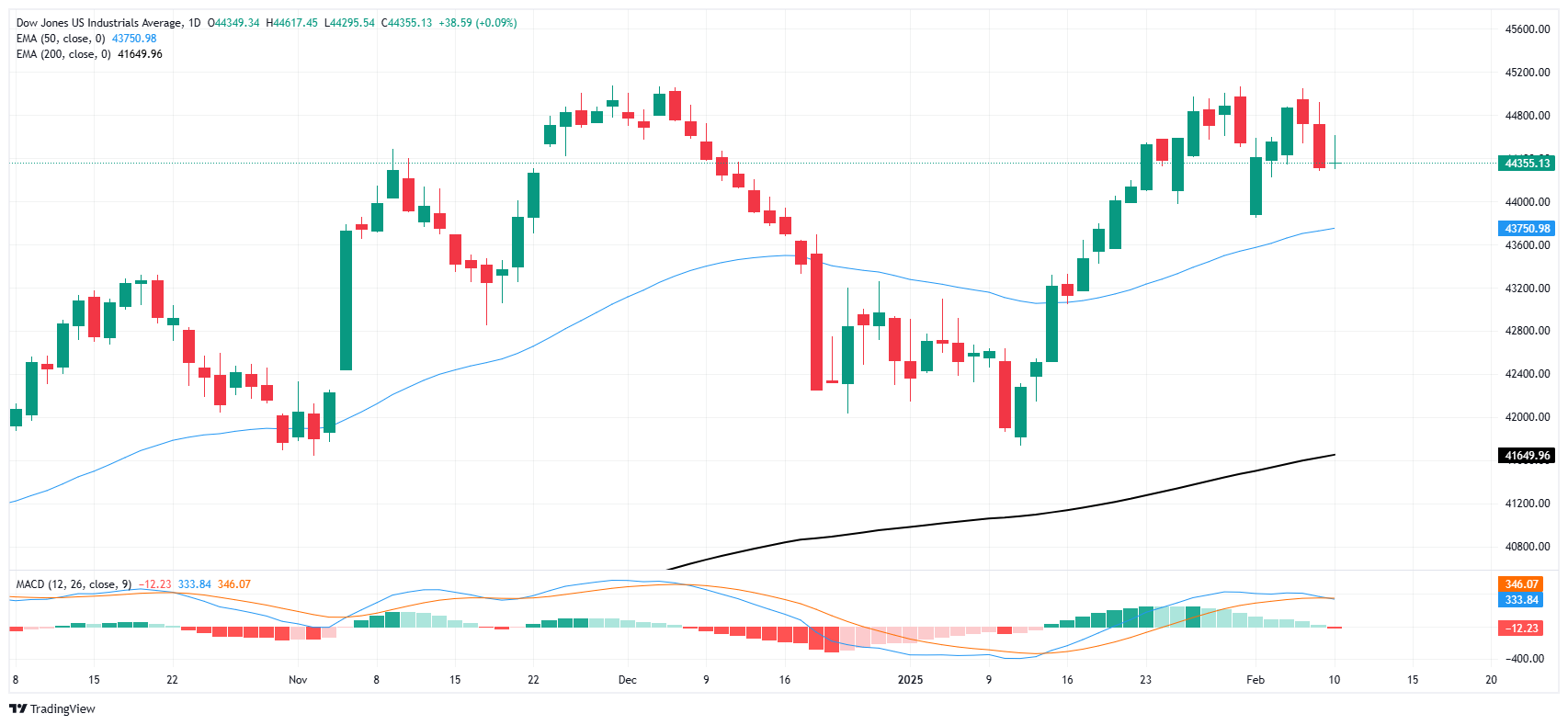
Fed FAQs
Monetary policy in the US is shaped by the Federal Reserve (Fed). The Fed has two mandates: to achieve price stability and foster full employment. Its primary tool to achieve these goals is by adjusting interest rates. When prices are rising too quickly and inflation is above the Fed’s 2% target, it raises interest rates, increasing borrowing costs throughout the economy. This results in a stronger US Dollar (USD) as it makes the US a more attractive place for international investors to park their money. When inflation falls below 2% or the Unemployment Rate is too high, the Fed may lower interest rates to encourage borrowing, which weighs on the Greenback.
The Federal Reserve (Fed) holds eight policy meetings a year, where the Federal Open Market Committee (FOMC) assesses economic conditions and makes monetary policy decisions. The FOMC is attended by twelve Fed officials – the seven members of the Board of Governors, the president of the Federal Reserve Bank of New York, and four of the remaining eleven regional Reserve Bank presidents, who serve one-year terms on a rotating basis.
In extreme situations, the Federal Reserve may resort to a policy named Quantitative Easing (QE). QE is the process by which the Fed substantially increases the flow of credit in a stuck financial system. It is a non-standard policy measure used during crises or when inflation is extremely low. It was the Fed’s weapon of choice during the Great Financial Crisis in 2008. It involves the Fed printing more Dollars and using them to buy high grade bonds from financial institutions. QE usually weakens the US Dollar.
Quantitative tightening (QT) is the reverse process of QE, whereby the Federal Reserve stops buying bonds from financial institutions and does not reinvest the principal from the bonds it holds maturing, to purchase new bonds. It is usually positive for the value of the US Dollar.
Author

Joshua Gibson
FXStreet
Joshua joins the FXStreet team as an Economics and Finance double major from Vancouver Island University with twelve years' experience as an independent trader focusing on technical analysis.