Dow Jones Industrial Average hesitates after dubious Vietnam trade deal and ADP jobs slump
- The Dow Jones held onto near-term highs on Wednesday, but risks are growing.
- President Trump announced a trade deal with Vietnam, US importers to foot the bill.
- ADP jobs data came in well below expectations, reigniting market fears of a weakening US economy.


The Dow Jones Industrial Average (DJIA) tested the low side on Wednesday, knocking back the early week’s bullish tilt after ADP Employment Change figures widely missed the mark and came in well below forecasts. The Trump administration has announced a trade deal with Vietnam, with US importers poised to bear the brunt of the burden for double-digit tariffs on all Vietnamese goods entering the US.
President Donald Trump announced that the US had reached some form of a trade deal with Vietnam. According to Trump, Vietnam would be subject to a 20% tariff on all goods bound for the US, with a 40% tariff on transshipment, while Vietnam would charge no tariffs whatsoever on US exports to the country. US exports to Vietnam totalled $13.1 billion in 2024. Donald Trump insisted that Vietnam specifically would be paying the import tax, neglecting to point out that US import taxes are charged at the port of entry to the US-based company that orders the goods.
US ADP Employment Change figures came in well below expectations on Wednesday, contracting by 33K net jobs and driving a sharp point through both median market forecasts and investor confidence in the US domestic economy. ADP jobs figures serve as a volatile preview of Nonfarm Payrolls (NFP), with the latest net job gains estimates from the Bureau of Labor Statistics (BLS) due on Thursday this week. Aggregate forecasts are expecting NFP net employment gains to rise 110K in June, a healthy number but still slightly down from May’s 139K.
Dow Jones price forecast
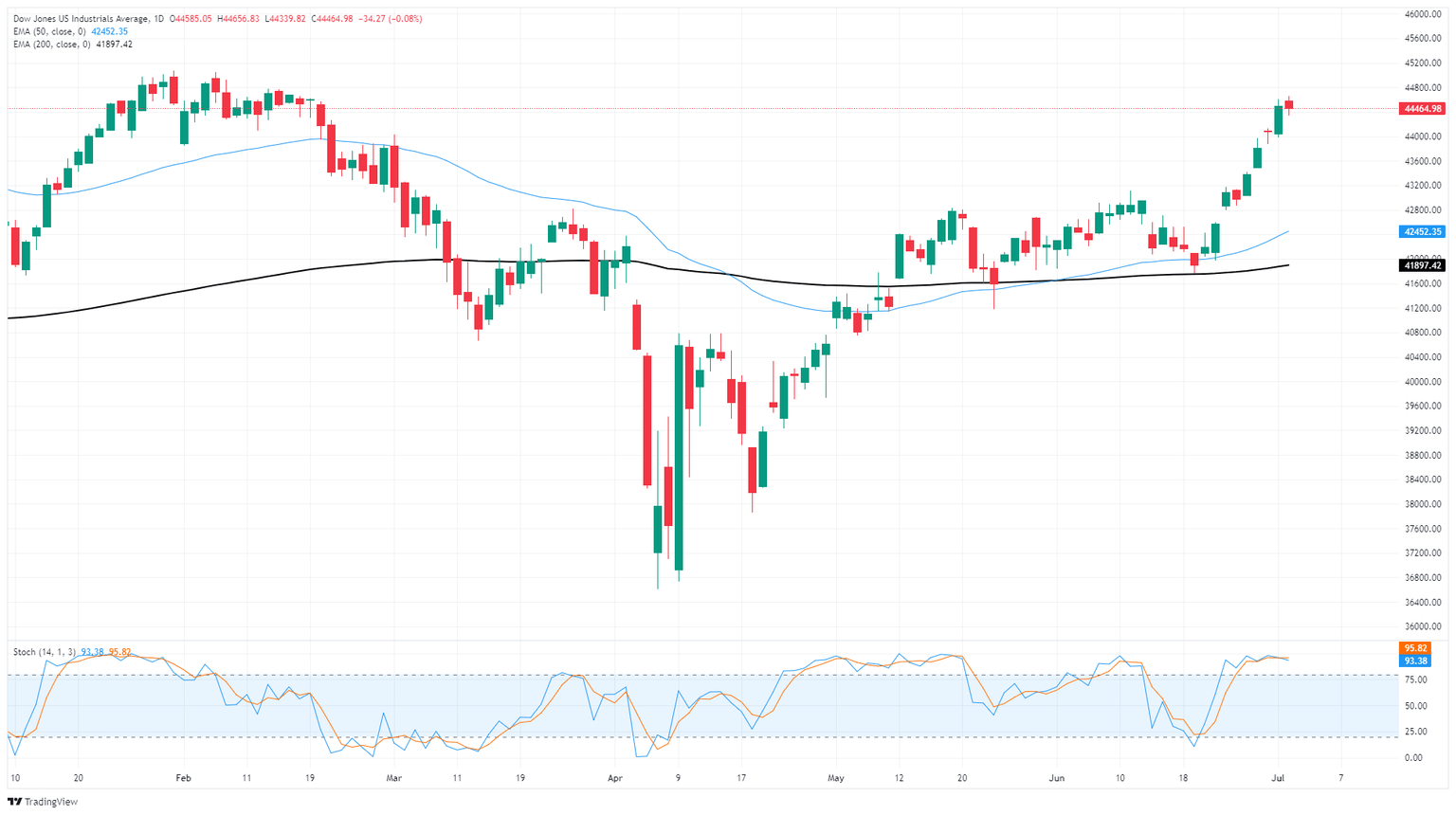
The Dow Jones is still holding onto bullish territory near 44,500, but intraday momentum has slowed sharply during the midweek market session. The Dow remains firmly pinned to the high side, trading far above the 200-day Exponential Moving Average (EMA) near 42,200; however, technical oscillators remain buried deep in overbought territory, warning of a downside correction on the cards to relieve some bullish steam built up in equities.
Dow Jones daily chart
Tariffs FAQs
Tariffs are customs duties levied on certain merchandise imports or a category of products. Tariffs are designed to help local producers and manufacturers be more competitive in the market by providing a price advantage over similar goods that can be imported. Tariffs are widely used as tools of protectionism, along with trade barriers and import quotas.
Although tariffs and taxes both generate government revenue to fund public goods and services, they have several distinctions. Tariffs are prepaid at the port of entry, while taxes are paid at the time of purchase. Taxes are imposed on individual taxpayers and businesses, while tariffs are paid by importers.
There are two schools of thought among economists regarding the usage of tariffs. While some argue that tariffs are necessary to protect domestic industries and address trade imbalances, others see them as a harmful tool that could potentially drive prices higher over the long term and lead to a damaging trade war by encouraging tit-for-tat tariffs.
During the run-up to the presidential election in November 2024, Donald Trump made it clear that he intends to use tariffs to support the US economy and American producers. In 2024, Mexico, China and Canada accounted for 42% of total US imports. In this period, Mexico stood out as the top exporter with $466.6 billion, according to the US Census Bureau. Hence, Trump wants to focus on these three nations when imposing tariffs. He also plans to use the revenue generated through tariffs to lower personal income taxes.
Author
Joshua Gibson
FXStreet
Joshua joins the FXStreet team as an Economics and Finance double major from Vancouver Island University with twelve years' experience as an independent trader focusing on technical analysis.