Dow Jones Industrial Average gains 600 points on shutdown resolution expectations
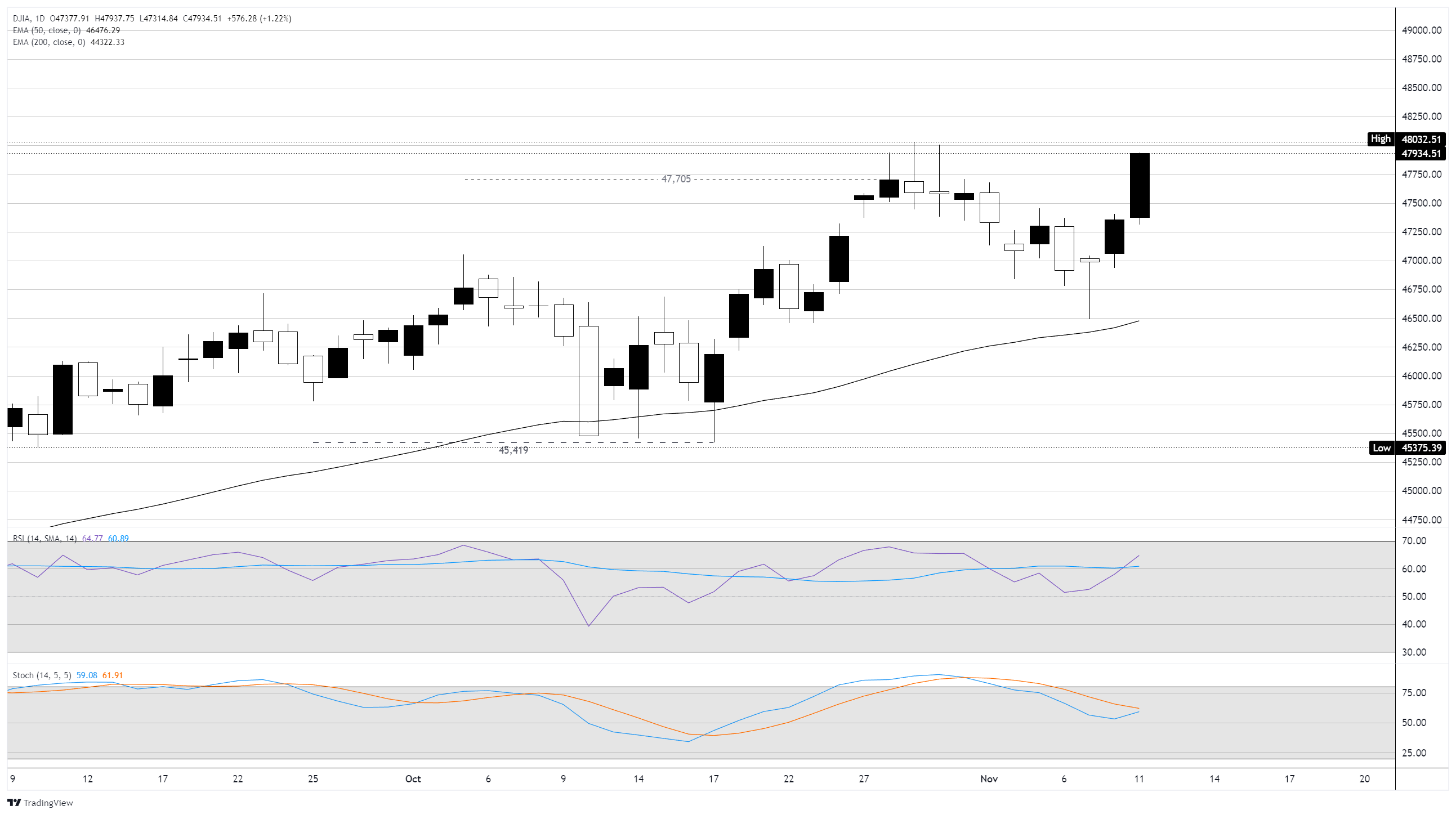
- The Dow Jones found room on the high side on Tuesday, challenging 48,000 once again.
- Equities are grappling with a continued softening in the AI bull trade, but the Dow is soldiering higher.
- Expectations for an end to the ongoing government shutdown are bolstering investor confidence.

The Dow Jones Industrial Average (DJIA) found some room to move higher on Tuesday, despite a general malaise setting into other major stock indexes as the AI tech rally continues to sputter. The Dow has launched itself back toward the 48,000 region as investors bank on a resolution to temporarily fund the US government and resume the flow of critical labor and inflation data.
Investor hope for a government closure solution remains high
The US government has pivoted to finding the necessary votes to pass a temporary funding bill that will see federal services resume operations, at least through the end of January before the cycle of political standoffs and government services hostage-taking can begin again.
A near-term reopening of the federal government following what has become the longest US government shutdown in American history will bring a deluge of official labor and inflation figures, which are necessary datapoints for the Federal Reserve (Fed) to continue delivering the market’s much-desired interest rate cuts.
AI operational costs likely to run much higher than everyone thinks
Renowned bear speculator Michael Burry noted on X-nee-Twitter earlier this week that most of the growth expectations surrounding the ongoing AI tech rally may be built on faulty accounting. According to the legendary investor, AI “hyperscalers”, or companies that provide compute power and rent data access to AI projects, are intentionally understating the depreciation costs of constantly upcycling data warehouse infrastructure to meet ever-growing data-crunching demand. According to Burry, the bulk of the investment cash being sunk into the AI space will continue to be burned at a faster-than-expected rate as AI demand chews through data infrastructure, and tech providers are overstating their future income expectations by drastically understating their equipment replacement costs.
Dow Jones daily chart
AI stocks FAQs
First and foremost, artificial intelligence is an academic discipline that seeks to recreate the cognitive functions, logical understanding, perceptions and pattern recognition of humans in machines. Often abbreviated as AI, artificial intelligence has a number of sub-fields including artificial neural networks, machine learning or predictive analytics, symbolic reasoning, deep learning, natural language processing, speech recognition, image recognition and expert systems. The end goal of the entire field is the creation of artificial general intelligence or AGI. This means producing a machine that can solve arbitrary problems that it has not been trained to solve.
There are a number of different use cases for artificial intelligence. The most well-known of them are generative AI platforms that use training on large language models (LLMs) to answer text-based queries. These include ChatGPT and Google’s Bard platform. Midjourney is a program that generates original images based on user-created text. Other forms of AI utilize probabilistic techniques to determine a quality or perception of an entity, like Upstart’s lending platform, which uses an AI-enhanced credit rating system to determine credit worthiness of applicants by scouring the internet for data related to their career, wealth profile and relationships. Other types of AI use large databases from scientific studies to generate new ideas for possible pharmaceuticals to be tested in laboratories. YouTube, Spotify, Facebook and other content aggregators use AI applications to suggest personalized content to users by collecting and organizing data on their viewing habits.
Nvidia (NVDA) is a semiconductor company that builds both the AI-focused computer chips and some of the platforms that AI engineers use to build their applications. Many proponents view Nvidia as the pick-and-shovel play for the AI revolution since it builds the tools needed to carry out further applications of artificial intelligence. Palantir Technologies (PLTR) is a “big data” analytics company. It has large contracts with the US intelligence community, which uses its Gotham platform to sift through data and determine intelligence leads and inform on pattern recognition. Its Foundry product is used by major corporations to track employee and customer data for use in predictive analytics and discovering anomalies. Microsoft (MSFT) has a large stake in ChatGPT creator OpenAI, the latter of which has not gone public. Microsoft has integrated OpenAI’s technology with its Bing search engine.
Following the introduction of ChatGPT to the general public in late 2022, many stocks associated with AI began to rally. Nvidia for instance advanced well over 200% in the six months following the release. Immediately, pundits on Wall Street began to wonder whether the market was being consumed by another tech bubble. Famous investor Stanley Druckenmiller, who has held major investments in both Palantir and Nvidia, said that bubbles never last just six months. He said that if the excitement over AI did become a bubble, then the extreme valuations would last at least two and a half years or long like the DotCom bubble in the late 1990s. At the midpoint of 2023, the best guess is that the market is not in a bubble, at least for now. Yes, Nvidia traded at 27 times forward sales at that time, but analysts were predicting extremely high revenue growth for years to come. At the height of the DotCom bubble, the NASDAQ 100 traded for 60 times earnings, but in mid-2023 the index traded at 25 times earnings.
Author

Joshua Gibson
FXStreet
Joshua joins the FXStreet team as an Economics and Finance double major from Vancouver Island University with twelve years' experience as an independent trader focusing on technical analysis.