Dow Jones Industrial Average flattens after earnings boost shaky market sentiment
- The Dow Jones churned on Wednesday as investors fight back their own apprehensions.
- A solid start to earnings season is keeping risk appetite on the high side despite looming geopolitical concerns.
- Official datasets remain dark amid the US government shutdown, but a rate cut silver lining remains the focus.

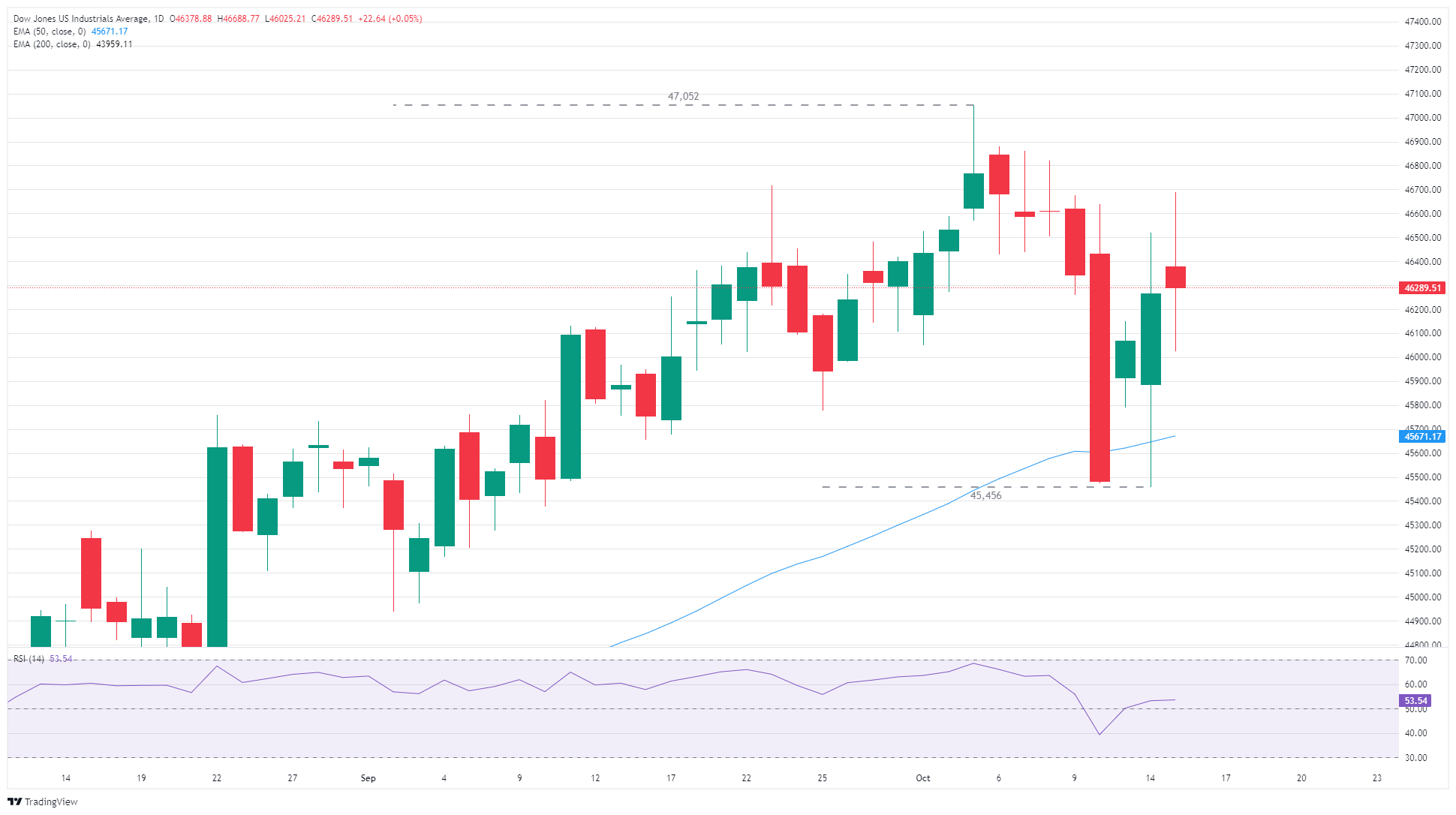
The Dow Jones Industrial Average (DJIA) found room on the high side on Wednesday, climbing into a second day of recovery flows and testing territory north of 46,600 before settling back to flat for the day. Another round of Wall Street earnings reports is kicking off the quarterly review period on a high note, with investment bank and luxury handbag earnings outpacing expectations.
Still-rising trade tensions between the US and China are still simmering away on the back burner, and the ongoing US government shutdown remains a key sticking point for global markets, but equities remain focused on earnings, the one blue patch in an otherwise grey sky.
Earnings trump trade wars and non-functioning governments, apparently
Morgan Stanley (MS) and Bank of America (BAC) both beat earnings expectations during the third quarter, rising nearly 6% and 5% respectively, on Wednesday. French luxury goods conglomerate Moet Hennessy Louis Vuitton SE (LVMH) soared over 12% on the day after thumping earnings expectations, further bolstering broad-market expectations that companies will continue to churn out record-setting earnings periods.
Official US datasets remain a large blank space as the Trump administration largely avoids getting involved in solving the federal government’s ongoing funding shutdown. Little indication has been given that the two sides of the US government are in a particular rush to bring an end to the federal closure, sparking comments from Trump aides that a sweeping firing of government workers is now underway. A federal judge in San Francisco issued a sweeping block of any firings by the Trump administration, at the specific request of multiple federal worker unions, a move that will both draw ire from President Trump and further assuage any concerns about long-term fallout from the shutdown for investors.
Investors also continue to brush off any negative outcomes from the government data freeze, largely due to a lack of any official reporting on labor, wages, and employment makes it easier for the Federal Reserve (Fed) to maintain its near-term trajectory of delivering two more interest rate cuts before the end of the year.
Dow Jones daily chart
Dow Jones FAQs
The Dow Jones Industrial Average, one of the oldest stock market indices in the world, is compiled of the 30 most traded stocks in the US. The index is price-weighted rather than weighted by capitalization. It is calculated by summing the prices of the constituent stocks and dividing them by a factor, currently 0.152. The index was founded by Charles Dow, who also founded the Wall Street Journal. In later years it has been criticized for not being broadly representative enough because it only tracks 30 conglomerates, unlike broader indices such as the S&P 500.
Many different factors drive the Dow Jones Industrial Average (DJIA). The aggregate performance of the component companies revealed in quarterly company earnings reports is the main one. US and global macroeconomic data also contributes as it impacts on investor sentiment. The level of interest rates, set by the Federal Reserve (Fed), also influences the DJIA as it affects the cost of credit, on which many corporations are heavily reliant. Therefore, inflation can be a major driver as well as other metrics which impact the Fed decisions.
Dow Theory is a method for identifying the primary trend of the stock market developed by Charles Dow. A key step is to compare the direction of the Dow Jones Industrial Average (DJIA) and the Dow Jones Transportation Average (DJTA) and only follow trends where both are moving in the same direction. Volume is a confirmatory criteria. The theory uses elements of peak and trough analysis. Dow’s theory posits three trend phases: accumulation, when smart money starts buying or selling; public participation, when the wider public joins in; and distribution, when the smart money exits.
There are a number of ways to trade the DJIA. One is to use ETFs which allow investors to trade the DJIA as a single security, rather than having to buy shares in all 30 constituent companies. A leading example is the SPDR Dow Jones Industrial Average ETF (DIA). DJIA futures contracts enable traders to speculate on the future value of the index and Options provide the right, but not the obligation, to buy or sell the index at a predetermined price in the future. Mutual funds enable investors to buy a share of a diversified portfolio of DJIA stocks thus providing exposure to the overall index.
Author

Joshua Gibson
FXStreet
Joshua joins the FXStreet team as an Economics and Finance double major from Vancouver Island University with twelve years' experience as an independent trader focusing on technical analysis.

















