Dollar Index remains weak as core PCE inflation rises, Personal spending fall
- Dollar Index falls after the Fed's preferred measure of inflation, the core PCE, rises in May.
- US Dollar continues to weaken, with the DXY nearing Thursday's low of 97.00
- US Michigan Consumer Sentiment Index and Michigan Expectations ahead, providing additional insight into how consumers feel about current conditions.

The US Dollar Index (DXY) is nearing 97.00 support as investors digest the latest batch of inflation data released out of the United States.
Friday’s US core Personal Consumption Expenditure (PCE), released by the US Bureau of Economic Analysis, has served as an additional catalyst for DXY.
This report, which represents the pace at which prices are rising in the US, is the Fed’s preferred measure of inflation, which has a direct impact on interest rate expectations.
US core Personal Expenditures come in hotter than expected
The headline PCE number came in line with expectations. The monthly figure rose by 0.1% in May, unchanged from the previous month. The YoY number also met estimates, rising 2.3%, slightly higher than April’s 2.2% reading.
However, the core figures, which exclude volatile products like food and energy, beat analyst forecasts, with both the monthly and annual readings coming in hotter than expected.
Core PCE rose 0.2% MoM in May, above the estimate of 0.1% while the YoY figure printed at 2.7%, also higher than the consensus, which had forecast the annual number to remain unchanged from April’s 2.6% print.
Personal Income fell by 0.4% for May, while analysts had expected a 0.3% increase, down from the 0.7% increase in April. Personal Spending also missed expectations, declining by 0.1%, falling from 0.2% in April and below the 0.1% estimate.
As the Fed’s preferred measure of inflation, an increase in core PCE puts the Fed in a difficult position.
With President Donald Trump pushing the Fed to cut rates, lower interest rates are generally supportive of economic growth, which tends to push inflation higher.
Still, even with inflation remaining above the Fed’s 2% target level, the economy is showing signs of slowing, which could force the Fed to reconsider the possibility of a July rate cut.
The latest data print pushed US Treasury yields lower, pushing the Dollar Index closer to major support, which helped limit losses on Thursday at 97.00.
Next, investors will be looking at the Michigan Sentiment and Expectations Index for additional signs of how consumers perceive the current economic conditions in the US and the prospects for the next 12 months.
If confidence in the US economy is waning, the Greenback may continue to head lower against a basket of currencies.
Technical analysis: Dollar Index nears 97.00
At the time of writing, DXY is trading near 97.05, extending its multi-month downtrend and remaining well below both the 20-day (98.46) and 50-day (99.31) Simple Moving Averages (SMA).
A descending trendline from the February peak continues to cap upside attempts, reinforcing the bearish structure. The Relative Strength Index (RSI) is hovering around 31.39, approaching oversold territory but not yet showing signs of reversal.
Dollar Index daily chart
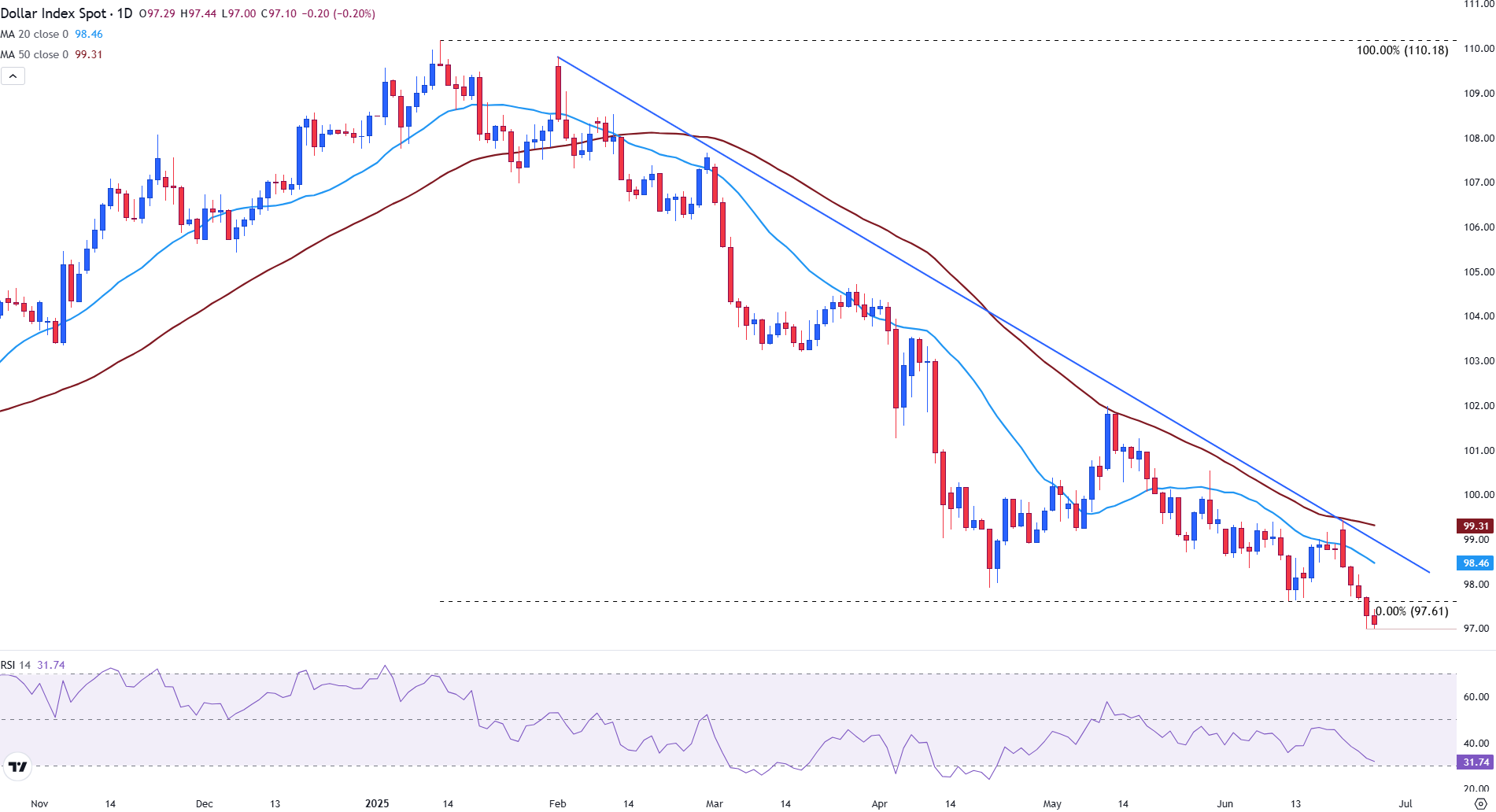
A confirmed break below 97.61 could open the way for a deeper correction, while any recovery would face resistance near 98.50 and 99.30, where the moving averages and trendline converge.
If prices fall below 97.00, the 96.00 psychological level could come into focus, potentially opening the door for a revisit of the February 2022 low near 95.15.
US Dollar FAQs
The US Dollar (USD) is the official currency of the United States of America, and the ‘de facto’ currency of a significant number of other countries where it is found in circulation alongside local notes. It is the most heavily traded currency in the world, accounting for over 88% of all global foreign exchange turnover, or an average of $6.6 trillion in transactions per day, according to data from 2022. Following the second world war, the USD took over from the British Pound as the world’s reserve currency. For most of its history, the US Dollar was backed by Gold, until the Bretton Woods Agreement in 1971 when the Gold Standard went away.
The most important single factor impacting on the value of the US Dollar is monetary policy, which is shaped by the Federal Reserve (Fed). The Fed has two mandates: to achieve price stability (control inflation) and foster full employment. Its primary tool to achieve these two goals is by adjusting interest rates. When prices are rising too quickly and inflation is above the Fed’s 2% target, the Fed will raise rates, which helps the USD value. When inflation falls below 2% or the Unemployment Rate is too high, the Fed may lower interest rates, which weighs on the Greenback.
In extreme situations, the Federal Reserve can also print more Dollars and enact quantitative easing (QE). QE is the process by which the Fed substantially increases the flow of credit in a stuck financial system. It is a non-standard policy measure used when credit has dried up because banks will not lend to each other (out of the fear of counterparty default). It is a last resort when simply lowering interest rates is unlikely to achieve the necessary result. It was the Fed’s weapon of choice to combat the credit crunch that occurred during the Great Financial Crisis in 2008. It involves the Fed printing more Dollars and using them to buy US government bonds predominantly from financial institutions. QE usually leads to a weaker US Dollar.
Quantitative tightening (QT) is the reverse process whereby the Federal Reserve stops buying bonds from financial institutions and does not reinvest the principal from the bonds it holds maturing in new purchases. It is usually positive for the US Dollar.
Author

Tammy Da Costa, CFTe®
FXStreet
Tammy is an economist and market analyst with a deep passion for financial markets, particularly commodities and geopolitics.