Did FedEx just deliver a buying opportunity?

FedEx (NYSE: FDX) fired a warning shot the market needs to pay attention to when it prereleasedQ3 earnings but there is more to the story than what the headlines are screaming.
FedEx is predicting a global recession in 2023 but the 20% decline in share prices is already offering a buying opportunity
Granted, it’s only been a few days since the prerelease hit the market but there are only two recorded institutional transactions and both are small in relation to FedEx and their own portfolios.
The takeaway is that institutional ownership is approaching 72% and on the rise with the net activity bullish for the last 3 consecutive quarters, including the current, calendar Q3 period.
In regard to the analysts, there’ve been at least 16 commentaries released since the profit warning including 4 downgrades and 16 price target reductions but the net result is bullish. The analyst sentiment slipped slightly but is still pegged at a Moderate Buy with a price target more than 50% above the current price action.
“We're disappointed having given FedEx the benefit of the doubt after operational missteps in Ground, labor issues with contractors, TNT integration progress in Europe, and commercial efforts to drive yield and mix…it's becoming clear that UPS is executing better, in our view,” said Stifel analyst J. Bruce Chan when he downgraded the stock to Hold from Buy and lowered the firms target to $195 and well below the $241 consensus.
Did FedEx selloff too much?
FedEx’s revenue and earnings are estimated to come in well below the consensus figures when it reports actual results later this week. The cause is attributed to rapid deceleration in the International business coupled with domestic weakness the company was unable to keep up with.
This is bad news for the current quarter but provides potential catalysts for higher share prices as well, 1near-term, and 1 long-term. The near-term catalyst is that actual results may not be as bad as the company is projecting and/or there may be some better news in the report that aids the outlook for earnings in FQ4 and F2024.
The long-term catalyst is that company's efforts to mitigate its cost base and prepare for the coming recession may set it up to perform better than the market’s expectations.
“While this performance is disappointing, we are aggressively accelerating cost reduction efforts and evaluating additional measures to enhance productivity, reduce variable costs, and implement structural cost-reduction initiatives.
These efforts are aligned with the strategy we outlined in June, and I remain confident in achieving our fiscal year 2025 financial targets,” says Raj Subramaniam, CEO, and president of FedEx.
The technical outlook: FedEx market capitulates
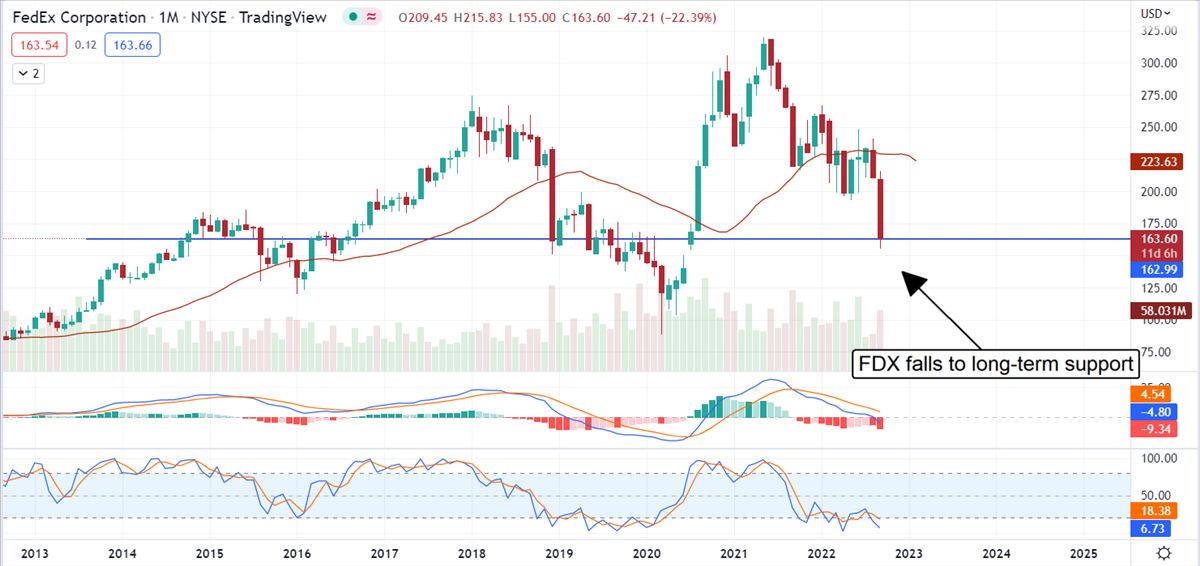
The price action in FedEx stock has been under pressure since hitting its peak in June 2021 and that context makes the new 20% drop in share prices look like capitulation.
The market imploded on the news, selling off on incredibly high volume, but someone was buying those shares and they drove the price action up off the low of the day confirming support that dates back to the 2014/2015 time period and a level that was confirmed during the Trump/Xi trade war.
The action following the initial decline also suggests support is strong at this level and points to a bottom for the stock. Assuming the market follows through on this signal, the price action may move lower but the downside should be limited and lead to a trading range until more news is available. Until then, the 2.85% dividend yield looks safe enough.
investors. The stock is now trading at only 10X its consensus earnings estimate and paying a dividend worth nearly 2.9% and the sell-side community is not baling out.
The analysts are trimming their targets and the institutions may alter the pace of their activity, but both groups think this stock is still a buy.
Author

Jacob Wolinsky
ValueWalk
Jacob Wolinsky is the founder of ValueWalk, a popular investment site. Prior to founding ValueWalk, Jacob worked as an equity analyst for value research firm and as a freelance writer. He lives in Passaic New Jersey with his wife and four children.