Crude Oil trying to hold steady at the low end of near-term chop
- WTI scrambled to keep afloat of $73.00 on Monday.
- Crude Oil markets are looking to see if Libya cuts balance OPEC boost.
- Declines in China business activity are also weighing on Crude Oil bids.

West Texas Intermediate (WTI) US Crude Oil held roughly on-balance to kick off the new trading week, finding a foothold and keeping intraday action on the north side of $73.00 per barrel. Libya announced a halt of Crude Oil exports out of the country on Monday as political sections grapple over who controls Libya’s Crude Oil balance sheets while the Organization for the Petroleum Exporting Countries (OPEC) is expected to ease restrictions on member state production caps, and slowing activity figures in China are weighing on Crude Oil demand expectations.
According to reporting, Libya has halted all Crude Oil exports from the nation as political rivals battle over who controls Libya’s Crude Oil production assets, and more importantly, profits. Production levels from Libya rea also expected to draw down in the immediate future.
OPEC’s extended league of non-member allies, OPEC+, is set to beginning easing back on voluntary production caps as smaller countries buckle under the weight of lopsided pumping limits meant to keep global Crude Oil prices buoyed. Energy markets are broadly hoping that Libya’s sudden plunge in exports and production will help to at least partially offset the expected upswing in OPEC+ production figures.
China’s recent raft of Purchasing Managers Index (PMI) activity surveys are increasingly tilting toward the low end as the country’s economic activity draws down much faster and steeper than many expected. With Chinese business activity stumbling into a steeper-than-forecast rut, markets are growing apprehensive that a drag in Chinese Crude Oil demand growth could leave the global oil market with a permanent overhang.
WTI price forecast
Crude Oil markets have once again found themselves trapped in a volatile range. WTI prices are bouncing between $72.00 and $77.00 per barrel, but a medium-term slide from July’s peaks near $84.00 per barrel has price action stuck on the low side of the 200-day Exponential Moving Average (EMA) near $78.00.
WTI daily chart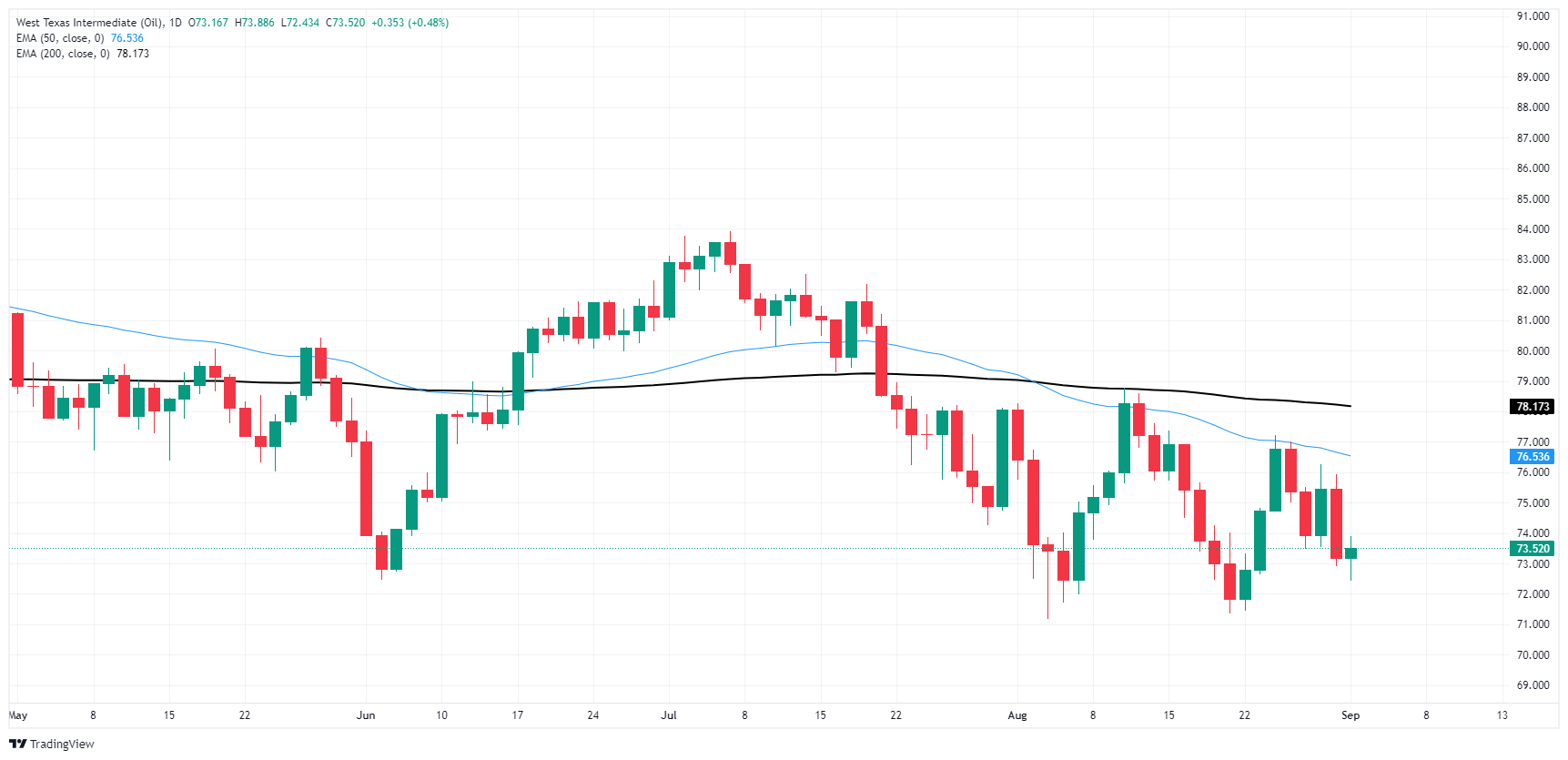
WTI Oil FAQs
WTI Oil is a type of Crude Oil sold on international markets. The WTI stands for West Texas Intermediate, one of three major types including Brent and Dubai Crude. WTI is also referred to as “light” and “sweet” because of its relatively low gravity and sulfur content respectively. It is considered a high quality Oil that is easily refined. It is sourced in the United States and distributed via the Cushing hub, which is considered “The Pipeline Crossroads of the World”. It is a benchmark for the Oil market and WTI price is frequently quoted in the media.
Like all assets, supply and demand are the key drivers of WTI Oil price. As such, global growth can be a driver of increased demand and vice versa for weak global growth. Political instability, wars, and sanctions can disrupt supply and impact prices. The decisions of OPEC, a group of major Oil-producing countries, is another key driver of price. The value of the US Dollar influences the price of WTI Crude Oil, since Oil is predominantly traded in US Dollars, thus a weaker US Dollar can make Oil more affordable and vice versa.
The weekly Oil inventory reports published by the American Petroleum Institute (API) and the Energy Information Agency (EIA) impact the price of WTI Oil. Changes in inventories reflect fluctuating supply and demand. If the data shows a drop in inventories it can indicate increased demand, pushing up Oil price. Higher inventories can reflect increased supply, pushing down prices. API’s report is published every Tuesday and EIA’s the day after. Their results are usually similar, falling within 1% of each other 75% of the time. The EIA data is considered more reliable, since it is a government agency.
OPEC (Organization of the Petroleum Exporting Countries) is a group of 13 Oil-producing nations who collectively decide production quotas for member countries at twice-yearly meetings. Their decisions often impact WTI Oil prices. When OPEC decides to lower quotas, it can tighten supply, pushing up Oil prices. When OPEC increases production, it has the opposite effect. OPEC+ refers to an expanded group that includes ten extra non-OPEC members, the most notable of which is Russia.
Author

Joshua Gibson
FXStreet
Joshua joins the FXStreet team as an Economics and Finance double major from Vancouver Island University with twelve years' experience as an independent trader focusing on technical analysis.

















