Coca-Cola vs Pepsi stock: Which is the better investment for 2026?

With the broader stock market indexes near all-time highs, investors may be seeking defensive options for their portfolios as we begin 2026.
Coca-Cola (KO) and Pepsi (PEP) are two defensive stocks that are usually of interest and tend to perform well during market corrections, as consumers buy food and beverages regardless of economic conditions.
Their defensive nature and reliable dividends often make Coca-Cola and Pepsi stock of interest to both retail and institutional investors. Institutional ownership currently accounts for 64% of Coca-Cola stock and 75% of Pepsi shares, making them stable investments that are typically less prone to volatility.
ROIC comparison
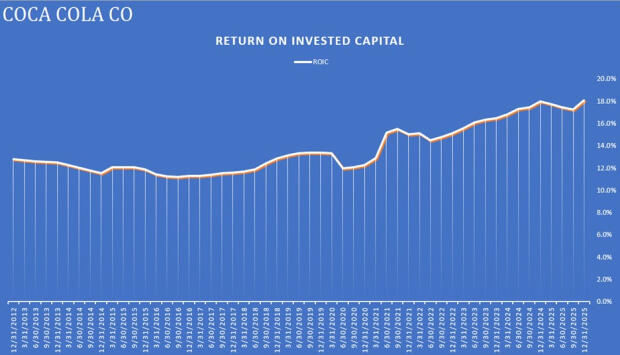
Coca-Cola has the higher return on invested capital (ROIC) percentage of 18% despite Pepsi’s expansion into food and snack products, such as its Frito-Lay and Quaker Foods brands.
Although Coca-Cola has kept its focus on beverages, its ROIC has seen a nice uptick toward the often admirable level of 20% or higher, illustrating a keen ability to return invested capital into profits.
(Invested capital represents the total amount of money a company raises, through equity and debt, to fund its operations and long-term growth).
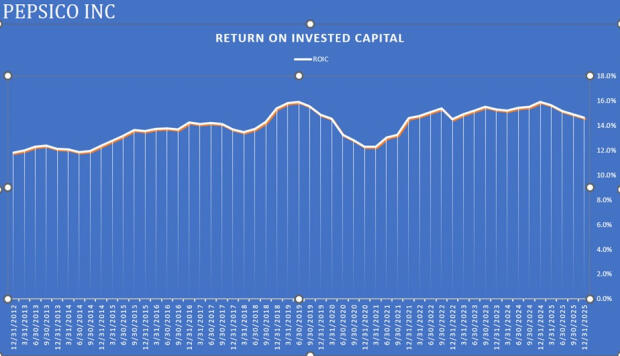
Meanwhile, Pepsi’s ROIC is at a respectable 14% and still suggests long-term shareholder value, but has declined in recent quarters.
Tracking Coca-Cola and Pepsi’s outlook
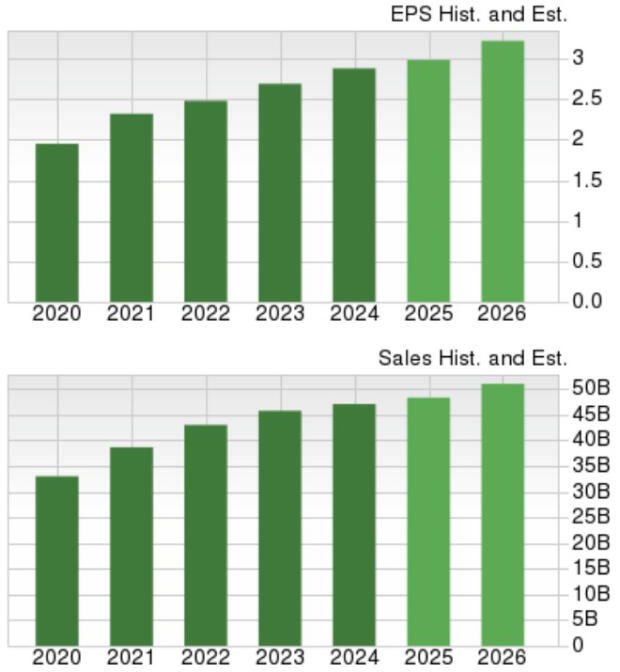
Coca-Cola is now thought to have ended fiscal 2025 with annual earnings rising 3% to $2.98 per share, and FY26 EPS is projected to rise another 8% to $3.22. This comes as Coca-Cola’s sales are expected to be up 3% for FY25 and are projected to increase another 5% this year to $51.01 billion. Coca-Cola will be reporting its Q4 2025 results on February 10.
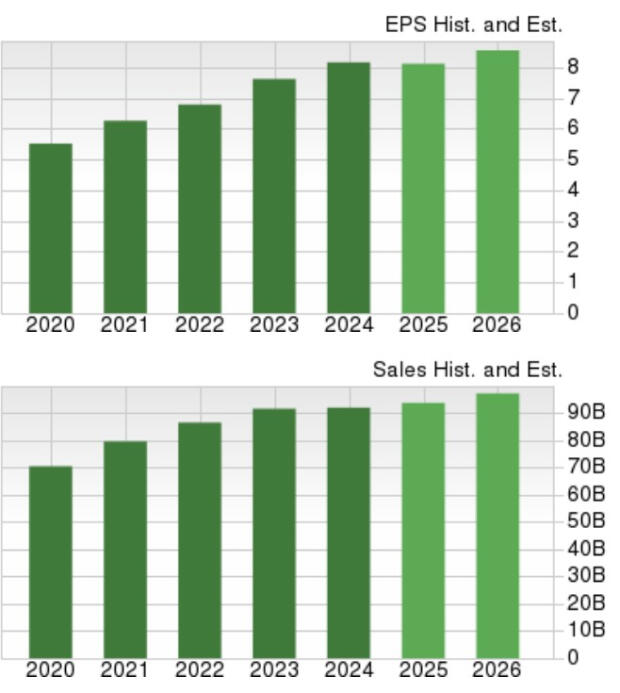
Pivoting to Pepsi, FY25 EPS is expected to slightly dip to $8.12 compared to $8.16 in 2024. That said, FY26 EPS is projected to rebound and rise 5% to $8.55. Pepsi’s sales are expected to be up 2% for FY25 and are projected to increase another 4% in FY26 to $97.07 billion. Pepsi reports Q4 2025 results on February 3.
Valuation and dividend comparison
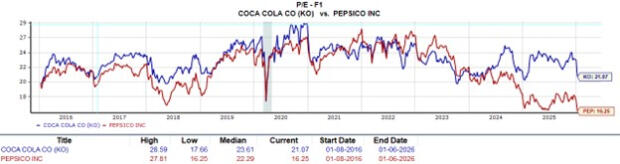
Magnifying Pepsi’s more robust financial figures is that PEP trades at 16X forward earnings and near the preferred level of less than 2X forward sales. Pepsi’s valuation ratios are roughly on par with the Zacks Beverages-Soft drinks Industry average, which includes other notable companies such as Moster Beverage (MNST) and Keurig Dr Pepper (KDP).
On the other hand, Coca-Cola is trading at a noticeable premium, especially in terms of price to forward sales at 6X.
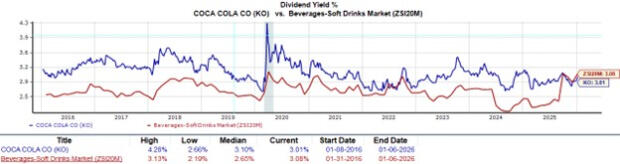
Coca-Cola’s 3% annual dividend yield is in line with the industry average, but Pepsi has the edge here as well at 4%. Classified as “Dividend Kings”, Coca-Cola and Pepsi have increased their dividends for more than 50 consecutive years, at 63 years and 53 years, respectively.
Summary and conclusion
As we begin 2026, Pepsi stock checks more of the boxes that investors may be looking for, despite Coca-Cola’s more promising return on invested capital. Although both consumer staples stocks are known for their defensive prowess and may attract investors with the broader indexes near all-time highs, Coca-Cola shares could be more susceptible to short-term weakness given its valuation relative to Pepsi and their beverage peers.
Want the latest recommendations from Zacks Investment Research? Download 7 Best Stocks for the Next 30 Days. Click to get this free report
Author

Zacks
Zacks Investment Research
Zacks Investment Research provides unbiased investment research and tools to help individuals and institutional investors make confident investing decisions.