Coca-Cola stock sinks after missing quarterly revenue consensus
- Coca-Cola disappoints with low-growth quarter, large free cash flow drop.
- KO stock slides after Q2 revenue comes in weak.
- Management expects headwinds in Q3 from US Dollar weakness.
- Market seems to be waiting for Tesla, Alphabet earnings on Wednesday.


Coca-Cola (KO) stock, a stalwart of many dividend portfolios and a constituent in all three major US equity indices, dropped by about 1% following the release of second-quarter earnings on Tuesday morning. While the purveyor of the top-ranked global pop brand saw adjusted earnings per share (EPS) arrive slightly ahead of consensus, revenue underperformed Wall Street consensus.
The Dow Jones Industrial Average (DJIA) is the only positive major US equity index on Tuesday, clinging to a 0.1% gain, while NASDAQ and S&P 500 have shed 0.5% and 0.2%, respectively, at the time of writing.
After the S&P 500 has slumped off a new all-time high on Monday, the market is bracing for bad news as it awaits high-profile earnings releases from Tesla (TSLA) and Alphabet (GOOGL) on Wednesday.
Coca-Cola earnings news
Coca-Cola earned $0.87 in adjusted EPS in the second quarter, which was 3 cents above projections and the year ago quarter. However, when inflation is taken into account, the quarter's profit was about flat.
Worse though was revenue in Q2 of $12.5 billion, which was $80 million behind consensus and up less than 1% over a year prior.
Revenue continued to slide in Latin America and at the company's bottling investments, but revenue rose by low single digits in North America, EMEA and Asia. The comparable adjusted operating margin in Q2 was quite good at 34.7%, the highest level in over three years. However, the company saw negative free cash flow of $2.1 billion in Q2. This was a stark $5 billion drop from a year earlier.
Global unit case volume dropped by 1% from a year earlier. The company's primary Coca-Cola product saw revenue decline 1% YoY, but Coca-Cola Zero Sugar grew sales by 14% in that period.
Executives said they would follow President Donald Trump's lead by introducing a cane sugar version of Coca-Cola to US customers, who are mostly used to the corn syrup-based product.
For the third quarter, which ends in September, Coca-Cola is estimating it will face a 5%-6% headwind from changes in exchange rates. This is largely due to the US Dollar losing value against many foreign currencies so far this year.
Coca-Cola stock forecast
It's sort of impressive how much Coca-Cola stock lacks volatility. The company has a beta of 0.45, according to its five-year monthly chart. This means that KO stock moves less than half as much as the market. If the market rises by 1% overall, then KO on average moves just 0.45%.
Likewise, since mid-February, Coca-Cola has just traded between $66 and $74. And for the majority of the last six months, KO has only traded within a tight band of $69 and $72. Even Tuesday's price dynamic was in spitting distance of the 50-day and 200-day Simple Moving Averages (SMAs).
This gives KO a large resistance band between $72 and $74, as well as a large support band between $66 and $69. Unsurprisingly, KO has a Relative Strength Index (RSI) reading of 45 as it shows little momentum. Traders will watch for a downside break of $66 or an upside break of $74 for further leads.
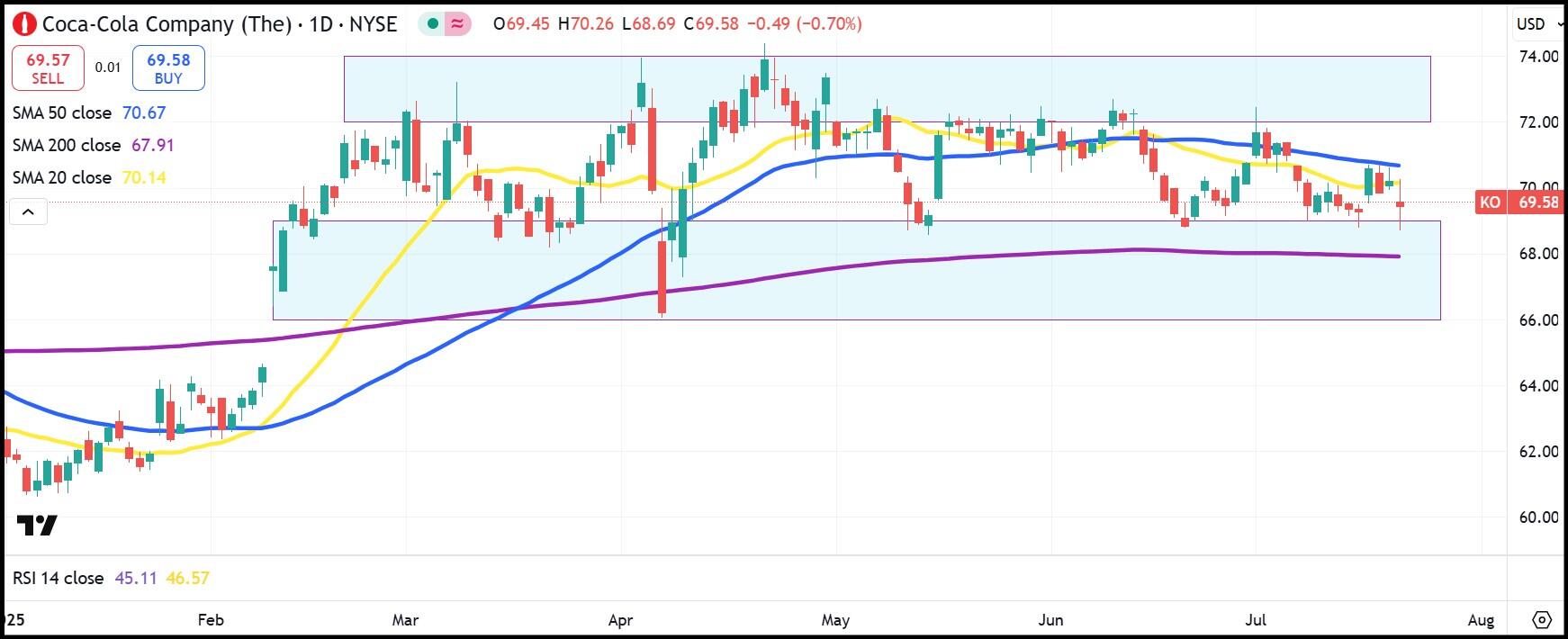
Coca-Cola daily stock chart
Author
Clay Webster
FXStreet
Clay Webster grew up in the US outside Buffalo, New York and Lancaster, Pennsylvania. He began investing after college following the 2008 financial crisis.