China FX Today: The Yuan in suspense as CPI data tests Beijing's strategy against deflation

The Chinese offshore currency (CNH) is trading in relative stability on Tuesday, with the USD/CNH exchange rate at 7.1134, down less than 0.1% on the session, as markets turn their focus towards China's inflation figures for August, which will be published early on Wednesday (01:30 GMT).
China's Consumer Price Index (CPI), a key indicator of inflation, is expected to fall by 0.2% year-on-year for August, compared with 0% in July, which could revive concerns about the health of Chinese domestic demand.
Forex traders today await this report as a credibility test for Beijing's economic policy, as the People's Bank of China (PBoC) set its benchmark USD/CNY rate at 7.1008 today, a level slightly lower than the previous day, suggesting a willingness to contain the currency's depreciation.
This new macroeconomic indicator will be decisive in guiding monetary expectations and assessing the government's ability to combat deflation effectively.
Technical analysis of USD/CNH: The downtrend continues
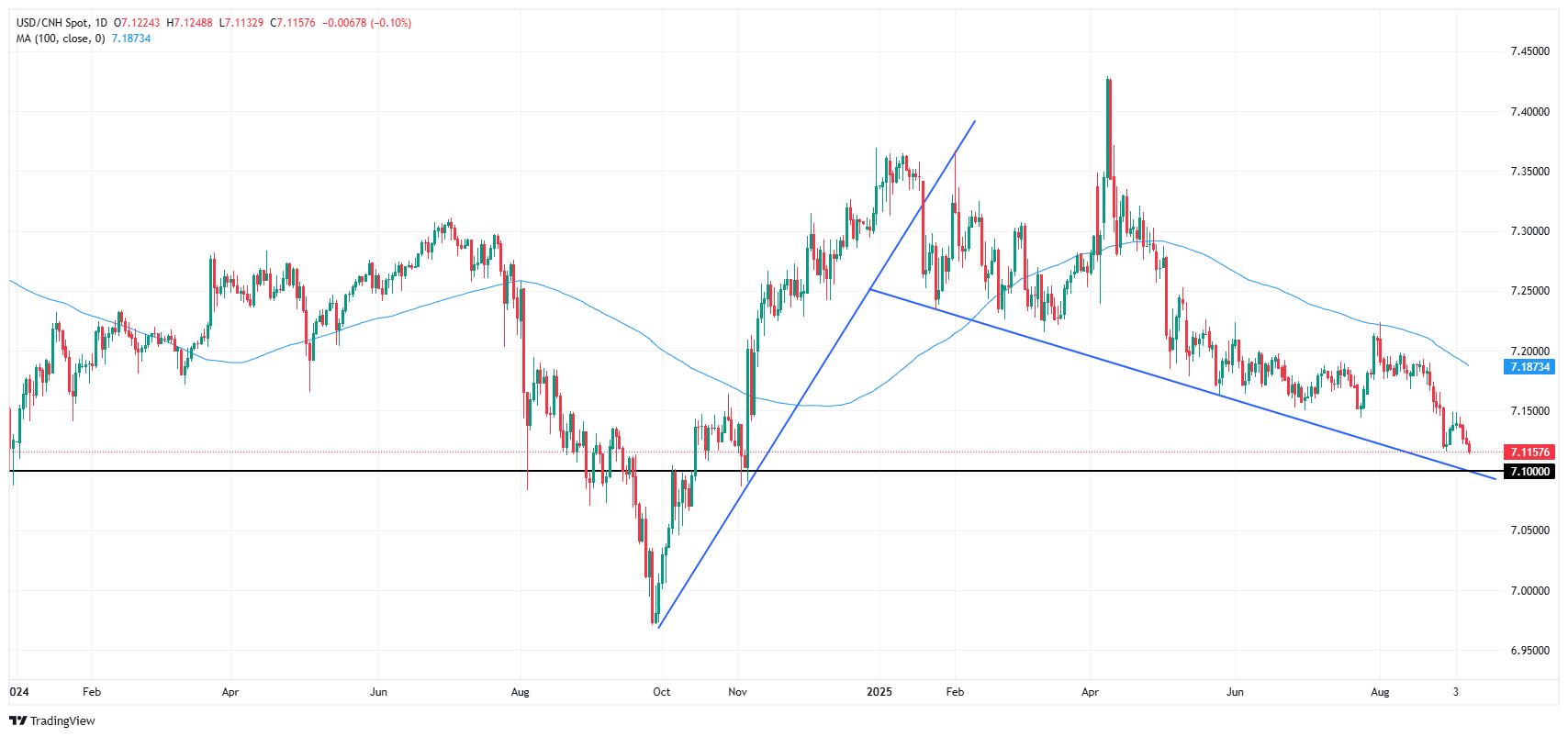
USD/CNH daily chart. Source: FXStreet.
The USD/CNH pair has remained on a clear downtrend since the start of the year, despite the brief rebound attempt that pushed the pair towards the April 8 peak at 7.4291.
While the pair has just marked a new low since November 6, 2024, at 7.1133, the next key support zone comes in at 7.1000, a level at which prices have found a floor in the past, and where the daily downtrend line passes.
A clear break below this zone could encourage USD/CNH to fall further towards the September 2024 low at 6.9713.
If support towards 7.1000 holds, the currency cross could rally towards the 100-day simple moving average, currently at 7.1873.
A resilient economy, but inflation may recede again
Since the beginning of the year, the Chinese economy has shown a certain resilience, with GDP growth of 5.3% in the first half of the year, supported by a recovery in consumption and exports to markets outside the United States.
However, as Christine Peltier of BNP Paribas points out, "the battle against deflation is far from won".
The slowdown in industrial activity in July (5.7% year-on-year vs. 6.6% in H1) and the contraction in manufacturing investment (-1.3% year-on-year) signal a loss of momentum.
Falling price momentum reinforces fears. The CPI had already stagnated at 0% in July, and data expected for August suggest inflation could plunge into negative territory.
The consensus forecast is for a 0.2% year-on-year drop, and some local firms, such as China International Capital Corp (CICC), even anticipate a fall of 0.4%, according to Wall Street CN, citing a high base effect and weak food prices.
The trend in the Producer Price Index (PPI) is also unfavorable. Disinflation in industrial sectors is continuing, in line with sluggish final demand and falling raw material prices.
Deflation and involution: Beijing's dilemma
Beijing is faced with a growing economic dilemma. On the one hand, the authorities have stepped up their so-called "anti-involution" efforts, a series of measures aimed at reducing production overcapacity, cleaning up competition and supporting prices in several key industrial sectors.
On the other hand, these policies could weigh on employment in the short term, particularly in low-productivity or over-indebted industries.
According to BNP Paribas' analysis, "the success of this strategy will depend on the government's ability to sustainably support domestic demand".
However, initiatives remain timid. Despite consumer subsidies, child allowances and targeted interest rate cuts, household spending remains fragile, as the retail sales slowed to 3.7% in July, compared with over 5% in the first half of the year.
August CPI: A high-stakes publication
The Chinese inflation figure due on Tuesday will be much more than a simple indicator: it will serve as a barometer for the credibility of Chinese economic policy.
Should the relapse into deflationary territory be confirmed, markets could anticipate a stronger reaction from the authorities, whether in the form of monetary easing or new fiscal measures to support demand.
As for the Yuan, it could continue to strengthen against the US Dollar (USD) in the short term, barring any positive price surprises or unexpected political developments.
Author

Ghiles Guezout
FXStreet
Ghiles Guezout is a Market Analyst with a strong background in stock market investments, trading, and cryptocurrencies. He combines fundamental and technical analysis skills to identify market opportunities.

















