|

China CPI rise slowest pace since Feb 2021, 0.1%, below expectations (0.3%)

The Consumer Price Index that is released by the National Bureau of Statistics of China has come out as follows:

  • China Consumer Price Index (YoY) came in at 0.1%, below expectations (0.3%) in April. This was the slowest pace since February 2021. 
  • China Consumer Price Index (MoM) came in at -0.1%, below expectations (0%) in April.
  • China Producer Price Index (YoY) came in at -3.6%, below expectations (-3.2%) in April.

AUD/USD update
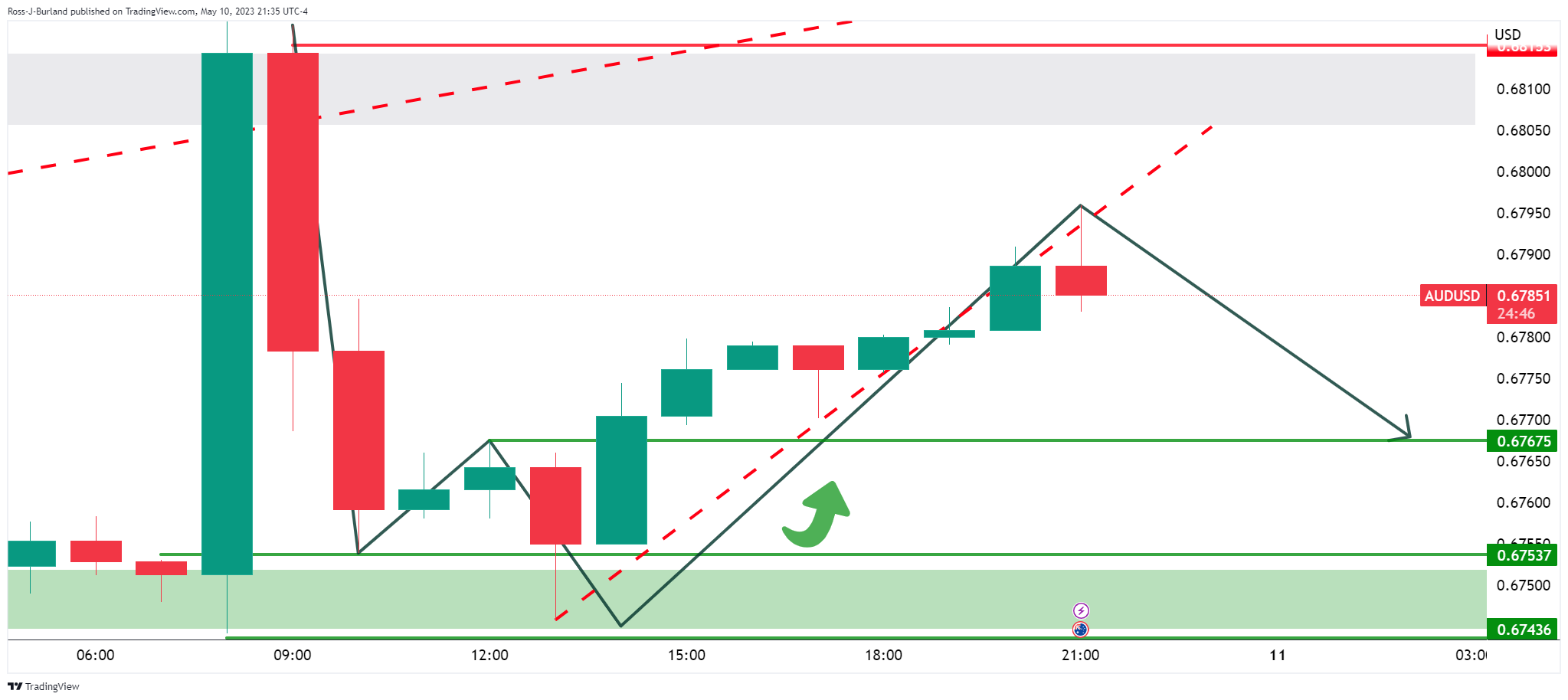
AUD/USD is trading at 0.6785 and is in the middle of the range of 0.670 and 0.6795 so far. The W-formation is a reversion pattern and there might be a correction to the downside. 

On the 15-min chart, we have a potential topping formation place: 

About the Consumer Price Index 

The Consumer Price Index is released by the National Bureau of Statistics of China. It is a measure of retail price variations within a representative basket of goods and services. The result is a comprehensive summary of the results extracted from the urban consumer price index and rural consumer price index. The purchase power of the CNY is dragged down by inflation. The CPI is a key indicator to measure inflation and changes in purchasing trends. A substantial consumer price index increase would indicate that inflation has become a destabilizing factor in the economy, potentially prompting The People’s Bank of China to tighten monetary policy and fiscal policy risk. Generally speaking, a high reading is seen as positive (or bullish) for the CNY, while a low reading is seen as negative (or Bearish) for the CNY.

Author

Ross J Burland

Ross J Burland, born in England, UK, is a sportsman at heart. He played Rugby and Judo for his county, Kent and the South East of England Rugby team.


More from Ross J Burland
Share:

Editor's Picks

AUD/USD gains traction near  0.7100 as the post-Fed USD rally pauses

AUD/USD finds fresh buyers and retakes 0.7100 in the Asian session on Thursday as the US Dollar pauses its hawkish Fed-inspired rally to its highest level since late July. However, RBA rate-hike bets and hopes for US-Iran diplomatic efforts lift risk sentiment and support the risk-sensitive Australian Dollar and the major.

USD/JPY reverses a dip below 156.00 as focus shifts to BoJ

USD/JPY is reversing a brief dip below 156.00 in the Asian session on Thursday, looking to snap a three-day winning streak to a nearly two-week top set the previous day. The US Dollar pauses following the post-Fed rally to seven-week highs, while a more hawkish repricing of the BoJ's policy normalization path supports the Japanese Yen. This keeps the pair's upside limited, with the focus now shifting to the BoJ policy decision due on Friday.

Gold bounces but not out of the woods yet

Gold is facing fresh sellers above $4,300 early Thursday, stalling its recovery from six-week lows of $4,235 reached soon after hawkish US Federal Reserve monetary policy announcements.

XRP and XLM rebound amid mixed signals
Ripple (XRP) and Stellar (XLM) extend their recovery at the time of writing on Thursday after finding support at key technical levels. However, mixed derivatives and on-chain data for both altcoins suggest that traders remain cautious and have yet to show strong conviction in a sustained rebound. Derivatives data shows a mixed and cautious outlook among traders.
The Fed rate hike: What happens now?
The dust has settled on tonight’s Fed meeting and the market reaction is clear: the Fed’s signal that there could be a series of rate hikes has spooked financial markets. Bonds sold off at the short end of the Treasury curve and US stocks also fell, led by the Dow Jones Industrial Average, which slipped more than 1% on Wednesday night.
How Japan became the World's Banker and why that era may be ending

Japan's ultra-low interest rates helped finance trillions of dollars in global investments for more than a decade, making the Japanese Yen one of the world’s cheapest sources of funding. With the Bank of Japan expected to tighten policy again this week, that advantage may be entering a new phase. While most major economies raised interest rates, Japan remained the world's outlier.