CF Industries: One of the gainers out of the sanction game?

“Fertilizer prices were already high before the war. They have now reached record levels amid a precipitous drop in Russian supply… The result is that fertilizer is about three to four times costlier now than in 2020” – Jon Emont and Silvina Frydlewsky, Wall Street Journal writers
Sanctions against Russia following its invasion on Ukraine have further intensified commodity and food shortages. Among them, a prohibition on Russia’s natural gas export does not solely hurt the oil market, but there is also a ripple effect towards the agricultural sector. This is because natural gas is a key input in the production of fertilizer, which is used by farmers to boost crop production.
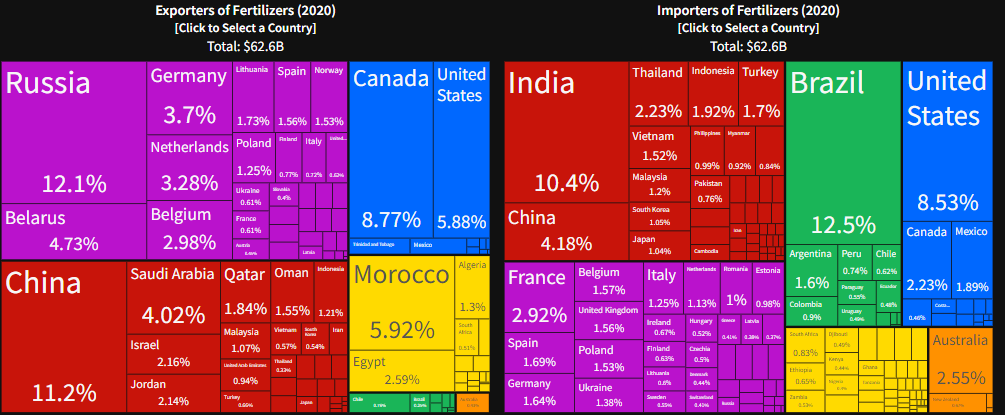
Figure 1: Exporters vs Importers of Fertilizers, in 2020. Source: OEC.World.
According to financial research firm CFRA, more than 1/3 of the world’s potash production, a key ingredient in fertilizer, is controlled by Russia and its ally Belarus, while the former alone controls 14% of nitrogen-based plant food production. Although the US is less dependent on Russia’s fertilizer, which accounts for only 9% of imports, as it has its own robust domestic production, prices going higher is unpreventable because price increases in the world market are likely to translate into similar price increases in the US market.
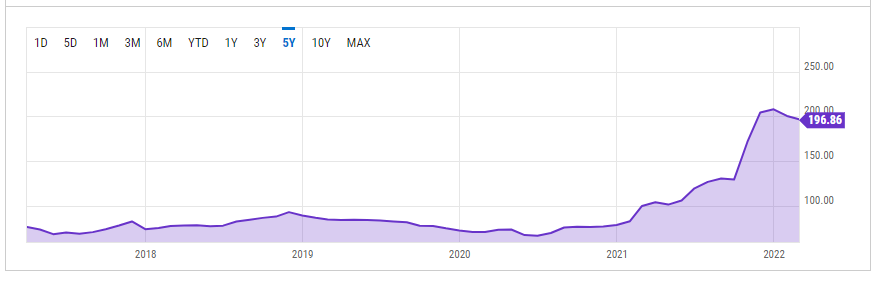
Fig.2: Fertilizers Price Index. Source: YCharts.
Based on the latest reported data, the fertilizers price index, which takes into account the weighted average of natural phosphate rock, phosphate, potassium and nitrogenous prices, stands at 196.86, up more than 96% from a year ago. It has even exceeded prices seen during the food and energy crisis in 2008.
A robust global demand and skyrocketing prices of crop nutrients may continue to benefit manufacturers and distributors of agricultural fertilizers such as CF Industries. The company mainly makes nitrogen, which has the biggest volume and nutrient volume out of the NPK (nitrogen, phosphorous, potassium). Recent news shows that CF Industries is currently increasing fertilizer shipments amid prolonged supply disruptions. Plant maintenance work of the company has had to be postponed until the second half of the year to meet growing demand. As the production rate may be less effective then, it will take some time to alleviate the supply shortages; consequently input prices remain at high levels, as do the company’s share values.
Technical analysis
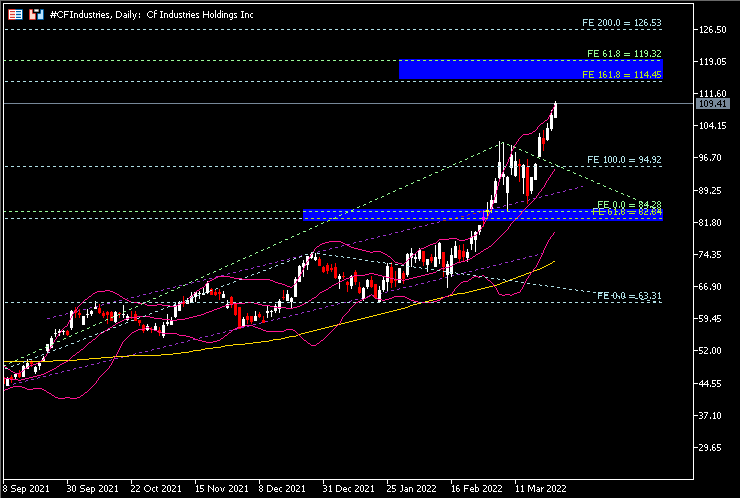
Technically, #CFIndustries remains traded on a strong bullish trend since its rebound from the lows at $19.68 seen on 15th March 2020. After two years, as of its close on last Friday, total accumulated gains have exceeded 450%. Candlestick remains attached to the upper line of Bollinger band, indicating trend continuation. In the near term, resistance to watch lies in the $114.45-$119.30 range, followed by $126.50. On the contrary, the middle line of Bollinger band at $94.90 serves as the nearest support. Breaking below the support may extend the bearish momentum towards the upper line of ascending channel, and confluence zone $82.60-$84.30.

















