Canadian Dollar roils on Tuesday as US tariffs begin
- The Canadian Dollar is churning on Tuesday and volatility is increasing.
- US President Trump’s 25% tariffs on Canadian goods kicked off on Tuesday.
- USD/CAD remains pinned near 1.4500 as another NFP Friday looms ahead.


The Canadian Dollar churn on the charts on Tuesday, roiling inside of its technical cage, but stuck close to the 1.4500 handle against the Greenback. Traders are hunkering down to see potential economic fallout from US President Donald Trump’s 25% tariffs on all US imports of Canadian goods, as well as a reduced 10% tariff on Canadian-sourced energy products.
Canada has already responded with its own targeted tranches of economic penalties on US goods, sparking further ire from President Trump, who has already vowed to increase his planned ‘reciprocal tariffs’ by a commensurate amount.
Daily digest market movers: Trump’s 25% tariffs against Canada come into effect
- A 25% tariff on all Canadian goods and 10% on Canadian energy products has kicked off on Tuesday.
- Markets are bracing for economic fallout as tit-for-tat trade retaliations heats up quickly.
- Canadian Prime Minister Justin Trudeau has green-lit his own 25% retaliatory tariff on US goods bound for Canada, due to take effect in 21 days.
- US President Donald Trump has vowed to increase his planned ‘reciprocal tariffs’ in retaliation to Canada’s retaliatory tariffs.
- Another Nonfarm Payrolls (NFP) print looms ahead this Friday, as well as Canadian employment figures. Key economic data will take on a renewed focus as markets look out for signs of recession caused by tariffs.
Canadian Dollar price forecast
The Canadian Dollar continues to churn within near-term technical levels against the US Dollar, keeping USD/CAD trapped near the 1.4500 handle. Geopolitics has kicked volatility higher, but Loonie traders are apprehensive about pushing USD/CAD into new territory for the time being.
The Canadian Dollar is posted near multi-year lows against the US Dollar, keeping USD/CAD bid into the high end, but momentum remains limited for now as markets jostle for position and await political developments.
USD/CAD daily chart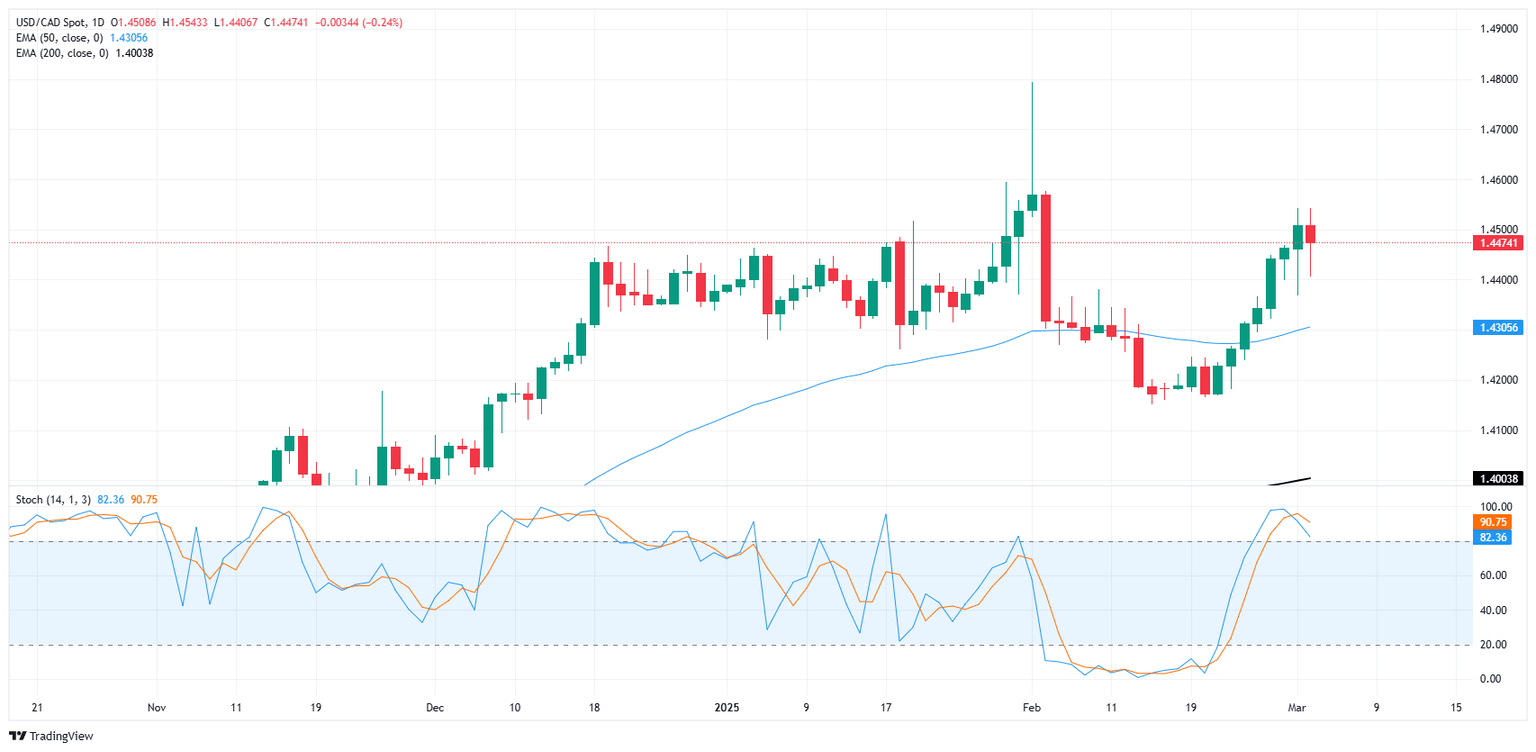
Canadian Dollar FAQs
The key factors driving the Canadian Dollar (CAD) are the level of interest rates set by the Bank of Canada (BoC), the price of Oil, Canada’s largest export, the health of its economy, inflation and the Trade Balance, which is the difference between the value of Canada’s exports versus its imports. Other factors include market sentiment – whether investors are taking on more risky assets (risk-on) or seeking safe-havens (risk-off) – with risk-on being CAD-positive. As its largest trading partner, the health of the US economy is also a key factor influencing the Canadian Dollar.
The Bank of Canada (BoC) has a significant influence on the Canadian Dollar by setting the level of interest rates that banks can lend to one another. This influences the level of interest rates for everyone. The main goal of the BoC is to maintain inflation at 1-3% by adjusting interest rates up or down. Relatively higher interest rates tend to be positive for the CAD. The Bank of Canada can also use quantitative easing and tightening to influence credit conditions, with the former CAD-negative and the latter CAD-positive.
The price of Oil is a key factor impacting the value of the Canadian Dollar. Petroleum is Canada’s biggest export, so Oil price tends to have an immediate impact on the CAD value. Generally, if Oil price rises CAD also goes up, as aggregate demand for the currency increases. The opposite is the case if the price of Oil falls. Higher Oil prices also tend to result in a greater likelihood of a positive Trade Balance, which is also supportive of the CAD.
While inflation had always traditionally been thought of as a negative factor for a currency since it lowers the value of money, the opposite has actually been the case in modern times with the relaxation of cross-border capital controls. Higher inflation tends to lead central banks to put up interest rates which attracts more capital inflows from global investors seeking a lucrative place to keep their money. This increases demand for the local currency, which in Canada’s case is the Canadian Dollar.
Macroeconomic data releases gauge the health of the economy and can have an impact on the Canadian Dollar. Indicators such as GDP, Manufacturing and Services PMIs, employment, and consumer sentiment surveys can all influence the direction of the CAD. A strong economy is good for the Canadian Dollar. Not only does it attract more foreign investment but it may encourage the Bank of Canada to put up interest rates, leading to a stronger currency. If economic data is weak, however, the CAD is likely to fall.
Author
Joshua Gibson
FXStreet
Joshua joins the FXStreet team as an Economics and Finance double major from Vancouver Island University with twelve years' experience as an independent trader focusing on technical analysis.

















