Canadian Dollar rebounds, bolstered by rise in Crude Oil prices
- The Canadian Dollar climbed 0.65% on Monday, supported by barrel bids.
- A general weakening in the US Dollar is further helping the Loonie.
- Canadian inflation data is due on Tuesday, expected to show another rise in inflation.

The Canadian Dollar (CAD) lurched higher by around two-thirds of one percent on Monday, bolstered by a geopolitical spike in Crude Oil prices, as well as a broad-market softening in Greenback bids that helped the Loonie gain a much-needed leg up.
Crude Oil prices lurched higher to kick off the new trading week, with West Texas Intermediate (WTI) barrel prices finding the $68 per barrel figure after US President Donald Trump vowed to take Houthis to task over the group’s ramp-up of hostilities against civilian tanker ships in the Red Sea. While Middle East shipping lanes have little to do with North American Crude Oil markets, which are generally contained within industrial supply lines between Canada and the US, a general ramp-up of hostilities targeting shipping lanes tends to spark additional fear in commodity markets, juicing energy costs higher.
Canadian Consumer Price Index (CPI) figures are in the barrel for Tuesday, and are expected to show another broad uptick in Canadian inflation pressures. An upside print in key inflation metrics bodes poorly for the Bank of Canada (BoC), which slashed interest rates again last week despite an expected upturn in inflation on the cards. The BoC is cutting rates in order to try and increase affordability in the runaway train that is the Canadian housing market. Unfortunately for BoC head Tiff Macklem, last week’s rate cut heading directly into another inflation upswing caused a general spike in Canadian bond markets, which most Canadian mortgages are priced against, causing housing funding costs to increase, not decrease.
Daily digest market movers: Canadian Dollar climbs ahead of key CPI inflation
- The Canadian Dollar’s Monday rally pushed USD/CAD back below both the 1.4300 handle and the 50-day Exponential Moving Average (EMA) at 1.4325.
- The Trump administration is gearing up for a direct conflict with Houthis in the Red Sea as the Middle East group vows to step up attacks on civilian and military ships in key supply lines.
- Annualized headline Canadian CPI inflation is expected to accelerate to 2.1% YoY on Tuesday, up from the previous print of 1.9%.
- Core BoC CPI inflation continues to ride above the Canadian central bank’s 2.0% target, but markets are struggling to nail down a consistent forecast for Tuesday’s print.
- Markets are gearing up for another Federal Reserve (Fed) rate call this week, due on Wednesday.
Canadian Dollar price forecast
The Canadian Dollar’s Monday rally has put the Loonie back on pace to break out of its ongoing consolidation pattern against the US Dollar. USD/CAD has fallen back below 1.4300 as the CAD gains ground, but the next key technical level will be the 1.4200 handle.
Despite Monday’s push lower in USD/CAD bids, the pair remains firmly entrenched in a sideways channel that has plagued the pair since December. CAD bidders will need to crack both the 1.4100 handle and the 200-day EMA at 1.4040 before a new Loonie rally can be confirmed.
USD/CAD daily chart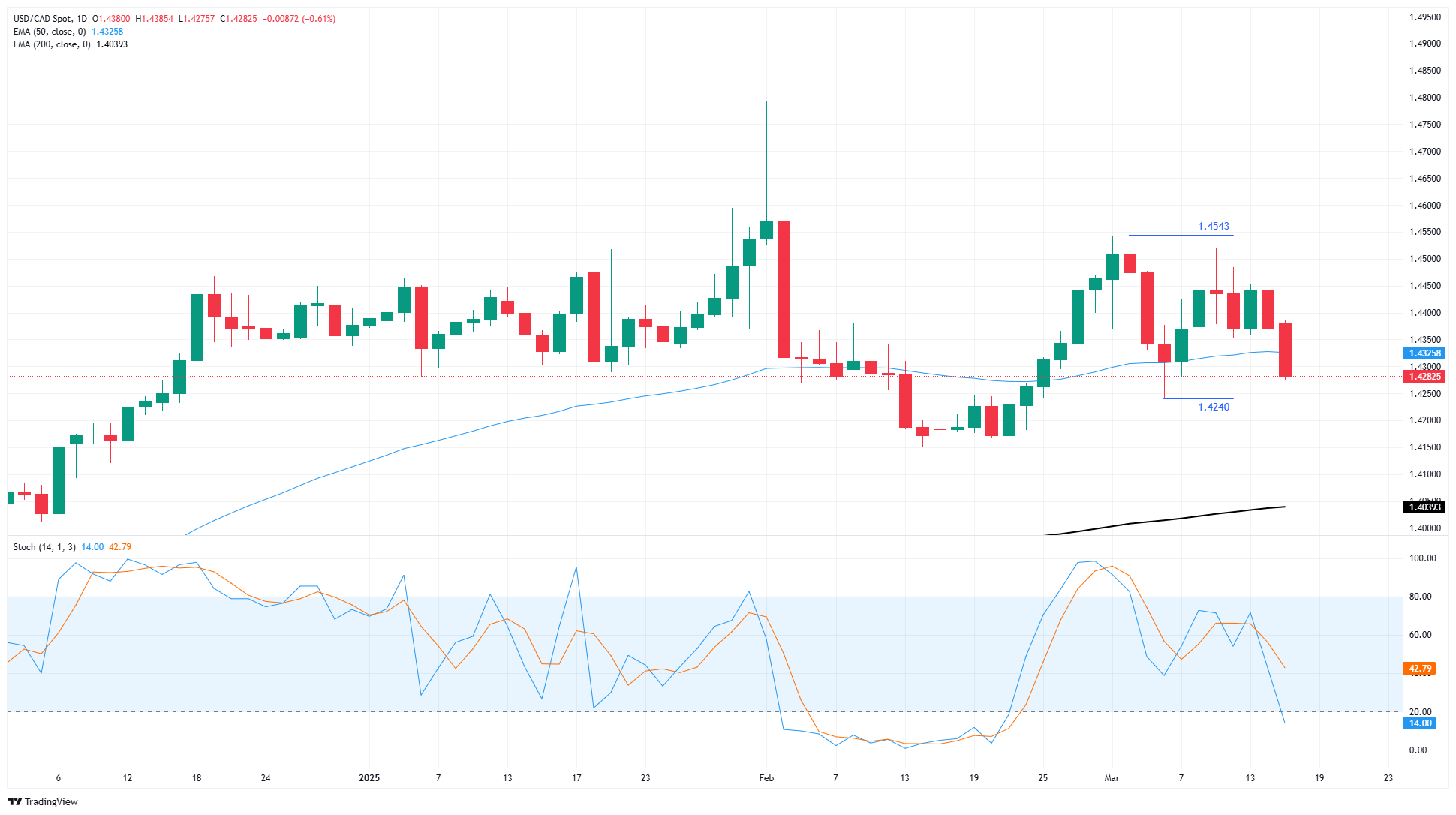
Canadian Dollar FAQs
The key factors driving the Canadian Dollar (CAD) are the level of interest rates set by the Bank of Canada (BoC), the price of Oil, Canada’s largest export, the health of its economy, inflation and the Trade Balance, which is the difference between the value of Canada’s exports versus its imports. Other factors include market sentiment – whether investors are taking on more risky assets (risk-on) or seeking safe-havens (risk-off) – with risk-on being CAD-positive. As its largest trading partner, the health of the US economy is also a key factor influencing the Canadian Dollar.
The Bank of Canada (BoC) has a significant influence on the Canadian Dollar by setting the level of interest rates that banks can lend to one another. This influences the level of interest rates for everyone. The main goal of the BoC is to maintain inflation at 1-3% by adjusting interest rates up or down. Relatively higher interest rates tend to be positive for the CAD. The Bank of Canada can also use quantitative easing and tightening to influence credit conditions, with the former CAD-negative and the latter CAD-positive.
The price of Oil is a key factor impacting the value of the Canadian Dollar. Petroleum is Canada’s biggest export, so Oil price tends to have an immediate impact on the CAD value. Generally, if Oil price rises CAD also goes up, as aggregate demand for the currency increases. The opposite is the case if the price of Oil falls. Higher Oil prices also tend to result in a greater likelihood of a positive Trade Balance, which is also supportive of the CAD.
While inflation had always traditionally been thought of as a negative factor for a currency since it lowers the value of money, the opposite has actually been the case in modern times with the relaxation of cross-border capital controls. Higher inflation tends to lead central banks to put up interest rates which attracts more capital inflows from global investors seeking a lucrative place to keep their money. This increases demand for the local currency, which in Canada’s case is the Canadian Dollar.
Macroeconomic data releases gauge the health of the economy and can have an impact on the Canadian Dollar. Indicators such as GDP, Manufacturing and Services PMIs, employment, and consumer sentiment surveys can all influence the direction of the CAD. A strong economy is good for the Canadian Dollar. Not only does it attract more foreign investment but it may encourage the Bank of Canada to put up interest rates, leading to a stronger currency. If economic data is weak, however, the CAD is likely to fall.
Author

Joshua Gibson
FXStreet
Joshua joins the FXStreet team as an Economics and Finance double major from Vancouver Island University with twelve years' experience as an independent trader focusing on technical analysis.