Canadian Dollar rebounds as Greenback recedes
- The Canadian Dollar clawed back 0.3% against the US Dollar on Friday.
- A fresh bout of investor risk appetite has pushed the Greenback back down.
- Despite a one-day rebound, the Loonie still remains near multi-month lows against the US Dollar.

The Canadian Dollar (CAD) caught a fresh bid on Friday, reclaiming some lost ground against the US Dollar (USD), although the Loonie still remains trapped near six-month lows against the Greenback. The possibility of tariff easing from the US sparked a fresh round of investor risk appetite to close out an otherwise middling week that saw the US Dollar broadly gain ground. Investor nerves continue to fray at the hands of brinkmanship politics and policy setting from the Trump administration, and traders are looking for any excuse to pare back on risk-off bets as the trade gets crowded.
Canadian Prime Minister Mark Carney declared this week that serious trade talks between Canada and multiple trading partners, including the US and China specifically, were underway in earnest. The announcement did little to sway CAD bidding momentum, but US President Donald Trump teased that he may be looking at easing China tariffs at some point in the future, causing an immediate wave of relief to wash through markets.
Daily digest market movers: Canadian Dollar finds relief amid easing Greenback flows
- The Canadian Dollar rose three-tenths of one percent against the US Dollar, paring back some of the week’s overall declines.
- The Loonie remains down slightly for the week, marking a fourth straight losing week against the Greenback.
- Canadian PM Mark Carney’s active trade negotiation announcement did little to assuage CAD concerns about the Canadian economic tipping over into a full-blown recession as US tariffs bite across a wide swath of Canadian industries.
- Donald Trump softballed the idea that China tariffs might not exist forever, prompting investors to pile back into risk bets and pare safe haven flows.
- Key Consumer Price Index (CPI) inflation data are due next week from both Canada and the US, on Tuesday and Friday, respectively.
Canadian Dollar price forecast
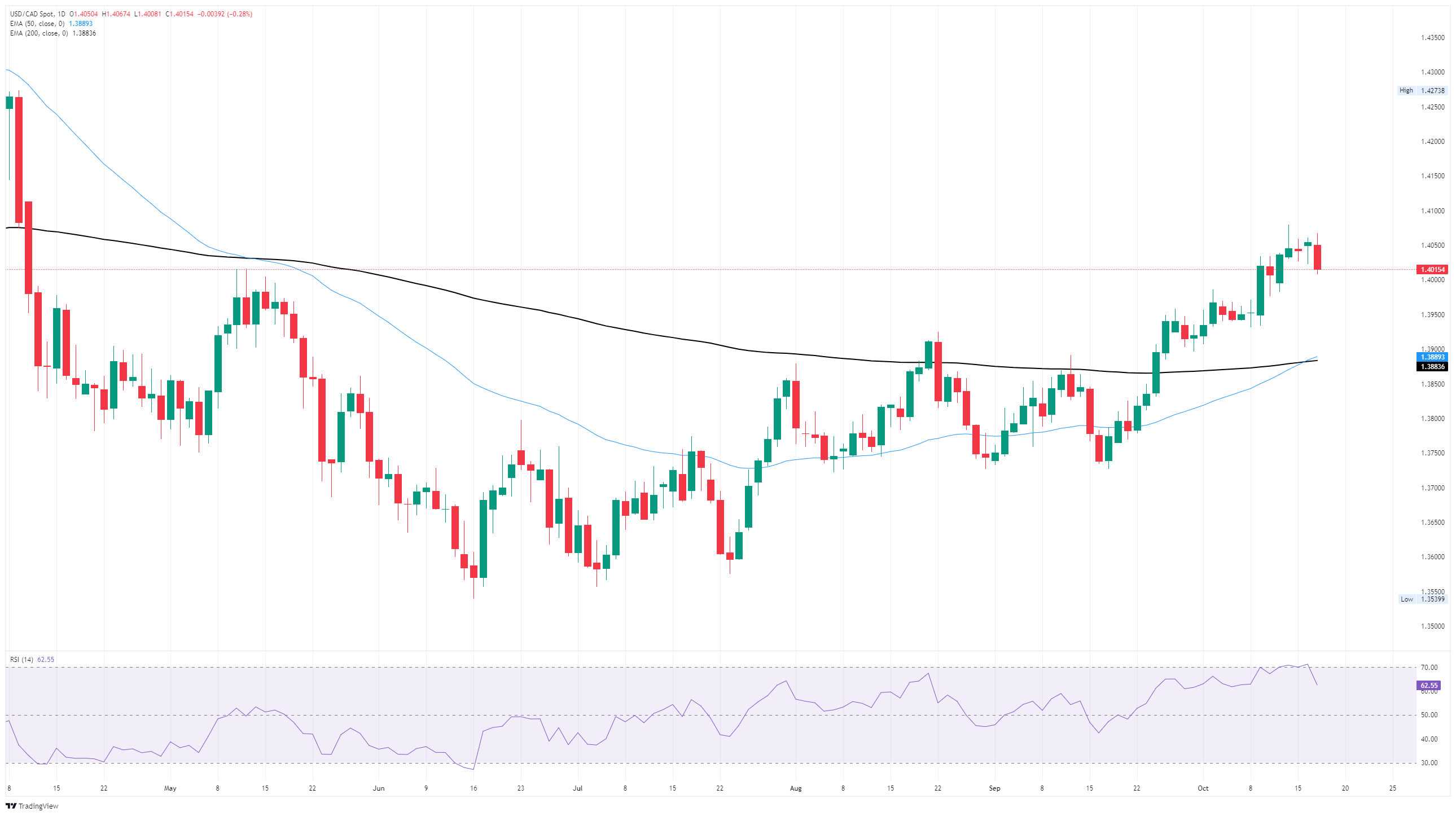
After spending much of the summer trading below both moving averages, USD/CAD broke above the 50-day Exponential Moving Average (EMA) in late July and has since built a steady series of higher highs and higher lows. The key development came earlier this month when the 50-day EMA crossed above the 200-day EMA, a signal often interpreted as a shift in medium-term momentum from bearish to bullish. That crossover, combined with the pair’s strong push above 1.40 last week, marked a clear change in tone.
However, the latest candles suggest that upward momentum may be pausing. The Relative Strength Index (RSI) has pulled back from near overbought territory, and Friday’s red candle shows sellers stepping in after the rally toward 1.4278. The pullback toward the 1.40 level will be an important test; if buyers defend this area, it could turn into a new support zone. A close back below 1.39 would weaken the recent bullish structure and raise the risk of a deeper retracement.
In short, USD/CAD’s medium-term outlook has improved, but the pair may need to consolidate gains before any attempt to extend higher.
USD/CAD daily chart
Canadian Dollar FAQs
The key factors driving the Canadian Dollar (CAD) are the level of interest rates set by the Bank of Canada (BoC), the price of Oil, Canada’s largest export, the health of its economy, inflation and the Trade Balance, which is the difference between the value of Canada’s exports versus its imports. Other factors include market sentiment – whether investors are taking on more risky assets (risk-on) or seeking safe-havens (risk-off) – with risk-on being CAD-positive. As its largest trading partner, the health of the US economy is also a key factor influencing the Canadian Dollar.
The Bank of Canada (BoC) has a significant influence on the Canadian Dollar by setting the level of interest rates that banks can lend to one another. This influences the level of interest rates for everyone. The main goal of the BoC is to maintain inflation at 1-3% by adjusting interest rates up or down. Relatively higher interest rates tend to be positive for the CAD. The Bank of Canada can also use quantitative easing and tightening to influence credit conditions, with the former CAD-negative and the latter CAD-positive.
The price of Oil is a key factor impacting the value of the Canadian Dollar. Petroleum is Canada’s biggest export, so Oil price tends to have an immediate impact on the CAD value. Generally, if Oil price rises CAD also goes up, as aggregate demand for the currency increases. The opposite is the case if the price of Oil falls. Higher Oil prices also tend to result in a greater likelihood of a positive Trade Balance, which is also supportive of the CAD.
While inflation had always traditionally been thought of as a negative factor for a currency since it lowers the value of money, the opposite has actually been the case in modern times with the relaxation of cross-border capital controls. Higher inflation tends to lead central banks to put up interest rates which attracts more capital inflows from global investors seeking a lucrative place to keep their money. This increases demand for the local currency, which in Canada’s case is the Canadian Dollar.
Macroeconomic data releases gauge the health of the economy and can have an impact on the Canadian Dollar. Indicators such as GDP, Manufacturing and Services PMIs, employment, and consumer sentiment surveys can all influence the direction of the CAD. A strong economy is good for the Canadian Dollar. Not only does it attract more foreign investment but it may encourage the Bank of Canada to put up interest rates, leading to a stronger currency. If economic data is weak, however, the CAD is likely to fall.
Author

Joshua Gibson
FXStreet
Joshua joins the FXStreet team as an Economics and Finance double major from Vancouver Island University with twelve years' experience as an independent trader focusing on technical analysis.