Canadian Dollar loses momentum as US flows drive Loonie market
- The Canadian Dollar fell back on Monday, paring recent gains against the US Dollar.
- The BoC’s latest outlook survey didn’t spell out doom and gloom, but didn’t give bulls much to work with either.
- Canadian Retail Sales data in the pipe ahead of key US CPI inflation figures later this week.

The Canadian Dollar (CAD) fell back against the US Dollar (USD) on Monday, paring back recent gains and keeping the Loonie trapped on the bottom end of six-month lows against the Greenback. Market volatility is at a swing low point, limiting hard meaningful moves.
The Bank of Canada (BoC) released its latest quarterly survey results. Canadian firms and consumers both continue to see an overall drag on the Canadian economy at the hands of President Trump and his strategy of firehosing global trade with arbitrary tariffs. However, the doom and gloom that plagued sentiment data through the first half of the year appears to have abated slightly.
Daily digest market movers: Canadian Dollar continues to struggle to find fresh upward momentum
- The Canadian Dollar fell back around 0.13% against the US Dollar at the outset of the new trading week.
- The Loonie is on pace to lose ground against the Greenback for a second straight month, with USD/CAD on the climb for three of the last four straight calendar months.
- According to the BoC’s latest survey, over a quarter of firms expect an outright recession to strike the Canadian economy within the next 12 months. However, the proportion of recession-fearing businesses was slightly cooler than the previous update.
- Overall, Canadian businesses and consumers both expect less drastic declines in growth compared to previous iterations of the sentiment survey, but inflation persistence fears remain a strong undercurrent.
- Canadian Consumer Price Index (CPI) inflation data is due on Tuesday, but the key inflation release this week will be US CPI figures due on Thursday.
Canadian Dollar price forecast
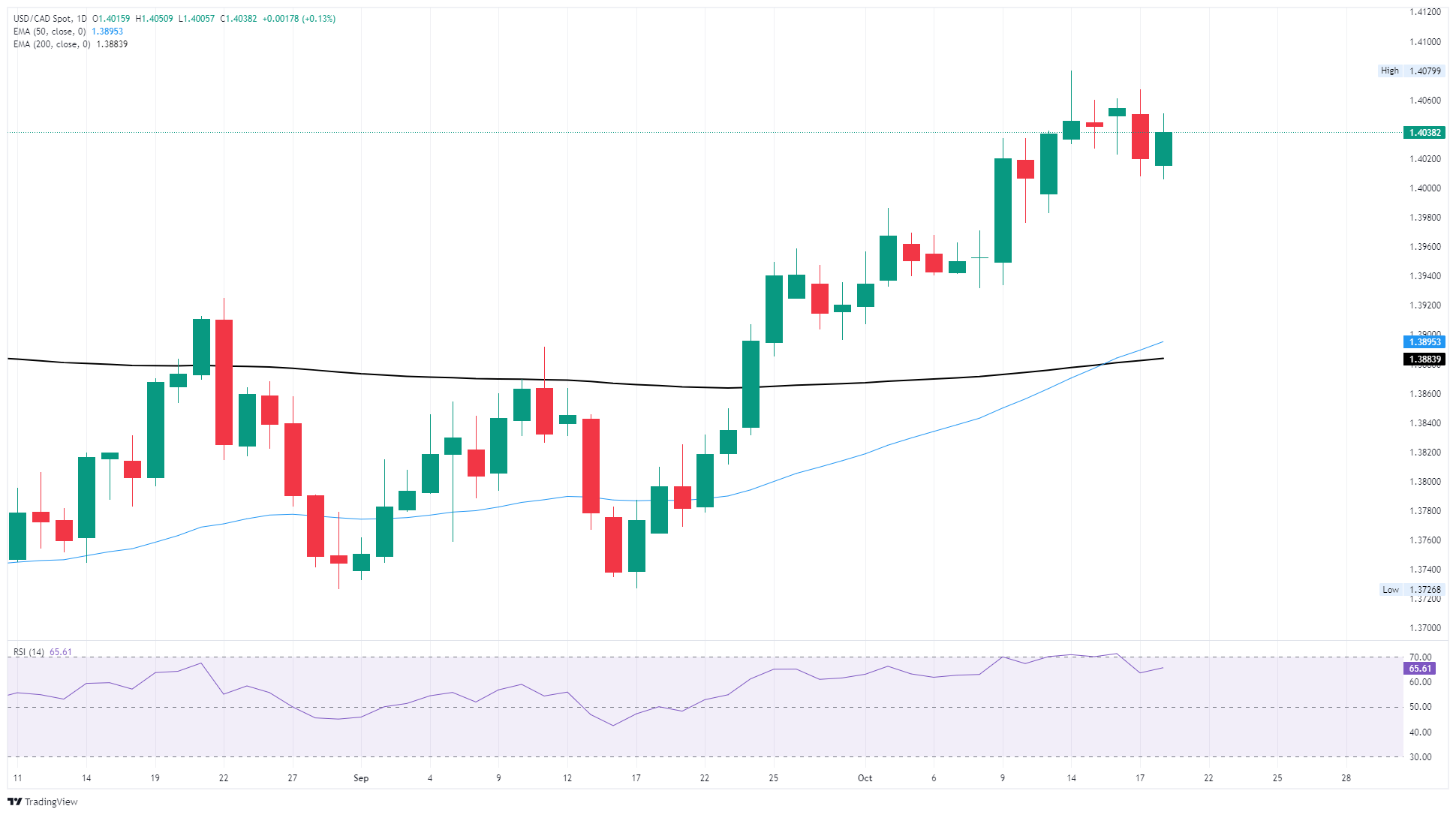
The 50-day Exponential Moving Average (EMA), currently around 1.3895, has crossed above the 200-day Exponential Moving Average (EMA) near 1.3884. This type of crossover is often viewed as a bullish signal, reflecting a transition from a medium-term recovery into a potentially longer-term upward trend. The price is now comfortably trading above both moving averages, which typically suggests sustained momentum.
Recent candles show a brief pause just above the 1.40 level, with the latest session closing near 1.4038 after testing highs around 1.4079. This pause could reflect short-term consolidation after the strong rally that started in mid-September. The Relative Strength Index (RSI) at 65.6 indicates that the pair is approaching overbought territory but not yet flashing warning signs of exhaustion.
From a price action perspective, buyers continue to control the trend as long as the pair holds above the 1.39 zone, which now acts as initial support. A clean break above 1.41 could open the door to a further push higher, while a drop below 1.39 would suggest a deeper pullback toward the 1.38 area.
Overall, momentum favors the upside for now, but the next few sessions will show whether USD/CAD can build on this breakout or needs a breather before resuming higher.
USD/CAD daily chart
Canadian Dollar FAQs
The key factors driving the Canadian Dollar (CAD) are the level of interest rates set by the Bank of Canada (BoC), the price of Oil, Canada’s largest export, the health of its economy, inflation and the Trade Balance, which is the difference between the value of Canada’s exports versus its imports. Other factors include market sentiment – whether investors are taking on more risky assets (risk-on) or seeking safe-havens (risk-off) – with risk-on being CAD-positive. As its largest trading partner, the health of the US economy is also a key factor influencing the Canadian Dollar.
The Bank of Canada (BoC) has a significant influence on the Canadian Dollar by setting the level of interest rates that banks can lend to one another. This influences the level of interest rates for everyone. The main goal of the BoC is to maintain inflation at 1-3% by adjusting interest rates up or down. Relatively higher interest rates tend to be positive for the CAD. The Bank of Canada can also use quantitative easing and tightening to influence credit conditions, with the former CAD-negative and the latter CAD-positive.
The price of Oil is a key factor impacting the value of the Canadian Dollar. Petroleum is Canada’s biggest export, so Oil price tends to have an immediate impact on the CAD value. Generally, if Oil price rises CAD also goes up, as aggregate demand for the currency increases. The opposite is the case if the price of Oil falls. Higher Oil prices also tend to result in a greater likelihood of a positive Trade Balance, which is also supportive of the CAD.
While inflation had always traditionally been thought of as a negative factor for a currency since it lowers the value of money, the opposite has actually been the case in modern times with the relaxation of cross-border capital controls. Higher inflation tends to lead central banks to put up interest rates which attracts more capital inflows from global investors seeking a lucrative place to keep their money. This increases demand for the local currency, which in Canada’s case is the Canadian Dollar.
Macroeconomic data releases gauge the health of the economy and can have an impact on the Canadian Dollar. Indicators such as GDP, Manufacturing and Services PMIs, employment, and consumer sentiment surveys can all influence the direction of the CAD. A strong economy is good for the Canadian Dollar. Not only does it attract more foreign investment but it may encourage the Bank of Canada to put up interest rates, leading to a stronger currency. If economic data is weak, however, the CAD is likely to fall.
Author

Joshua Gibson
FXStreet
Joshua joins the FXStreet team as an Economics and Finance double major from Vancouver Island University with twelve years' experience as an independent trader focusing on technical analysis.