Canadian Dollar extends declines into a second day after flubbing Tuesday rebound

Most recent article: Canadian Dollar struggling to hold onto gains after BoC holds rates at 5%
- The Canadian Dollar sees new lows but seeks a foothold in the American session.
- Bank of Canada rate call on Wednesday to draw CAD traders’ attention.
- Shifts in risk appetite have the markets moving in and out of the safe havens.
The Canadian Dollar (CAD) eased back further on Tuesday, seeing a short-lived rebound before slipping back into the day's lows, shedding a fourth of a percent against the US Dollar (USD). Market sentiment rattled through early Tuesday trading after Moody’s downgraded China’s credit outlook, sending the US Dollar broadly higher on the day.
The Bank of Canada (BoC) makes an appearance on Wednesday with the Canadian central bank’s latest rate call, and money markets expect another rate hold with dovish tweaks from the BoC.
Crude Oil markets are mixed on Tuesday as West Texas Intermediate (WTI) slumps through the day before a recovery back to the high side during the American market session.
Daily Digest Market Movers: Canadian Dollar tracks Crude Oil in both directions as markets weigh risk positioning
- Canadian Dollar traders are sidelined ahead of the BoC’s Wednesday rate call, US Dollar flows drive the bids.
- Money markets expect the BoC to stand pat on interest rates this week, though some dovish tweaks to the Canadian central bank’s talking points are expected.
- BoC overnight rate to remain at 5%, BoC Governor Tiff Macklem expected to omit comments about inflationary risks and focus on weaker Q3 performance instead.
- Broad-market sentiment took a hit early on Tuesday after Moody’s downgraded China’s credit outlook from stable to negative, pushing markets into the US Dollar and forcing down the Canadian Dollar as a knock-on effect.
- US data is mixed on Tuesday with the Institute for Supply Management’s (ISM) Services Purchasing Managers Index (PMI) coming in better than expected, while the JOLTS Job Openings for October printed fewer available job postings than expected.
- The US job market remains tight with the JOLTS posting its lowest job openings in over two and a half years.
- Crude Oil markets are mixed on the day with fossil fuel bids under pressure from declining global demand and rising crude stocks.
- Russia, UAE to discuss achieving broader unity on OPEC production cuts, backstopping Crude Oil bids on Tuesday by preventing further declines.
Canadian Dollar price today
The table below shows the percentage change of Canadian Dollar (CAD) against listed major currencies today. Canadian Dollar was the weakest against the Japanese Yen.
| USD | EUR | GBP | CAD | AUD | JPY | NZD | CHF | |
| USD | 0.40% | 0.32% | 0.38% | 0.98% | -0.08% | 0.58% | 0.30% | |
| EUR | -0.39% | -0.07% | 0.02% | 0.60% | -0.46% | 0.21% | -0.07% | |
| GBP | -0.32% | 0.08% | 0.09% | 0.68% | -0.36% | 0.29% | 0.00% | |
| CAD | -0.39% | 0.00% | -0.09% | 0.57% | -0.45% | 0.21% | -0.09% | |
| AUD | -0.99% | -0.59% | -0.68% | -0.59% | -1.04% | -0.39% | -0.68% | |
| JPY | 0.07% | 0.44% | 0.35% | 0.43% | 1.04% | 0.64% | 0.36% | |
| NZD | -0.58% | -0.18% | -0.26% | -0.19% | 0.40% | -0.66% | -0.28% | |
| CHF | -0.31% | 0.08% | 0.01% | 0.09% | 0.68% | -0.39% | 0.28% |
The heat map shows percentage changes of major currencies against each other. The base currency is picked from the left column, while the quote currency is picked from the top row. For example, if you pick the Euro from the left column and move along the horizontal line to the Japanese Yen, the percentage change displayed in the box will represent EUR (base)/JPY (quote).
Technical Outlook: Canadian Dollar splits the rally, planted in Tuesday’s midrange
The Canadian Dollar (CAD) is stuck somewhere in the middle on Tuesday, down four-tenths of a percent against the US Dollar (USD) and nearly half a percent against the Japanese Yen (JPY). On the upside, the Loonie outperformed the Antipodeans, up two-thirds of a percent and a fifth of a percent against the Aussie (AUD) and the Kiwi (NZD), respectively.
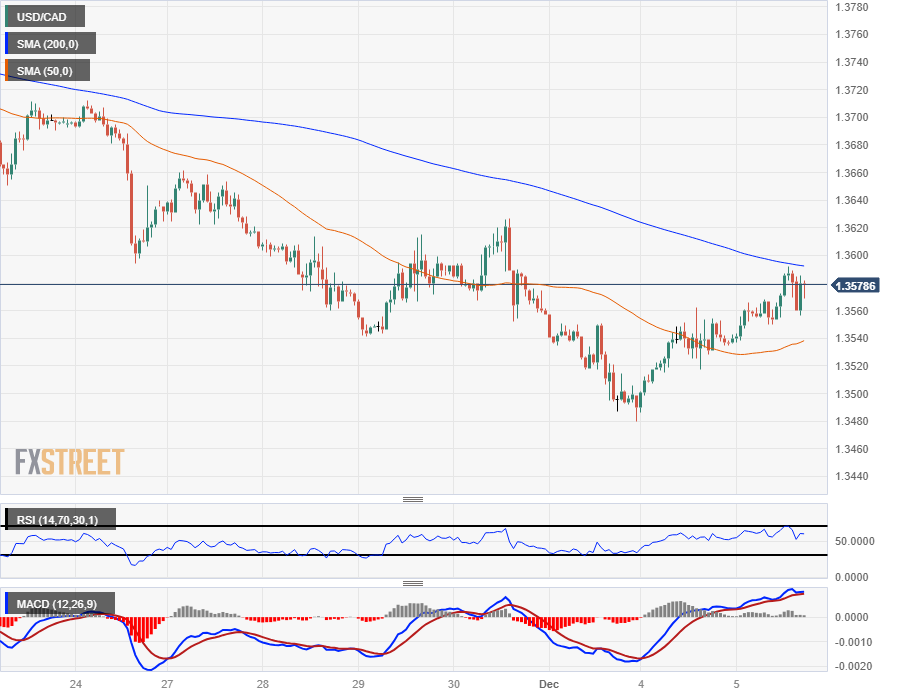
The USD/CAD set a new high for the week near 1.3590 before the Canadian Dollar pared away some of the day’s losses to land near 1.3560, and intraday price action remains capped by the 200-hour Simple Moving Average (SMA) dropping through the 1.3600 handle.
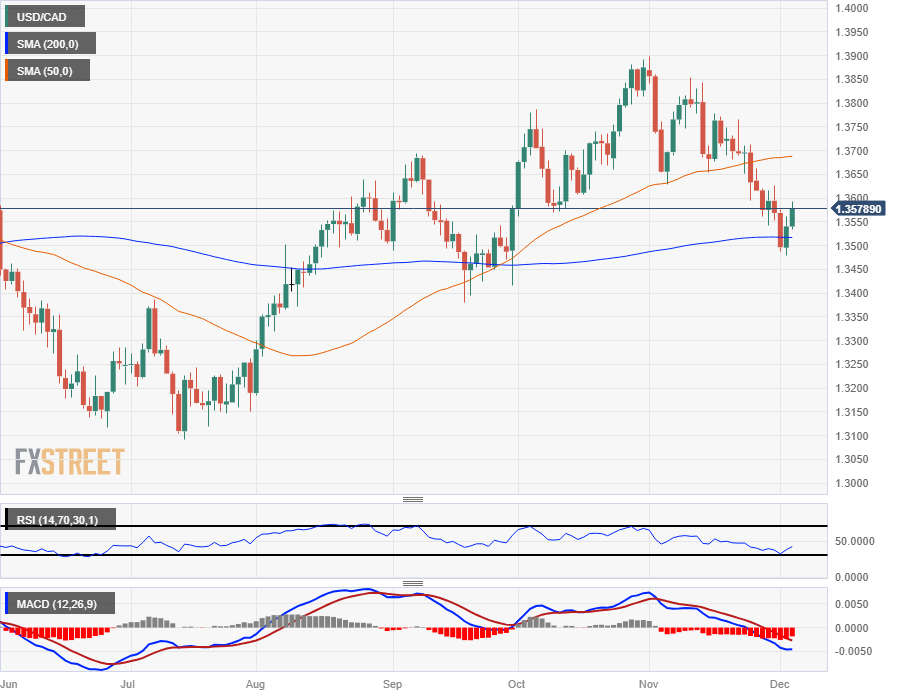
The USD/CAD is still within shooting range of a technical bounce from the 200-day SMA just north of the 1.3500 handle, and a continued recovery from the US Dollar will see the pair taking a run at the 50-day SMA near 1.3700.
On the downside, a break below the week’s bottom bids of 1.3480 will see bearish momentum accelerate, and bears’ sights will be set on 2023’s lows just beyond 1.3100.
USD/CAD Hourly Chart
USD/CAD Daily Chart
Bank of Canada FAQs
What is the Bank of Canada and how does it influence the Canadian Dollar?
The Bank of Canada (BoC), based in Ottawa, is the institution that sets interest rates and manages monetary policy for Canada. It does so at eight scheduled meetings a year and ad hoc emergency meetings that are held as required. The BoC primary mandate is to maintain price stability, which means keeping inflation at between 1-3%. Its main tool for achieving this is by raising or lowering interest rates. Relatively high interest rates will usually result in a stronger Canadian Dollar (CAD) and vice versa. Other tools used include quantitative easing and tightening.
What is Quantitative Easing (QE) and how does it affect the Canadian Dollar?
In extreme situations, the Bank of Canada can enact a policy tool called Quantitative Easing. QE is the process by which the BoC prints Canadian Dollars for the purpose of buying assets – usually government or corporate bonds – from financial institutions. QE usually results in a weaker CAD. QE is a last resort when simply lowering interest rates is unlikely to achieve the objective of price stability. The Bank of Canada used the measure during the Great Financial Crisis of 2009-11 when credit froze after banks lost faith in each other’s ability to repay debts.
What is Quantitative tightening (QT) and how does it affect the Canadian Dollar?
Quantitative tightening (QT) is the reverse of QE. It is undertaken after QE when an economic recovery is underway and inflation starts rising. Whilst in QE the Bank of Canada purchases government and corporate bonds from financial institutions to provide them with liquidity, in QT the BoC stops buying more assets, and stops reinvesting the principal maturing on the bonds it already holds. It is usually positive (or bullish) for the Canadian Dollar.
Author

Joshua Gibson
FXStreet
Joshua joins the FXStreet team as an Economics and Finance double major from Vancouver Island University with twelve years' experience as an independent trader focusing on technical analysis.