Canadian Dollar finds gains on overall market flows
- The Canadian Dollar rose on Wednesday, supported by other markets.
- A lack of data from Canada leaves CAD at the mercy of sentiment.
- Canadian GDP figures set to be overshadowed by US PCE inflation.

The Canadian Dollar (CAD) drifted higher on Wednesday, bolstered more by overall market flows than any intrinsic bidding power behind the CAD itself. Markets have overspent on bullish risk appetite in the face of looming Federal Reserve (Fed) interest rate cuts expected in September, giving the Canadian Dollar room to breathe and pare back recent gains against the Greenback.
Canada remains broadly absent from this week’s economic calendar, with Friday’s Canadian Gross Domestic Product (GDP) figures slated to be entirely eclipsed by US Personal Consumption Expenditure Price Index (PCE) inflation data due to release at the same time.
Daily digest market movers
- An overall retreat in overextended market sentiment has sapped momentum from bidders, giving the Greenback a leg up and a chance to recover against a long side opposite the CAD.
- Canada is widely expected to report a slight downtick in annualized GDP on Friday, forecast to print at 1.6% in Q2 versus the previous 1.7%.
- Core US PCE inflation is expected to print at 2.7% YoY, a slight rise from the previous 2.6%.
- A below-expectations print in US PCE inflation will surely ignite a fresh broad-market splurge on rate cut expectations, while an above-forecast release will send rate cut hopes scurrying into the shadows.
- US GDP figures due on Thursday could also throw a spanner in the works, but the release is likely to be muted with US annualized QoQ expected to hold steady at 2.8%.
Canadian Dollar price forecast
The Canadian Dollar (CAD) shed weight on Wednesday, paring back recent gains against the Greenback, but only slightly. USD/CAD is still churning chart paper on the south side of the 1.3500 handle, and a near-term plunge from recent chart highs near 1.3950 has left long-term moving averages in the dust.
USD/CAD daily chart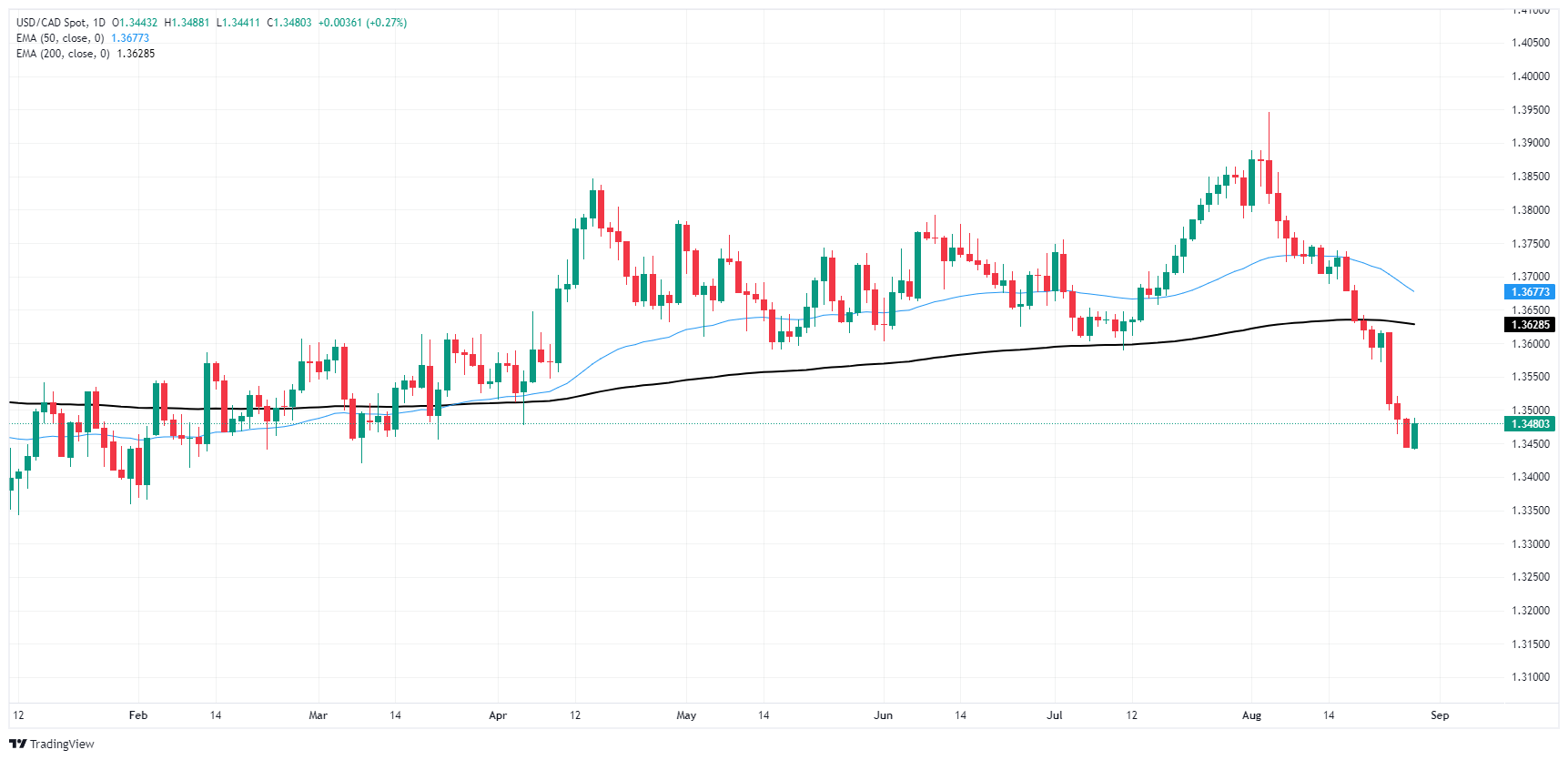
Canadian Dollar FAQs
The key factors driving the Canadian Dollar (CAD) are the level of interest rates set by the Bank of Canada (BoC), the price of Oil, Canada’s largest export, the health of its economy, inflation and the Trade Balance, which is the difference between the value of Canada’s exports versus its imports. Other factors include market sentiment – whether investors are taking on more risky assets (risk-on) or seeking safe-havens (risk-off) – with risk-on being CAD-positive. As its largest trading partner, the health of the US economy is also a key factor influencing the Canadian Dollar.
The Bank of Canada (BoC) has a significant influence on the Canadian Dollar by setting the level of interest rates that banks can lend to one another. This influences the level of interest rates for everyone. The main goal of the BoC is to maintain inflation at 1-3% by adjusting interest rates up or down. Relatively higher interest rates tend to be positive for the CAD. The Bank of Canada can also use quantitative easing and tightening to influence credit conditions, with the former CAD-negative and the latter CAD-positive.
The price of Oil is a key factor impacting the value of the Canadian Dollar. Petroleum is Canada’s biggest export, so Oil price tends to have an immediate impact on the CAD value. Generally, if Oil price rises CAD also goes up, as aggregate demand for the currency increases. The opposite is the case if the price of Oil falls. Higher Oil prices also tend to result in a greater likelihood of a positive Trade Balance, which is also supportive of the CAD.
While inflation had always traditionally been thought of as a negative factor for a currency since it lowers the value of money, the opposite has actually been the case in modern times with the relaxation of cross-border capital controls. Higher inflation tends to lead central banks to put up interest rates which attracts more capital inflows from global investors seeking a lucrative place to keep their money. This increases demand for the local currency, which in Canada’s case is the Canadian Dollar.
Macroeconomic data releases gauge the health of the economy and can have an impact on the Canadian Dollar. Indicators such as GDP, Manufacturing and Services PMIs, employment, and consumer sentiment surveys can all influence the direction of the CAD. A strong economy is good for the Canadian Dollar. Not only does it attract more foreign investment but it may encourage the Bank of Canada to put up interest rates, leading to a stronger currency. If economic data is weak, however, the CAD is likely to fall.
Author

Joshua Gibson
FXStreet
Joshua joins the FXStreet team as an Economics and Finance double major from Vancouver Island University with twelve years' experience as an independent trader focusing on technical analysis.