Canadian Dollar continues to churn amid tariff woes
- The Canadian Dollar whipsawed on Monday, briefly falling before rising to new familiar technical levels.
- BoC survey outlook sees further tariff stress on the horizon as businesses hunker down for declining sales and price spikes.
- Key US inflation data dots the economic calendar landscape this week.


The Canadian Dollar (CAD) whipsawed to kick off the new trading week, briefly rising after the US Dollar (USD) took a fresh beating on rumors of a possible tariff extension from the Trump administration. US President Donald Trump was quick to quash the rumors, stating that not only is he not considering any tariff exemptions, but that he would be seeking additional tariffs on China after Chinese officials responded to new US tariffs with counter-tariffs.
The Bank of Canada’s (BoC) latest Business Outlook Survey found that many Canadian firms are bracing for extended fallout from the US’s across-the-board and “reciprocal” tariffs. The survey period, which is from February, does not include President Trump’s tariffs announced on April 2, and survey results moving forward will likely continue to take a turn for the worse.
Daily digest market movers: Tariff headlines dominate market flows
- The Canadian Dollar remains trapped near the 1.4200 handle against the US Dollar.
- The Loonie fell 0.6% against the Greenback early Monday, before reversing course and returning to the day’s opening bids.
- US President Donald Trump has issued a threat to impose an additional 50% tariff on China as the Trump administration ramps up its retaliatory stance on countries that fight back against US tariffs.
- According to the BoC’s outlook survey, a growing number of Canadian firms are expecting to have to raise prices thanks to US tariffs.
- Canadian consumers also expect rising odds of a recession in the months to come.
- US Consumer Price Index (CPI) inflation figures are due later this week on Thursday.
- Friday's US Producer Price Index (PPI) and University of Michigan (UoM) Consumer Sentiment Index figures will draw plenty of investor attention as markets barrel toward a post-tariff environment.
Canadian Dollar price forecast
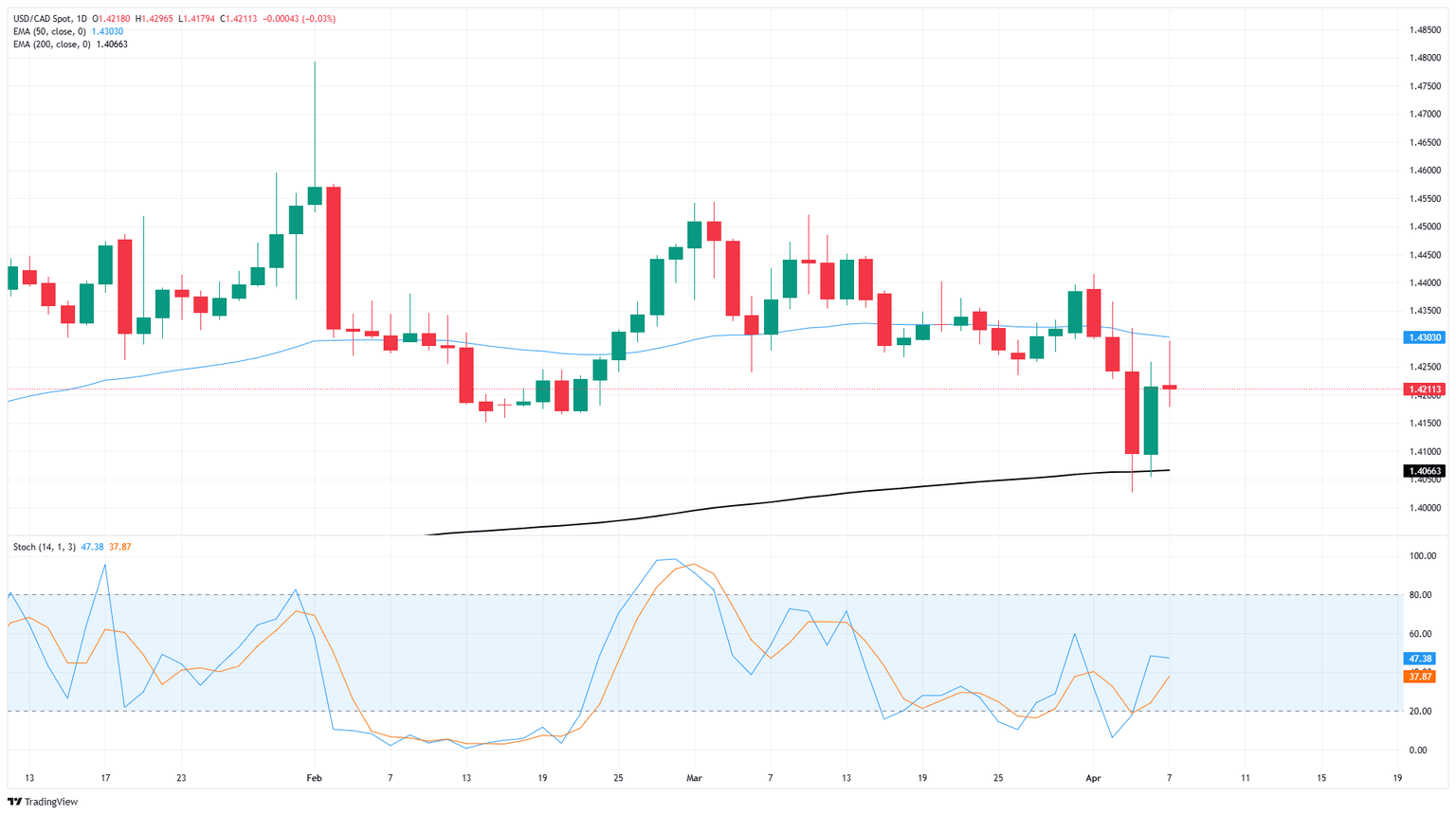
Despite near-term shifts in intraday bids and a sharp uptick in general volatility, the Canadian Dollar continues to churn out familiar technical levels against the Greenback. USD/CAD remains trapped near the 1.4200 handle, with price action going back-and-forth between key technical points.
USD/CAD remains trapped just beneath the 50-day Exponential Moving Average (EMA) near 1.4300. However, Loonie bulls remain unable to push bids below the 200-day EMA near 1.4100, leaving price to waffle between the two major moving averages.
USD/CAD daily chart
Canadian Dollar FAQs
The key factors driving the Canadian Dollar (CAD) are the level of interest rates set by the Bank of Canada (BoC), the price of Oil, Canada’s largest export, the health of its economy, inflation and the Trade Balance, which is the difference between the value of Canada’s exports versus its imports. Other factors include market sentiment – whether investors are taking on more risky assets (risk-on) or seeking safe-havens (risk-off) – with risk-on being CAD-positive. As its largest trading partner, the health of the US economy is also a key factor influencing the Canadian Dollar.
The Bank of Canada (BoC) has a significant influence on the Canadian Dollar by setting the level of interest rates that banks can lend to one another. This influences the level of interest rates for everyone. The main goal of the BoC is to maintain inflation at 1-3% by adjusting interest rates up or down. Relatively higher interest rates tend to be positive for the CAD. The Bank of Canada can also use quantitative easing and tightening to influence credit conditions, with the former CAD-negative and the latter CAD-positive.
The price of Oil is a key factor impacting the value of the Canadian Dollar. Petroleum is Canada’s biggest export, so Oil price tends to have an immediate impact on the CAD value. Generally, if Oil price rises CAD also goes up, as aggregate demand for the currency increases. The opposite is the case if the price of Oil falls. Higher Oil prices also tend to result in a greater likelihood of a positive Trade Balance, which is also supportive of the CAD.
While inflation had always traditionally been thought of as a negative factor for a currency since it lowers the value of money, the opposite has actually been the case in modern times with the relaxation of cross-border capital controls. Higher inflation tends to lead central banks to put up interest rates which attracts more capital inflows from global investors seeking a lucrative place to keep their money. This increases demand for the local currency, which in Canada’s case is the Canadian Dollar.
Macroeconomic data releases gauge the health of the economy and can have an impact on the Canadian Dollar. Indicators such as GDP, Manufacturing and Services PMIs, employment, and consumer sentiment surveys can all influence the direction of the CAD. A strong economy is good for the Canadian Dollar. Not only does it attract more foreign investment but it may encourage the Bank of Canada to put up interest rates, leading to a stronger currency. If economic data is weak, however, the CAD is likely to fall.
Author
FXStreet Insights Team
FXStreet
The FXStreet Insights Team is a group of journalists that handpicks selected market observations published by renowned experts. The content includes notes by commercial as well as additional insights by internal and external analysts.