Breaking: Canada CPI inflation holds steady at 1.7% in May as expected


Inflation in Canada, as measured by the change in the Consumer Price Index (CPI), remained unchanged at 1.7% on a yearly basis in May, Statistics Canada reported on Tuesday. This reading aligned with market expectations.
On a monthly basis, the CPI rose 0.6% following the 0.1% decline reported in April. This print surpassed the market expectation of 0.5%.
The core CPI, which excludes volatile food and energy prices, increased 2.5% on a yearly basis, matching April's reading.
Market reaction to Canada inflation data
These figures don't seem to be having a significant impact on the Canadian Dollar's valuation. At the time of press, USD/CAD was trading at 1.3720, losing 0.1% on the day.
Canadian Dollar PRICE Today
The table below shows the percentage change of Canadian Dollar (CAD) against listed major currencies today. Canadian Dollar was the strongest against the US Dollar.
| USD | EUR | GBP | JPY | CAD | AUD | NZD | CHF | |
|---|---|---|---|---|---|---|---|---|
| USD | -0.25% | -0.61% | -0.77% | -0.10% | -0.74% | -0.86% | -0.36% | |
| EUR | 0.25% | -0.39% | -0.52% | 0.17% | -0.48% | -1.04% | -0.10% | |
| GBP | 0.61% | 0.39% | -0.16% | 0.54% | -0.09% | -0.65% | 0.14% | |
| JPY | 0.77% | 0.52% | 0.16% | 0.69% | 0.02% | -0.11% | 0.31% | |
| CAD | 0.10% | -0.17% | -0.54% | -0.69% | -0.64% | -1.19% | -0.41% | |
| AUD | 0.74% | 0.48% | 0.09% | -0.02% | 0.64% | -0.56% | 0.23% | |
| NZD | 0.86% | 1.04% | 0.65% | 0.11% | 1.19% | 0.56% | 0.80% | |
| CHF | 0.36% | 0.10% | -0.14% | -0.31% | 0.41% | -0.23% | -0.80% |
The heat map shows percentage changes of major currencies against each other. The base currency is picked from the left column, while the quote currency is picked from the top row. For example, if you pick the Canadian Dollar from the left column and move along the horizontal line to the US Dollar, the percentage change displayed in the box will represent CAD (base)/USD (quote).
This section below was published as a preview of the Canada Consumer Price Index (CPI) data at 08:00 GMT.
- Canadian inflation is expected to consolidate in May.
- The headline Consumer Price Index is seen rising 1.7% from a year earlier.
- In the last few days, the selling pressure on the Canadian Dollar has intensified.
This Tuesday, Statistics Canada will release the Consumer Price Index (CPI) for May. This will get the market's attention because it will provide new information about inflation trends that the Bank of Canada (BoC) uses to make decisions about interest rates. Economists think that headline inflation will match April’s annual increase of 1.7%. But on a monthly basis, inflation may have gone up by 0.5%, which is much more than the 0.1% drop in April.
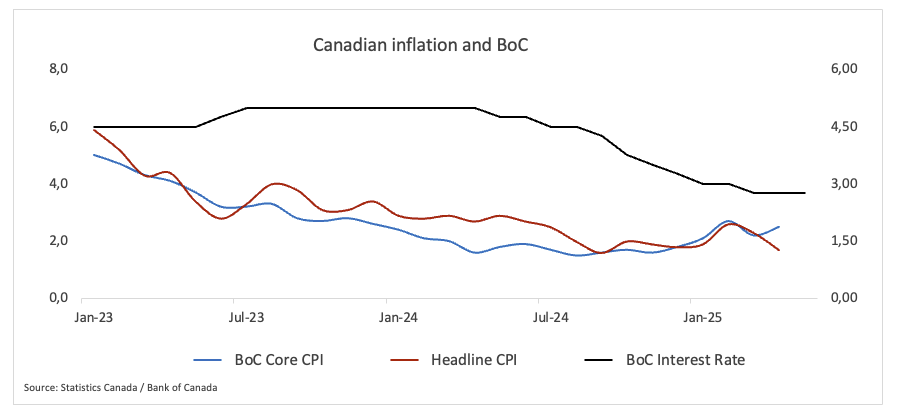
The Bank of Canada will also release its core inflation measures, which leave out unstable price swings to show the underlying momentum. These main indicators went up 2.6% from the same month last year in April.
Analysts remain on high alert regarding the potential pass-through of domestic inflation from the impact of US tariffs, even though there are signs that price pressure is easing. Because the inflation outlook is now less certain, both investors and policymakers are expected to be careful in the coming weeks.
What can we expect from Canada’s inflation rate?
The Bank of Canada maintained its benchmark rate at 2.75% earlier this month, a decision that was largely expected. The central bank has chosen to evaluate the complete effects of US tariffs before considering additional stimulus measures. Since June 2024, the central bank has reduced borrowing costs by 225 basis points. However, Governor Tiff Macklem has indicated that further cuts may be necessary if trade-related challenges intensify.
Market participants now assign a roughly 45% probability to a July rate cut, with overnight index swaps implying about 36 basis points of easing by year-end.
At his post-meeting press conference, Governor Macklem acknowledged the challenge of isolating tariff effects in headline CPI figures, noting the bank’s growing reliance on business surveys and soft data, which already point to rising input costs.
When is the Canada CPI data due, and how could it affect USD/CAD?
Canada’s April inflation data is due out on Tuesday at 12:30 GMT, and markets are bracing for a potential pickup of inflationary pressure.
If inflation exceeds expectations, it could confirm the belief that tariff-induced price pressure is beginning to manifest, leading the Bank of Canada to adopt a more cautious approach, potentially strengthening the Canadian Dollar (CAD), and possibly bolstering expectations for additional rate cuts, thereby exerting some pressure on the Loonie.
That said, an unexpected jump in inflation isn’t necessarily positive news either. A sharp increase in inflation could potentially raise concerns about the health of the Canadian economy, and paradoxically, such a surprise could also negatively impact the currency. In short, markets are watching closely — not just for the headline number but for the broader message it sends about where policy and growth are headed.
Senior Analyst Pablo Piovano from FXStreet pointed out that the Canadian Dollar has surrendered part of its recent gains, lifting USD/CAD from levels last seen in early October 2024 near 1.3540 to the boundaries of 1.3800, the figure at the beginning of the week or fresh four-week highs.
“The resurgence of the bearish tone could motivate USD/CAD to revisit its 2025 bottom at 1.3538, marked on June 16,” Piovano said. “That would be followed by the September 2024 trough of 1.3418 and the weekly base of 1.3358 reached on January 31, 2024.”
“A firmer conviction from bulls could push spot to its provisional barrier at the 55-day SMA at 1.3827, prior to the weekly top of 1.3860 set on May 29 and then its May peak at 1.4015 hit on May 12,” he added.
“Looking at the broader picture, further losses in the pair are likely below its key 200-day SMA at 1.4030,” Piovano added.
“Furthermore, USD/CAD is currently showing some marked recovery, as the Relative Strength Index (RSI) approaches the 56 mark, while the Average Directional Index (ADX) is easing toward 26, indicating some loss of impetus in the current trend.
Canadian Dollar FAQs
The key factors driving the Canadian Dollar (CAD) are the level of interest rates set by the Bank of Canada (BoC), the price of Oil, Canada’s largest export, the health of its economy, inflation and the Trade Balance, which is the difference between the value of Canada’s exports versus its imports. Other factors include market sentiment – whether investors are taking on more risky assets (risk-on) or seeking safe-havens (risk-off) – with risk-on being CAD-positive. As its largest trading partner, the health of the US economy is also a key factor influencing the Canadian Dollar.
The Bank of Canada (BoC) has a significant influence on the Canadian Dollar by setting the level of interest rates that banks can lend to one another. This influences the level of interest rates for everyone. The main goal of the BoC is to maintain inflation at 1-3% by adjusting interest rates up or down. Relatively higher interest rates tend to be positive for the CAD. The Bank of Canada can also use quantitative easing and tightening to influence credit conditions, with the former CAD-negative and the latter CAD-positive.
The price of Oil is a key factor impacting the value of the Canadian Dollar. Petroleum is Canada’s biggest export, so Oil price tends to have an immediate impact on the CAD value. Generally, if Oil price rises CAD also goes up, as aggregate demand for the currency increases. The opposite is the case if the price of Oil falls. Higher Oil prices also tend to result in a greater likelihood of a positive Trade Balance, which is also supportive of the CAD.
While inflation had always traditionally been thought of as a negative factor for a currency since it lowers the value of money, the opposite has actually been the case in modern times with the relaxation of cross-border capital controls. Higher inflation tends to lead central banks to put up interest rates which attracts more capital inflows from global investors seeking a lucrative place to keep their money. This increases demand for the local currency, which in Canada’s case is the Canadian Dollar.
Macroeconomic data releases gauge the health of the economy and can have an impact on the Canadian Dollar. Indicators such as GDP, Manufacturing and Services PMIs, employment, and consumer sentiment surveys can all influence the direction of the CAD. A strong economy is good for the Canadian Dollar. Not only does it attract more foreign investment but it may encourage the Bank of Canada to put up interest rates, leading to a stronger currency. If economic data is weak, however, the CAD is likely to fall.
Author
FXStreet Team
FXStreet
Composed of a group of economic journalists and FX experts, the FXStreet content team produces and oversees all content published on FXStreet. It provides a purely journalistic approach to the Forex market.
















