Breaking: BoC Core CPI surprised to the downside in August

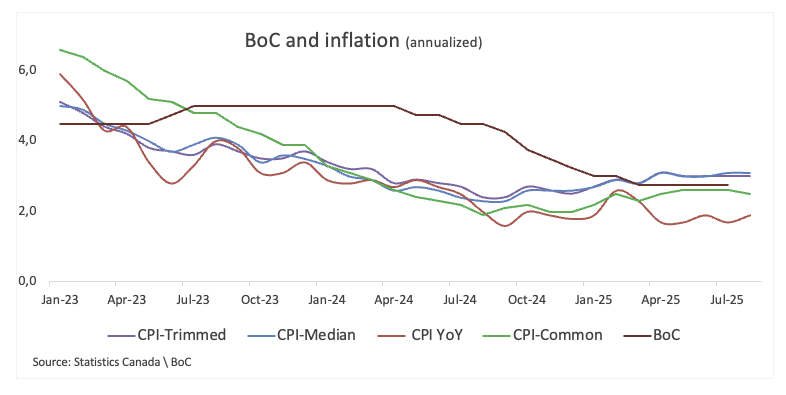
Inflation in Canada went up a tad in August, with the headline Consumer Price Index (CPI) rising 1.9% compared to the same month last year. According to Statistics Canada, this number is higher than the 1.7% increase in July and comes in short of prior estimates. In addition, the CPI contracted by 0.1% from the previous month.
The Bank of Canada (BoC) keeps an eye on the core CPI, which doesn't include volatile items like food and energy. It went up 2.6% from a year earlier and came in flat on a monthly basis.
In terms of monetary policy, the BoC's carefully monitored inflation measures showed that the Common CPI rose by 2.5% over the last year, the Trimmed CPI rose by 3.0%, and the Median CPI rose by 3.1%.
Market reaction
The Canadian Dollar (CAD) extends its gains on Tuesday, dragging USD/CAD to the area of two-week lows near 1.3750 in the wake of the release of Canadian inflation data in August.
Canadian Dollar Price Today
The table below shows the percentage change of Canadian Dollar (CAD) against listed major currencies today. Canadian Dollar was the strongest against the US Dollar.
| USD | EUR | GBP | JPY | CAD | AUD | NZD | CHF | |
|---|---|---|---|---|---|---|---|---|
| USD | -0.38% | -0.29% | -0.13% | -0.17% | -0.06% | 0.02% | -0.43% | |
| EUR | 0.38% | 0.09% | 0.14% | 0.19% | 0.36% | 0.38% | -0.05% | |
| GBP | 0.29% | -0.09% | 0.08% | 0.11% | 0.28% | 0.29% | -0.16% | |
| JPY | 0.13% | -0.14% | -0.08% | 0.03% | 0.15% | -0.03% | -0.25% | |
| CAD | 0.17% | -0.19% | -0.11% | -0.03% | 0.12% | 0.15% | -0.26% | |
| AUD | 0.06% | -0.36% | -0.28% | -0.15% | -0.12% | 0.10% | -0.43% | |
| NZD | -0.02% | -0.38% | -0.29% | 0.03% | -0.15% | -0.10% | -0.40% | |
| CHF | 0.43% | 0.05% | 0.16% | 0.25% | 0.26% | 0.43% | 0.40% |
The heat map shows percentage changes of major currencies against each other. The base currency is picked from the left column, while the quote currency is picked from the top row. For example, if you pick the Canadian Dollar from the left column and move along the horizontal line to the US Dollar, the percentage change displayed in the box will represent CAD (base)/USD (quote).
This section below was published as a preview of the Canadian inflation report for August at 08:00 GMT.
- Canadian inflation is seen picking up pace in August.
- The headline Consumer Price Index is expected to remain below the target.
- The Canadian Dollar continues to trade within a consolidation range.
Statistics Canada will publish August’s inflation figures on Tuesday. The numbers will give the Bank of Canada (BoC) a fresh read on price pressure as the central bank weighs its next move on interest rates. The BoC is expected to trim the interest rate by 25 basis points to 2.50% on Wednesday.
Economists expect the headline Consumer Price Index (CPI) to slightly surpass the BoC’s 2.0% target in August, following a 1.7% annual gain in July. On a monthly basis, prices are still forecast to climb 0.1%.
The BoC will also be watching its preferred “core” measure, which strips out the more volatile food and energy components. In July, that gauge rose 2.6% from a year earlier and edged 0.1% higher from June.
While there are signs inflation is cooling, analysts remain wary. The threat of US tariffs pushing up domestic prices looms large, adding uncertainty to the outlook. For the time being, both markets and policymakers are likely to exercise caution.
What can we expect from Canada’s inflation rate?
The Bank of Canada kept its benchmark rate at 2.75% on July 30, a decision that lined up with market expectations.
Governor Tiff Macklem explained that the pause reflected lingering stickiness in inflation. The bank’s preferred core gauges, the trim mean and trim median, have been hovering near 3%, with a wider set of indicators also ticking higher. That shift, he admitted, has caught policymakers’ eyes and will be monitored closely in the months ahead.
Still, Macklem was keen to stress that not all of the recent price pressure will last. A firmer Canadian Dollar, slower wage growth, and an economy running below potential should all help ease inflation over time.
For markets, the headline CPI print will be the immediate focus. But at the BoC, attention will remain squarely on the details: the trim, median and common measures. The first two have picked up speed, feeding concern inside the bank, while the common gauge has stayed more restrained.
When is the Canada CPI data due, and how could it affect USD/CAD?
Markets will be watching closely on Tuesday at 12:30 GMT, when Statistics Canada publishes the inflation report for the month of August. Traders are alert to the risk that price pressures could flare up again.
A stronger-than-expected reading would reinforce concerns that tariff-related costs are beginning to filter through to consumers. That could make the Bank of Canada more cautious in its policy stance, a scenario that would likely lend short-term support to the Canadian Dollar (CAD), while keeping attention fixed on trade developments.
According to FXStreet’s Senior Analyst, Pablo Piovano, the Canadian Dollar (CAD) has been trading in a consolidative range against the US Dollar (USD) in the last few days, with USD/CAD orbiting the 1.3850 zone. He notes that renewed selling could see the pair drift back toward the August floor in the 1.3730-1.3720 band. Further support sits at the weekly base at 1.3575 (July 23) and the June valley at 1.3556 (July 3), before reaching the year’s bottom at 1.3538 (June 16).
On the topside, resistance is pegged at the August top at 1.3924 (August 22), followed by the 1.4000 round level, with the May ceiling at 1.4015 (May 13) being reinforced by the 200-day Simple Moving Average (SMA).
From a broader perspective, Piovano argues that the bearish bias stays intact as long as spot trades beneath its 200-day SMA.
That said, momentum signals remain mixed: the Relative Strength Index (RSI) has eased toward 55, hinting at waning upside momentum, while the Average Directional Index (ADX) near 18 suggests that the broader trend is only slowly building strength.
Inflation FAQs
Inflation measures the rise in the price of a representative basket of goods and services. Headline inflation is usually expressed as a percentage change on a month-on-month (MoM) and year-on-year (YoY) basis. Core inflation excludes more volatile elements such as food and fuel which can fluctuate because of geopolitical and seasonal factors. Core inflation is the figure economists focus on and is the level targeted by central banks, which are mandated to keep inflation at a manageable level, usually around 2%.
The Consumer Price Index (CPI) measures the change in prices of a basket of goods and services over a period of time. It is usually expressed as a percentage change on a month-on-month (MoM) and year-on-year (YoY) basis. Core CPI is the figure targeted by central banks as it excludes volatile food and fuel inputs. When Core CPI rises above 2% it usually results in higher interest rates and vice versa when it falls below 2%. Since higher interest rates are positive for a currency, higher inflation usually results in a stronger currency. The opposite is true when inflation falls.
Although it may seem counter-intuitive, high inflation in a country pushes up the value of its currency and vice versa for lower inflation. This is because the central bank will normally raise interest rates to combat the higher inflation, which attract more global capital inflows from investors looking for a lucrative place to park their money.
Formerly, Gold was the asset investors turned to in times of high inflation because it preserved its value, and whilst investors will often still buy Gold for its safe-haven properties in times of extreme market turmoil, this is not the case most of the time. This is because when inflation is high, central banks will put up interest rates to combat it. Higher interest rates are negative for Gold because they increase the opportunity-cost of holding Gold vis-a-vis an interest-bearing asset or placing the money in a cash deposit account. On the flipside, lower inflation tends to be positive for Gold as it brings interest rates down, making the bright metal a more viable investment alternative.
Economic Indicator
Consumer Price Index (YoY)
The Consumer Price Index (CPI), released by Statistics Canada on a monthly basis, represents changes in prices for Canadian consumers by comparing the cost of a fixed basket of goods and services. The YoY reading compares prices in the reference month to the same month a year earlier. Generally, a high reading is seen as bullish for the Canadian Dollar (CAD), while a low reading is seen as bearish.
Read more.Last release: Tue Aug 19, 2025 12:30
Frequency: Monthly
Actual: 1.7%
Consensus: 1.7%
Previous: 1.9%
Source: Statistics Canada
Author

FXStreet Team
FXStreet
Composed of a group of economic journalists and FX experts, the FXStreet content team produces and oversees all content published on FXStreet. It provides a purely journalistic approach to the Forex market.