Can UBER stock earnings give LYFT a ride higher?
- UBER stock is set to release its earnings after the close on Wednesday.
- LYFT earnings disappointed after the close on Tuesday.
- LYFT stock fell 27% after announcing earnings after the close.

Uber gets the chance to lift up LYFT stock after its disappointing earnings and guidance after the close on Tuesday. Ok, so an easy pun but Lyft earnings proved quite the shocker with a huge spike lower in the after-hours market. That has surely set the bar low for earnings from Uber on Wednesday, but so far UBER stock has been relatively immune from LYFT stock's fall. While LYFT is down 27% at the time of writing UBER shares are only down 4% by comparison.
Read more stock market research
LYFT stock news: Struggling to hire drivers
LYFT released earnings after the close on Tuesday. Earnings per share (EPS) came in at $0.07 for the adjusted number ahead of forecasts for $-0.07 from Wall Street. GAAP EPS though was slightly behind estimates $-0.57 versus $-0.55 expected. Revenue was $875.6 million, beating Wall Street estimates by nearly $30 million, but the problem that hit LYFT stock was the outlook and struggle to hire drivers. Lyft said next quarter revenue is likely to be just short of $1 billion with consensus currently at $1.02 billion. Again nothing doo dramatic here one would think. The company said it still is not fully back to pre-covid business levels: "Keep in mind our Q1 rideshare ride volumes, which hit a new covid high, we're still only around 70% recovered versus the Q4 2019 level", said Lyft CEO Logan Green.
LYFT stock forecast: Bottoming out?
Dan Ives of Wedbush said the huge fall in LYFT stock price after earnings was a "severe overreaction", but also noted it is spending like a 1980's rockstar! Your author tends to agree and I have just bottom-fished here and bought some hopefully cheap ones. The risk-reward is now pricing in more bad news from Uber. Anything slightly more bullish (or less negative) should see LYFT recover some ground. The Fed of course is also up but again here it appears bad news is priced in.
$21.36 is the next major support being the spike low from October 2020. Also of note is the fact that the RSI has now moved into oversold territory.
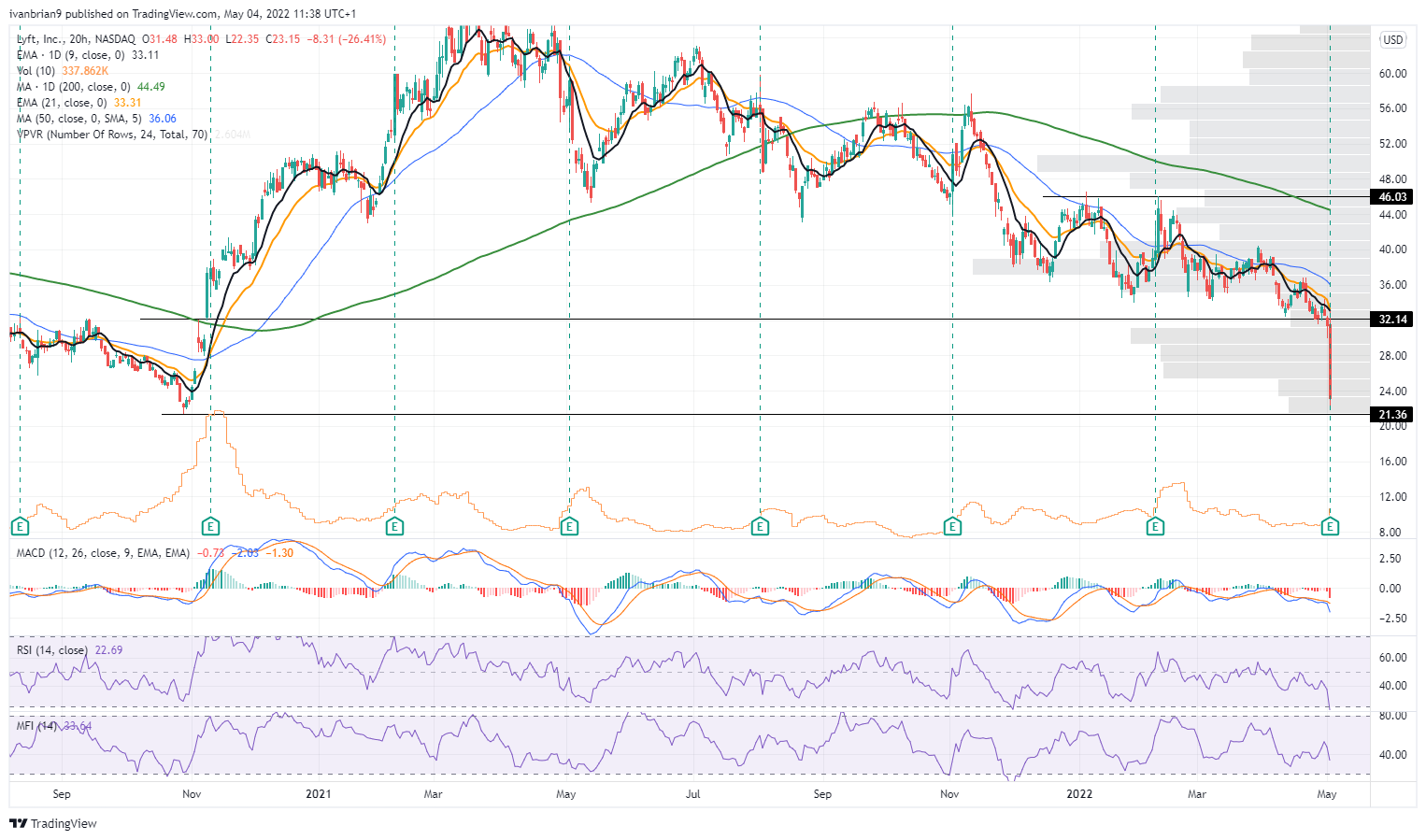
LYFT stock chart, daily
UBER stock news: Inflation and job-vacancy concerns
Uber will report its earnings after the close on Wednesday. Lyft has put a downer on the sector so any positivity at all is likely to see an outperformance. Uber is expected the report earnings per share of $-0.11 and revenue of $6.1 billion. UBER stock is down significantly this year, 30% year to date.
Uber remains heavily exposed to consumer discretionary spending which is a concern with inflation rising sharply. Takeaway and delivery may suffer from a shift in consumer behavior later in 2022 as inflation continues to bite. Again here Uber will likely need to spend to attract employees. This is not a problem unique to Lyft and Uber, however. Job vacancies are at multi-year highs and companies across all industries are finding it difficult to hire workers. That could easily be solved with a more lax immigration policy to get labor into the US but whoa! that is a huge political issue and debate, so let's not even go there. I am just merely commenting on the demographics and an easy solution, not advocating anything!
UBER stock forecast: Testing huge support at $28
Huge support level around $28 which is being tested in the premarket. Earnings will play this one out but a break would target $20.
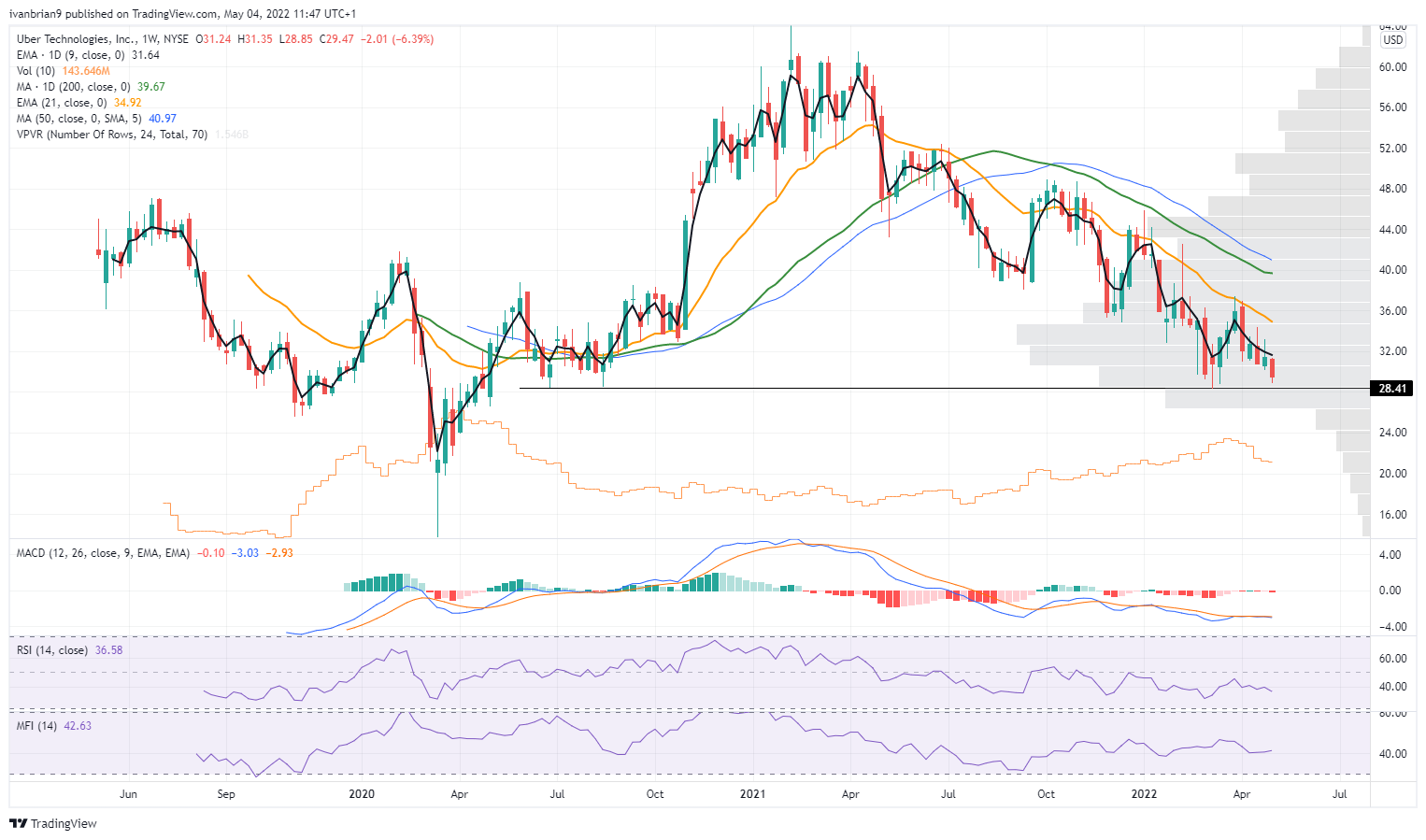
UBER stock chart, weekly
*The author is long LYFT.
Author

Ivan Brian
FXStreet
Ivan Brian started his career with AIB Bank in corporate finance and then worked for seven years at Baxter. He started as a macro analyst before becoming Head of Research and then CFO.

















