Brent Crude Oil surges on US–China agreement and easing recession fears
- Brent Crude trades above $65 per barrel, gaining over 2% in Monday’s session
- US–China 90-day tariff suspension underpins risk-on sentiment
- Market focus shifts to Tuesday’s US CPI and inventory data for further directional cues

Brent Crude Oil has extended gains at the start of the trading week, buoyed by a temporary easing in geopolitical tensions and improving macroeconomic sentiment.
As of publication time, Brent is trading at approximately $65.40 per barrel, marking a 2.37% gain on the day. The move follows an agreement between the United States (US) and China to reduce and suspend certain tariffs for a 90-day period—an initiative widely seen as a de-escalation of trade hostilities and a potential catalyst for global economic stabilization.
The bilateral tariff truce is currently the principal driver of risk appetite across commodities and equities. China, as one of the world’s largest importers of Brent-linked crude oil, stands to benefit directly from more favourable trade conditions, thereby reinforcing demand expectations. The suspension of tariffs is expected to support cross-border industrial activity and fuel-intensive sectors such as manufacturing, logistics, and shipping, all key components of global oil consumption.
Although the arrangement is temporary and may be subject to renegotiation or reversal, its immediate impact has been to reduce fears of a global economic slowdown. This improvement in sentiment has translated into broad-based strength in risk-sensitive assets, including crude oil.
CPI data and US inventory reports to guide Brent price trajectory
Brent Crude’s short-term direction now hinges on key upcoming data releases, with traders closely monitoring indicators that could impact demand expectations and broader market sentiment.
Tuesday’s US Consumer Price Index (CPI) report is expected to play a pivotal role. As a critical gauge of inflation, the CPI influences expectations for Federal Reserve (Fed) policy.
A stronger-than-expected inflation print may reinforce expectations for a prolonged restrictive stance by the Fed, potentially exerting downward pressure on crude by strengthening the US Dollar and dampening demand.
Conversely, a softer CPI reading may bolster commodities by supporting risk sentiment.
In addition, crude oil traders will be watching this week’s inventory data for signs of underlying demand strength.
The American Petroleum Institute (API) is scheduled to release its weekly report on Tuesday, followed by the US Energy Information Administration (EIA) data on Wednesday.
While these reports primarily pertain to West Texas Intermediate (WTI), their implications for US consumption patterns and market balance remain highly relevant for Brent pricing.
A greater-than-anticipated draw in stockpiles would suggest tightening supply conditions and could provide further upward momentum for Brent. On the other hand, a surprise build may temper recent gains by signalling oversupply.
Brent Crude faces psychological resistance at $66
Brent Crude briefly rallied to a session high of $66.87 during early European trade before paring gains slightly.
The move pushed prices above the 20-day Simple Moving Average (SMA) at $63.84 and approached—but did not surpass—the 38.2% Fibonacci retracement of the 2025 move, at $67.21.
The 50-day SMA at $67.45 also remains untested, acting as a significant technical ceiling.
Brent Crude Oil daily chart
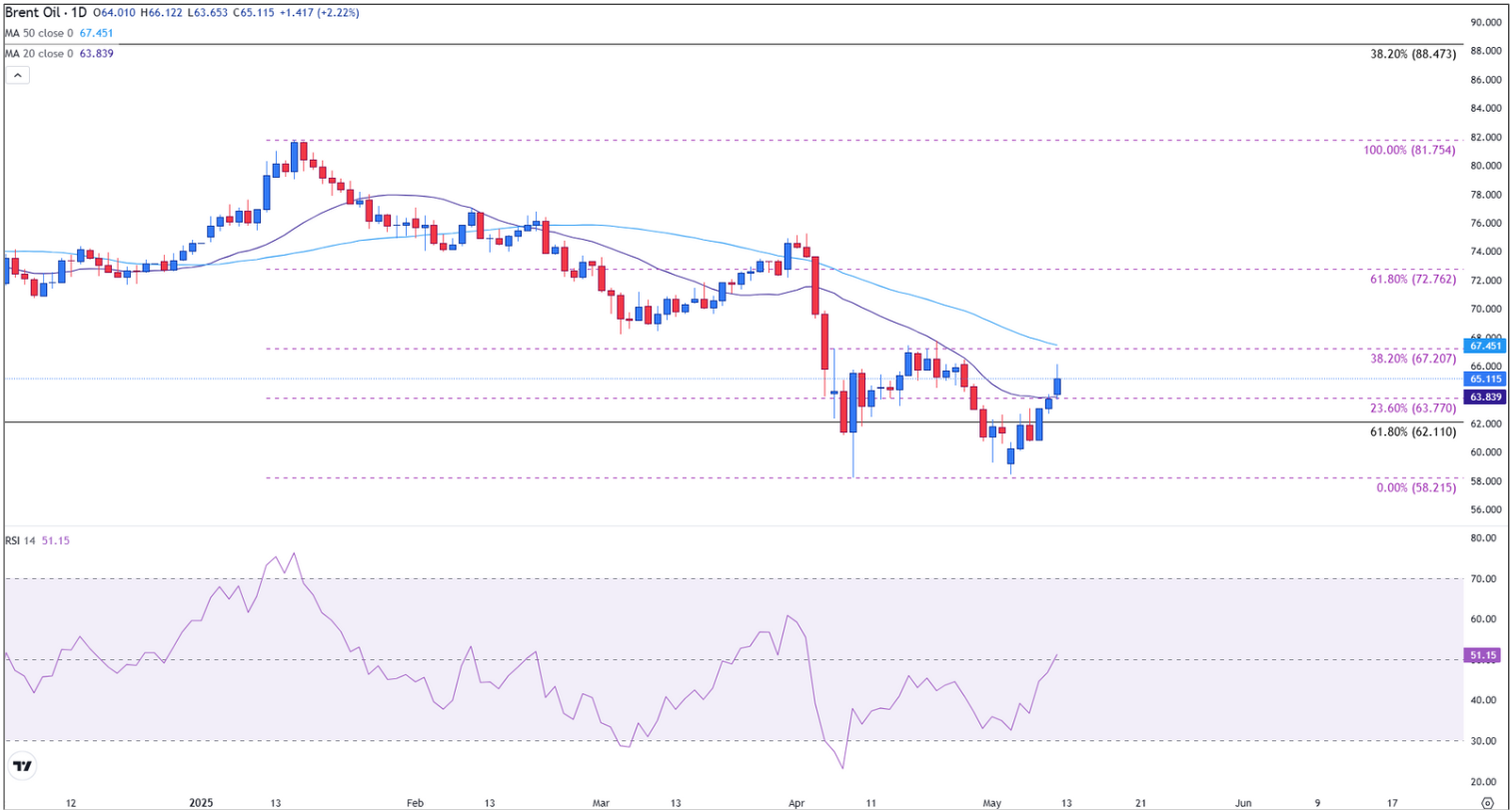
Immediate resistance is now seen at $66.87, with stronger resistance between $67.20 and $67.45—a zone that combines Fibonacci and moving average levels. A confirmed break above this range would likely open the door toward $69.98, which represents the 50% retracement of the year-to-date decline and closely aligns with the psychological $70.00 threshold.
On the downside, first support lies at the 20-day SMA ($63.84), followed by more significant support at the 61.8% long-term Fibonacci retracement at $62.11, measured from the April 2020 low to the March 2022 high.
The Relative Strength Index (RSI) on the daily chart is holding near 51, suggesting neutral momentum with potential for further upside if key resistance levels are cleared. Brent remains within a short-term recovery channel, although sustained gains above the 50-day SMA would be necessary to confirm a breakout.
Brent Crude Oil FAQs
Brent Crude Oil is a type of Crude Oil found in the North Sea that is used as a benchmark for international Oil prices. It is considered ‘light’ and ‘sweet’ because of its high gravity and low sulfur content, making it easier to refine into gasoline and other high-value products. Brent Crude Oil serves as a reference price for approximately two-thirds of the world's internationally traded Oil supplies. Its popularity rests on its availability and stability: the North Sea region has well-established infrastructure for Oil production and transportation, ensuring a reliable and consistent supply.
Like all assets supply and demand are the key drivers of Brent Crude Oil price. As such, global growth can be a driver of increased demand and vice versa for weak global growth. Political instability, wars, and sanctions can disrupt supply and impact prices. The decisions of OPEC, a group of major Oil-producing countries, is another key driver of price. The value of the US Dollar influences the price of Brent Crude Oil, since Oil is predominantly traded in US Dollars, thus a weaker US Dollar can make Oil more affordable and vice versa.
The weekly Oil inventory reports published by the American Petroleum Institute (API) and the Energy Information Agency (EIA) impact the price of Brent Crude Oil. Changes in inventories reflect fluctuating supply and demand. If the data shows a drop in inventories it can indicate increased demand, pushing up Oil price. Higher inventories can reflect increased supply, pushing down prices. API’s report is published every Tuesday and EIA’s the day after. Their results are usually similar, falling within 1% of each other 75% of the time. The EIA data is considered more reliable, since it is a government agency.
OPEC (Organization of the Petroleum Exporting Countries) is a group of 12 Oil producing nations who collectively decide production quotas for member countries at twice-yearly meetings. Their decisions often impact Brent Crude Oil prices. When OPEC decides to lower quotas, it can tighten supply, pushing up Oil prices. When OPEC increases production, it has the opposite effect. OPEC+ refers to an expanded group that includes ten extra non-OPEC members, the most notable of which is Russia.
Author

Tammy Da Costa, CFTe®
FXStreet
Tammy is an economist and market analyst with a deep passion for financial markets, particularly commodities and geopolitics.