Breaking: Gold climbs to new record-high above $3,700

Gold (XAU/USD) extended its rally in the second half of the day on Tuesday and reached a new record-high above $3,700.
The broad-based selling pressure surrounding the US Dollar (USD) helps XAU/USD continue to push higher as investors gear up for the Federal Reserve's (Fed) monetary policy announcements on Wednesday.
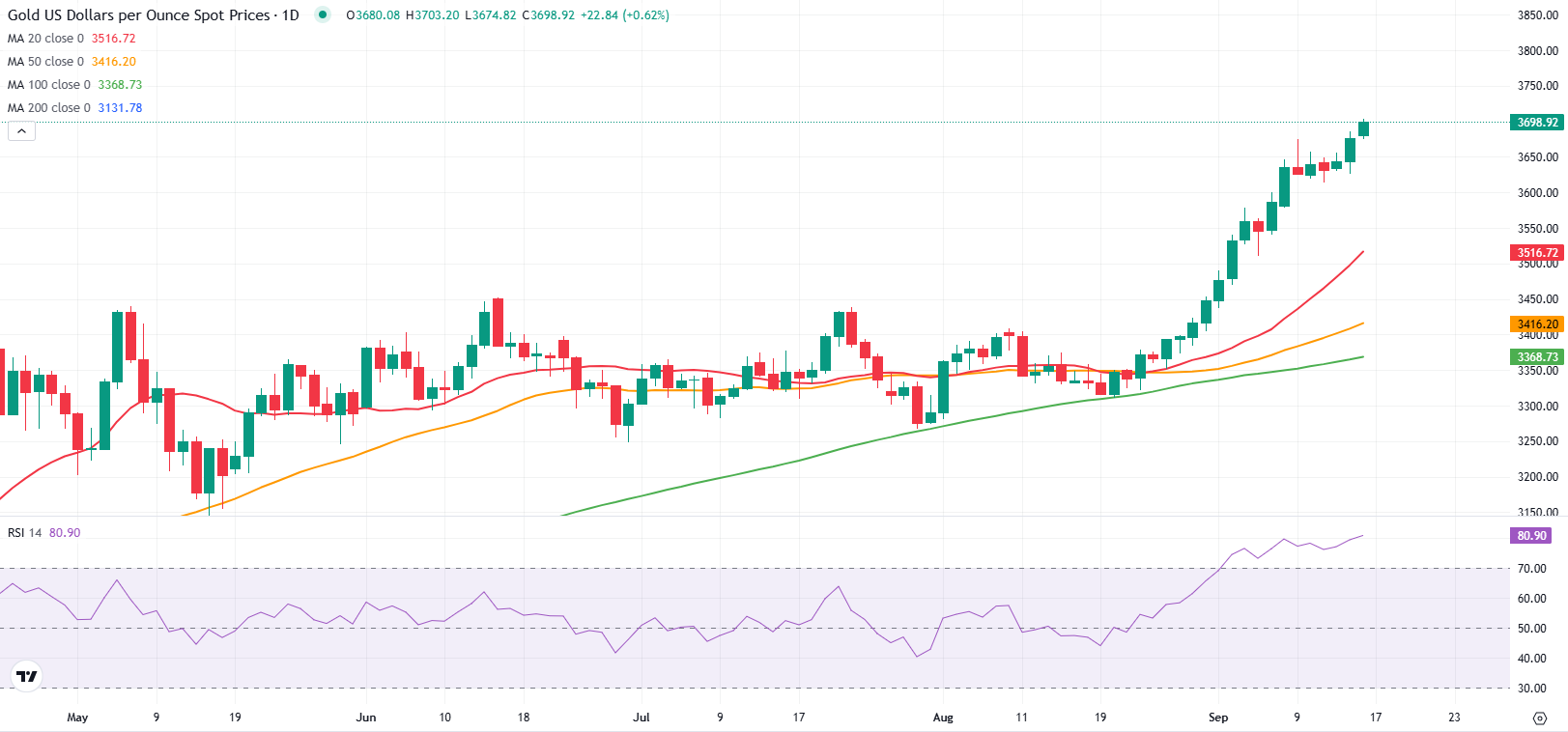
Gold daily chart
Although markets widely expect the Fed to cut the policy rate by 25 basis points (bps), the revised Summary of Economic Projections and the voting pattern within the Federal Open Market Committee (FOMC) could hint at dovish voices growing louder.
Senate Republicans confirmed on Monday White House economic adviser Stephen Miran to join the Federal Reserve Board. Miran, who is seen as a dove with the potential to prefer a 50 bps cut, will be able to vote at the upcoming meeting.
Additionally, Fed Governors Michelle Bowman and Christopher Waller – a candidate to replace Chair Powell next year – could look to send a message by reflecting a dovish stance, as they did in July’s meeting.
Meanwhile, latest macroeconomic data releases from the US fail to support the USD. The US Census Bureau reported that Retail Sales increased by 0.6% on a monthly basis in August, beating the market expectation of 0.2%. Other data showed that Industrial Production expanded by 0.1%.
Gold FAQs
Gold has played a key role in human’s history as it has been widely used as a store of value and medium of exchange. Currently, apart from its shine and usage for jewelry, the precious metal is widely seen as a safe-haven asset, meaning that it is considered a good investment during turbulent times. Gold is also widely seen as a hedge against inflation and against depreciating currencies as it doesn’t rely on any specific issuer or government.
Central banks are the biggest Gold holders. In their aim to support their currencies in turbulent times, central banks tend to diversify their reserves and buy Gold to improve the perceived strength of the economy and the currency. High Gold reserves can be a source of trust for a country’s solvency. Central banks added 1,136 tonnes of Gold worth around $70 billion to their reserves in 2022, according to data from the World Gold Council. This is the highest yearly purchase since records began. Central banks from emerging economies such as China, India and Turkey are quickly increasing their Gold reserves.
Gold has an inverse correlation with the US Dollar and US Treasuries, which are both major reserve and safe-haven assets. When the Dollar depreciates, Gold tends to rise, enabling investors and central banks to diversify their assets in turbulent times. Gold is also inversely correlated with risk assets. A rally in the stock market tends to weaken Gold price, while sell-offs in riskier markets tend to favor the precious metal.
The price can move due to a wide range of factors. Geopolitical instability or fears of a deep recession can quickly make Gold price escalate due to its safe-haven status. As a yield-less asset, Gold tends to rise with lower interest rates, while higher cost of money usually weighs down on the yellow metal. Still, most moves depend on how the US Dollar (USD) behaves as the asset is priced in dollars (XAU/USD). A strong Dollar tends to keep the price of Gold controlled, whereas a weaker Dollar is likely to push Gold prices up.
Author

FXStreet Team
FXStreet
Composed of a group of economic journalists and FX experts, the FXStreet content team produces and oversees all content published on FXStreet. It provides a purely journalistic approach to the Forex market.