Breaking: Bank of Japan keeps policy steady, tweaks forward guidance, yen at fresh session lows, 129.52+


The Bank of Japan was expected and has maintained its key interest rates at today’s meeting, continuing to defend low rates with bond-buying but is uber dovish and pessimistic in its guidance.
The yen is now pushed above 129 the figure toughing a 20-year high and that is where it will need to stay for a convincing prospect of a continuation for the foreseeable future.
While the BoJ was expected to keep its existing ultra-loose policy settings, the yen tumbled as the central bank announced its plan to conduct unlimited fixed-rate bond purchase operations every business day "until it is highly likely that no bids will be submitted".
BoJ decision, statement & outlook
What we know so far, as comments and statements are dripped fed through the wires vs Reuters as follows...
- BoJ keeps monetary policy steady.
- BoJmaintains the short-term interest rate target at -0.1%.
- Maintains a 10-year JGB yield target of around 0%.
- Leaves unchanged its forward guidance on interest rates, says expects short- and long-term policy rates to remain at 'present or lower levels.
- Tweaks forward guidance on monetary policy bias
- Will ease policy without hesitation as needed with an eye on pandemic impact while striving to sustain market stability and support corporate funding
- Clarifies operation on unlimited fixed-rate bond-buying
- Will offer to buy 10-year JGB at 0.25% every business day via fixed-rate operations unless it is highly likely that no bids will be submitted.
Inflation outlook:
- Board's core CPI median forecast for fiscal 2022 at +1.9% (not +0.9%) vs +1.1% in Jan.
- Board's core CPI median forecast for fiscal 2023 at +1.1% (not +1.2%) vs +1.1% in Jan.
- Board's core CPI median forecast for fiscal 2024 at +1.1% (not +1.5%).
- Inflation expectations heightening mainly for the short-term.
- Sharp rise in energy, food costs weighs on households' real income, corporate profits.
Report on risks:
- Risks to Japan's economic outlook are roughly balanced.
- Prolonged rise in commodity prices may hurt economy via worsening terms of trade.
- Japan's economy is likely to recover, risks to price outlook skewed to upside for time being, roughly balanced thereafter.
- Consumer inflation is likely to gradually accelerate the pace of increase.
- Japan's economy is likely to pick up as a trend pandemic, Ukraine fallout, commodity prices and market moves among risks to the economic outlook.
- The relief measures forced savings during the pandemic likely to moderate hit to the economy from worsening terms of trade.
- Consumer inflation is likely to accelerate to around 2% briefly but moderate as the boost from energy prices declines.
- Corporate profits are likely to remain elevated as a whole due to the weak yen.
Other key notes:
- BoJ made the decision on yield curve control by 8-1 vote
- BoJ board member Kataoka dissented from the decision on YCC
- BoJ will conduct fixed-rate JGB buying operations every working day except for when the bidding is not apparently expected.
USD/JPY update
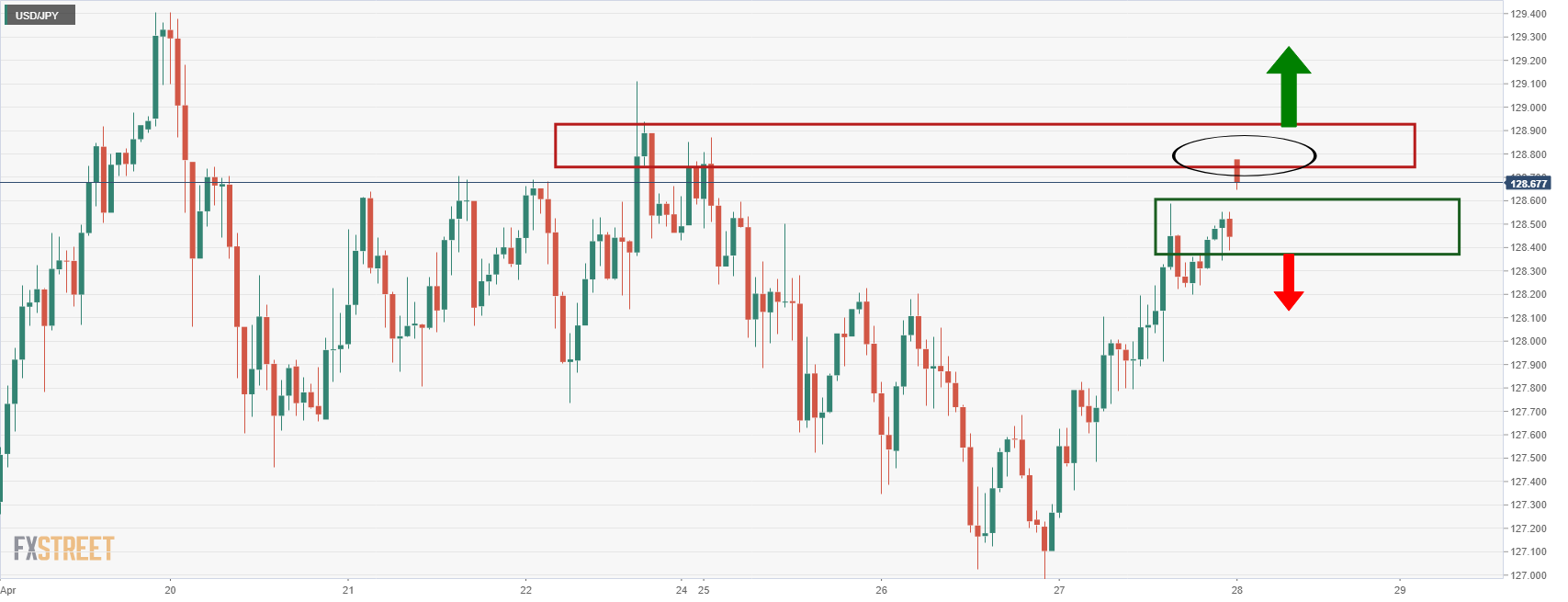
Prior to the decision, the yen was on the backfoot, testing hourly resistance:
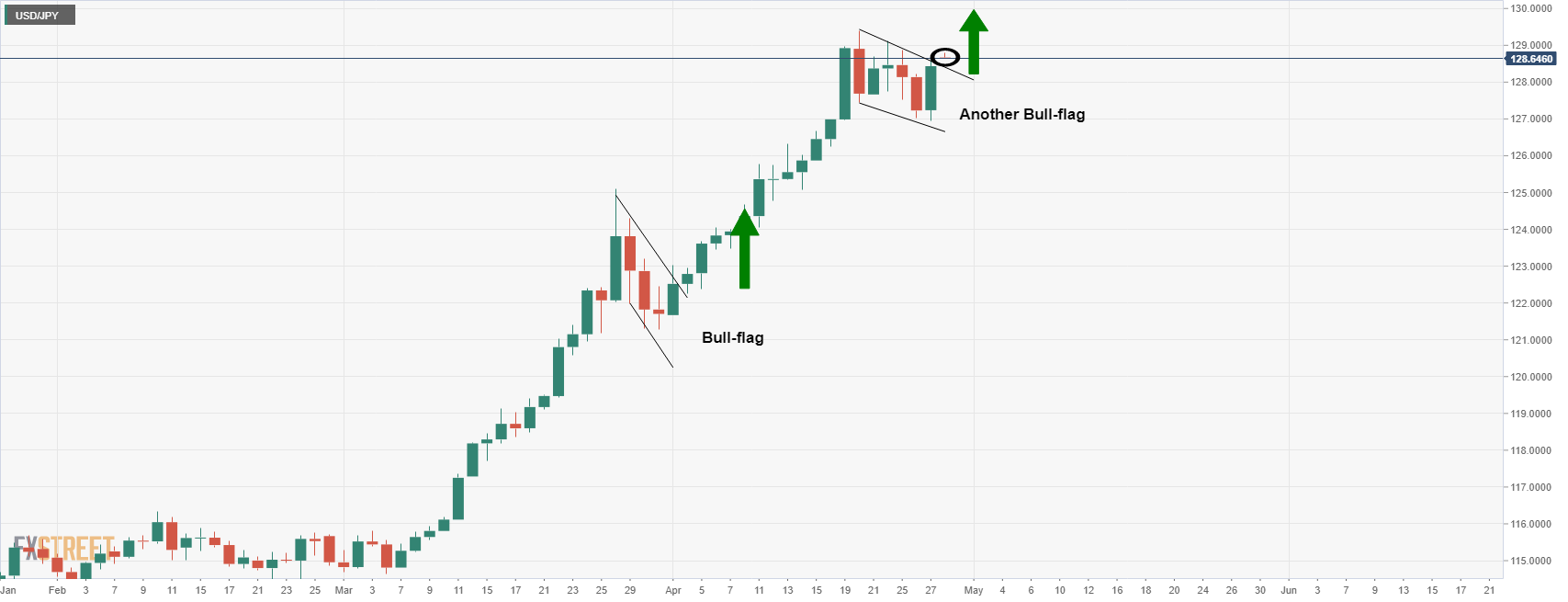
The pair was already breaking the ceiling of the bull-flag n the daily chart:
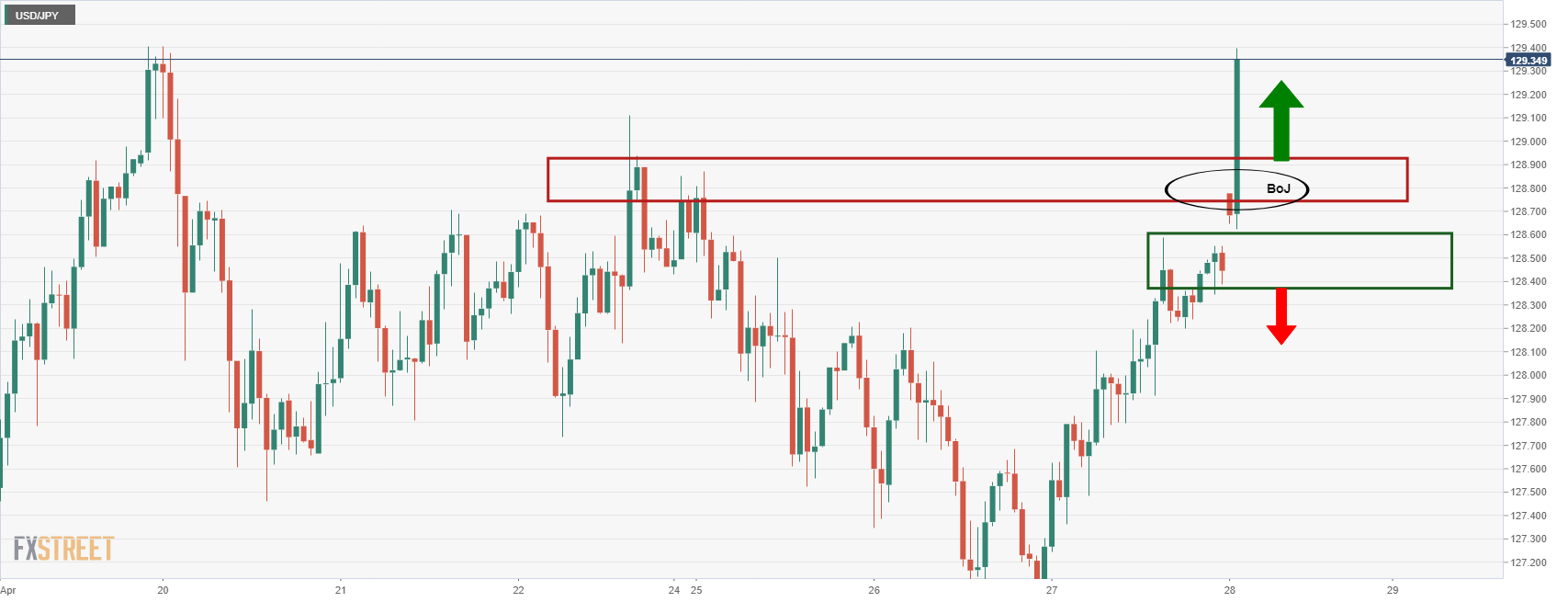
Meanwhile, the yen has dropped and is now through 129 the figure, scoring a high of 129.47 so far:
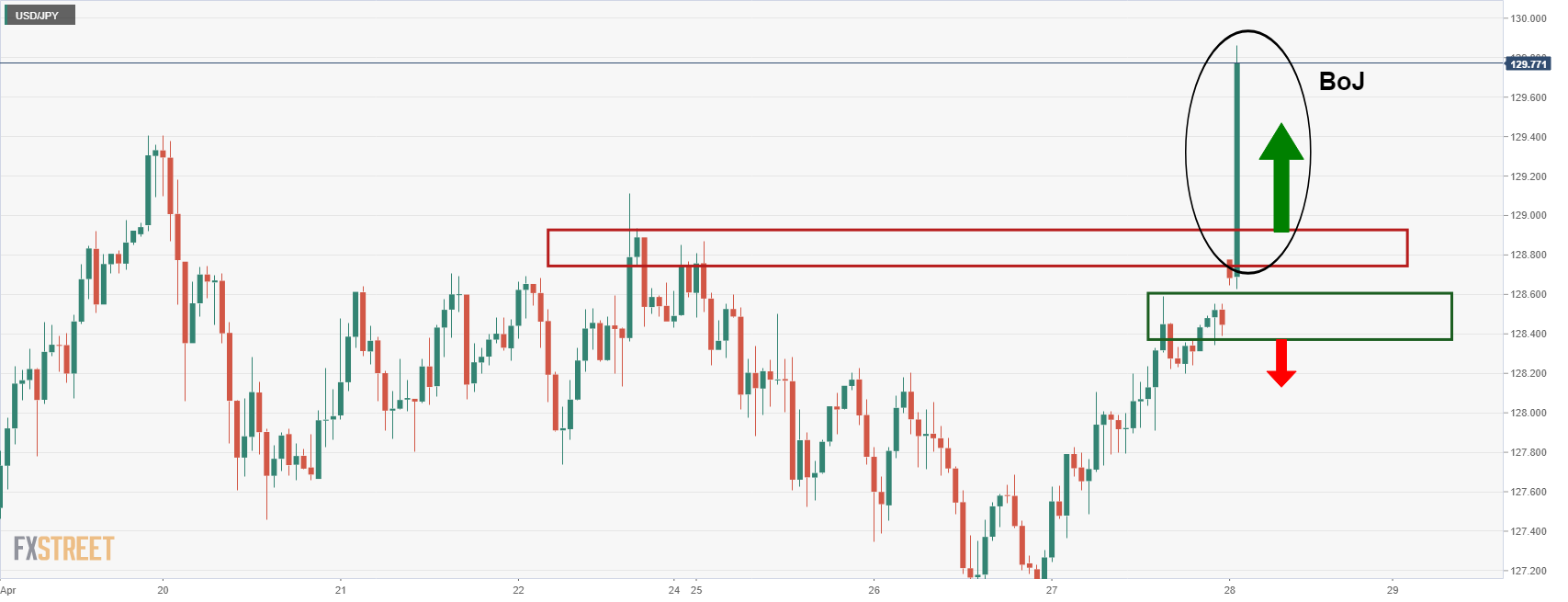
Update:
USD/JPY has rallied to a fresh high approximately 30 minutes after the announcements of 129.87 as the bond yields bull-flatten (long term yields decreasing more quickly than short-term rates):
About the BoJ interest rate decision
BoJ Interest Rate Decision is announced by the Bank of Japan. Generally, if the BoJ is hawkish about the inflationary outlook of the economy and rises the interest rates it is positive, or bullish, for the JPY. Likewise, if the BoJ has a dovish view on the Japanese economy and keeps the ongoing interest rate, or cuts the interest rate it is negative, or bearish.
Author
FXStreet Team
FXStreet