|

BoJ Minutes: Members agreed Japan's economy is picking up

The Bank of Japan's minutes for the September meeting minutes are starting to hit the wires as follows:

BoJ minutes

 A few members said need to be vigilant to impact monetary tightening by some central banks could have on global markets.
    
Members agreed Japan's economy is picking up.
    
Several members said weak yen could hurt households, small firms and non-manufacturers.
    
One member said weak yen has effect of pushing up domestic economic activity in long-term.
    
Some members said must expand inbound tourism, capex, hike wages to maximise merits of weak yen.
    
One member said various indicators on trend inflation rising.
    
A few members said corporate price-setting behaviour may be changing.
    
One member said expects prices to continue for wide range of goods.
    
One member said must humbly watch without any preset idea risk of inflation overshooting expectations sharply, including from impact of FX.
    
A few members said there is still distance from japan achieving BoJ's price target in stable, sustained manner.
    
One member said while BoJ needs to keep eye out on side-effects of monetary easing, no need to change policy immediately.
    
One member said recent rapid, speculative fx moves undesirable for japan's economy.
    
Several members said BoJ must communicate to public its monetary policy does not directly target fx moves.
    
One member said BoJ must communicate exit strategy from easy policy when appropriate time comes
    
One member said monetary easing effect of BoJs policy could heighten if japan's natural interest rate increases

USD/JPY H1 chart
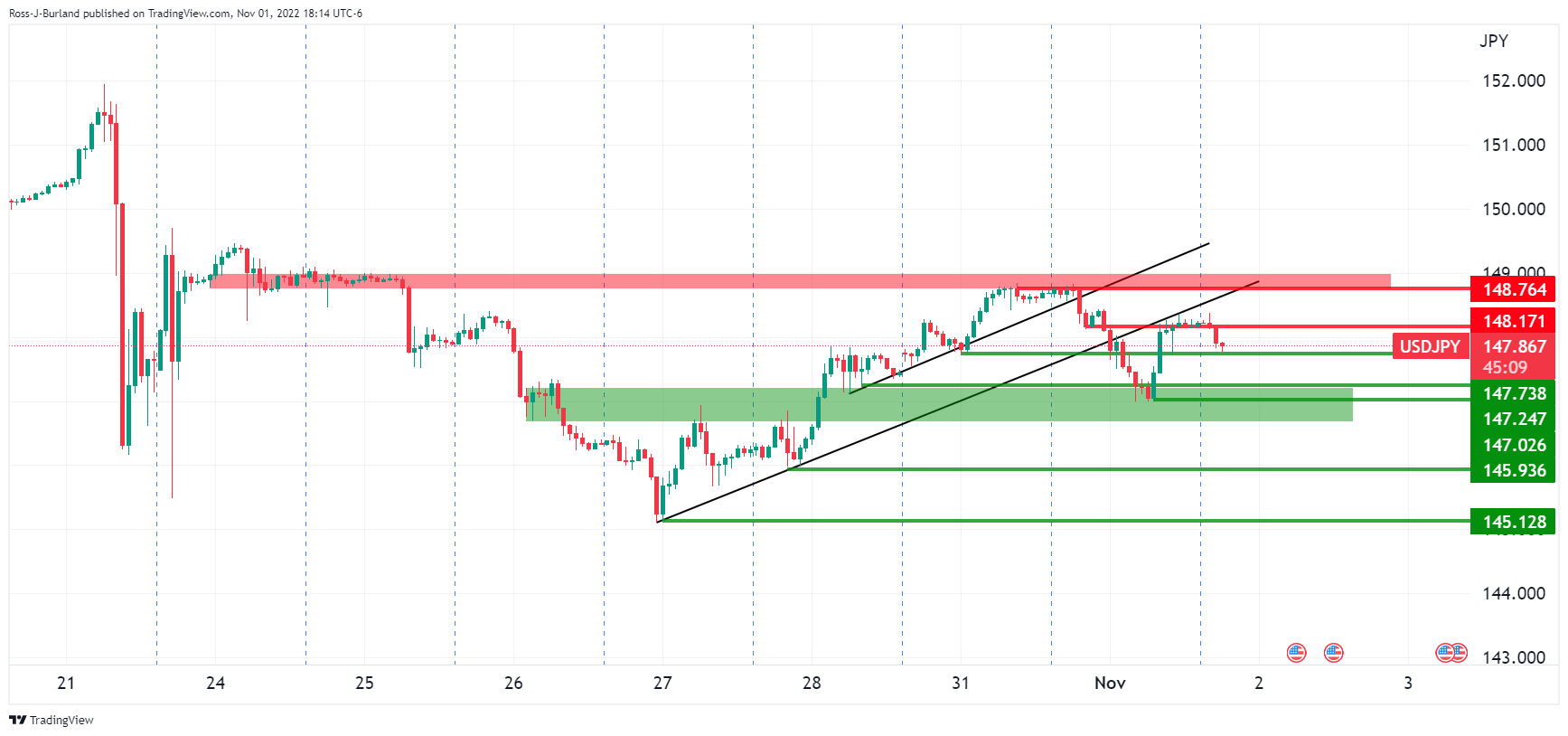
The price is embedded below the trendlines and horizontal resistance following a recent break of structure.

Author

Ross J Burland

Ross J Burland, born in England, UK, is a sportsman at heart. He played Rugby and Judo for his county, Kent and the South East of England Rugby team.


More from Ross J Burland
Share:

Editor's Picks

AUD/USD picks up bids above 0.7100 after RBA-speak

AUD/USD picks up bids above 0.7100 in the Asian session on Tuesday, following hawkish comments from RBA Assistant Governor Sarah Hunter and Governor Michele Bullock. However, escalating tensions in the Middle East and the Fed's hawkish outlook remain supportive of the bullish US Dollar undertone, which could limit the pair. The crucial Trump-Xi summit is later this week and remains in focus.

USD/JPY holds small gains near 157.50 as JPY intervention risks loom

USD/JPY posts modest gains while trading near 157.50 in the Asian session on Tuesday as intervention fears help limit losses for the Japanese Yen. However, the BoJ's dovish rate hike to a 31-year high keeps JPY bulls on the back foot. Meanwhile, the US Dollar retains a bullish undertone amid the Fed's hawkish outlook and escalating Middle East tensions, providing tailwinds for the pair.

Gold recedes a tad; still above $4,300

Gold extends its decline for a second straight session, slipping below the $4,300 mark per troy ounce, just to regain some composure afterwards. The precious metal remains under pressure as expectations that the Fed will keep interest rates higher for longer continue to support US Treasury yields and the US Dollar.

Crypto Today: Bitcoin, Ethereum, XRP rally slows amid rising ETF inflows

The cryptocurrency market remains elevated on Tuesday, with Bitcoin trading around $85,798, nearly 49% above the year low of $57,756. Ethereum and Ripple trade within a robust bullish outlook above $2,700 and $1.51, respectively.

Energy and risk markets remain in the driver’s seat
US stock markets rallied up 2.26% (Nasdaq) yesterday with AI/tech names leading the advance. The Nasdaq even tested the all-time high reached early June. The likes of the S&P 500 and EuroStoxx50 recovered up to 1.5%. Positive risk vibes and lower energy prices supported consolidation on bond markets following the past month’s heavy losses. European yield curves bull steepened.
BoJ Recap: Not as hawkish as expected

The Bank of Japan (BoJ) raised its short-term interest-rate target to 1.25% from 1.00% in a 7-2 vote, marking another step in the normalisation of monetary policy and widely matching what everyone has been expecting for weeks.