AVAV breaks major support — is $192 the next stop?

AeroVironment (AVAV) just delivered one of those trading sessions that demands your full attention. The drone and unmanned aircraft systems maker cratered more than 16% on Monday, slicing through a support level that had held firm for the better part of nine months. When a floor that significant gives way on volume like this (5.66 million shares), you don't brush it off as noise.
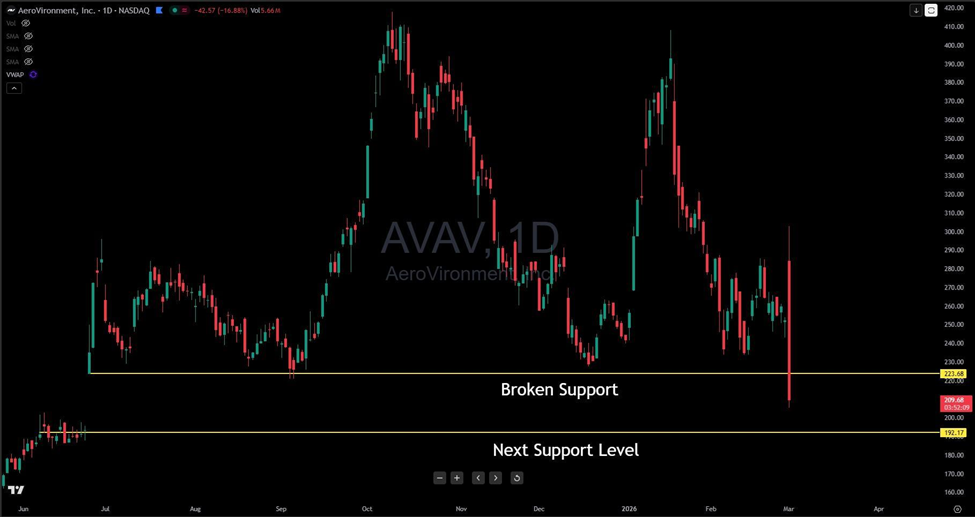
Let's talk about what that broken level actually means. The $223–$230 zone had been tested repeatedly since last summer, holding through multiple pullbacks and serving as the foundation beneath every rally attempt in that stretch. Price memory is real in technical analysis, and that level had accumulated a lot of it. The fact that today's candle didn't just probe it but blew straight through tells you something about the conviction behind this move.
What's also worth noting is the broader structure this breakdown is unfolding within. AVAV put in two prominent peaks near $410 — one in late September, another in late December — before sellers took control and began unwinding the position. That twin-peak formation has been distributing supply for months, and today's break feels like the market finally acknowledging what that pattern was telegraphing.
So where does price go from here? The next meaningful reference point sits down at $192.17, which aligns with the lows carved out back in early summer 2025. That's roughly another 8% lower from current levels around $209. If buyers are going to make a stand, that's the logical place to watch for it.
The difficult truth for bulls right now is that $223, the level that just broke, will likely flip to resistance on any bounce attempt. That's how support-turned-resistance dynamics work, and traders looking to fade any near-term recovery should keep that zone on their radar.
Of course, we always must acknowledge the potential invalidation for the bearish thesis. A swift reclaim of $223 on strong volume would suggest the breakdown was a shakeout rather than a genuine structural shift. Until that happens, the path of least resistance points lower, and $192 is the level to watch.
Author

Benjamin Pool
Verified Investing
A seasoned financial expert with a passion for empowering individuals to mastering smart money management.
















