Australia’s Unemployment Rate declines to 4.1% in December vs. 4.4% expected

Australia’s Unemployment Rate declined to 4.1% in December from 4.3% in November, according to the official data released by the Australian Bureau of Statistics (ABS) on Thursday. The figure came in below the market consensus of 4.4%.
Furthermore, the Australian Employment Change arrived at 65.2K in December from -28.7K in November (revised from -21.3K), compared with the consensus forecast of 30K.
The participation rate in Australia increased to 66.7% in December, compared to 66.6% in November (revised from 66.7%). Meanwhile, Full-Time Employment rose by 54.8K in the same period from a decline of 65.3K in the previous reading (revisde from -56.5K). The Part-Time Employment increased by 10.4K in December versus a rise of 36.6 prior (revised from 35.2K).
Sean Crick, ABS head of labour statistics, said with the key highlights noted below
This month we saw more 15-24 year olds moving into employment, contributing to the rise in overall employment and the fall in the unemployment rate.
The growth in employment was driven by male employment, which rose by 49,000 people, while female employment recorded a smaller increase of 17,000 people.
The number of hours worked was up by 0.4 per cent, in line with the 0.4 per cent rise in employment.
Market reaction to the Australia’s employment data
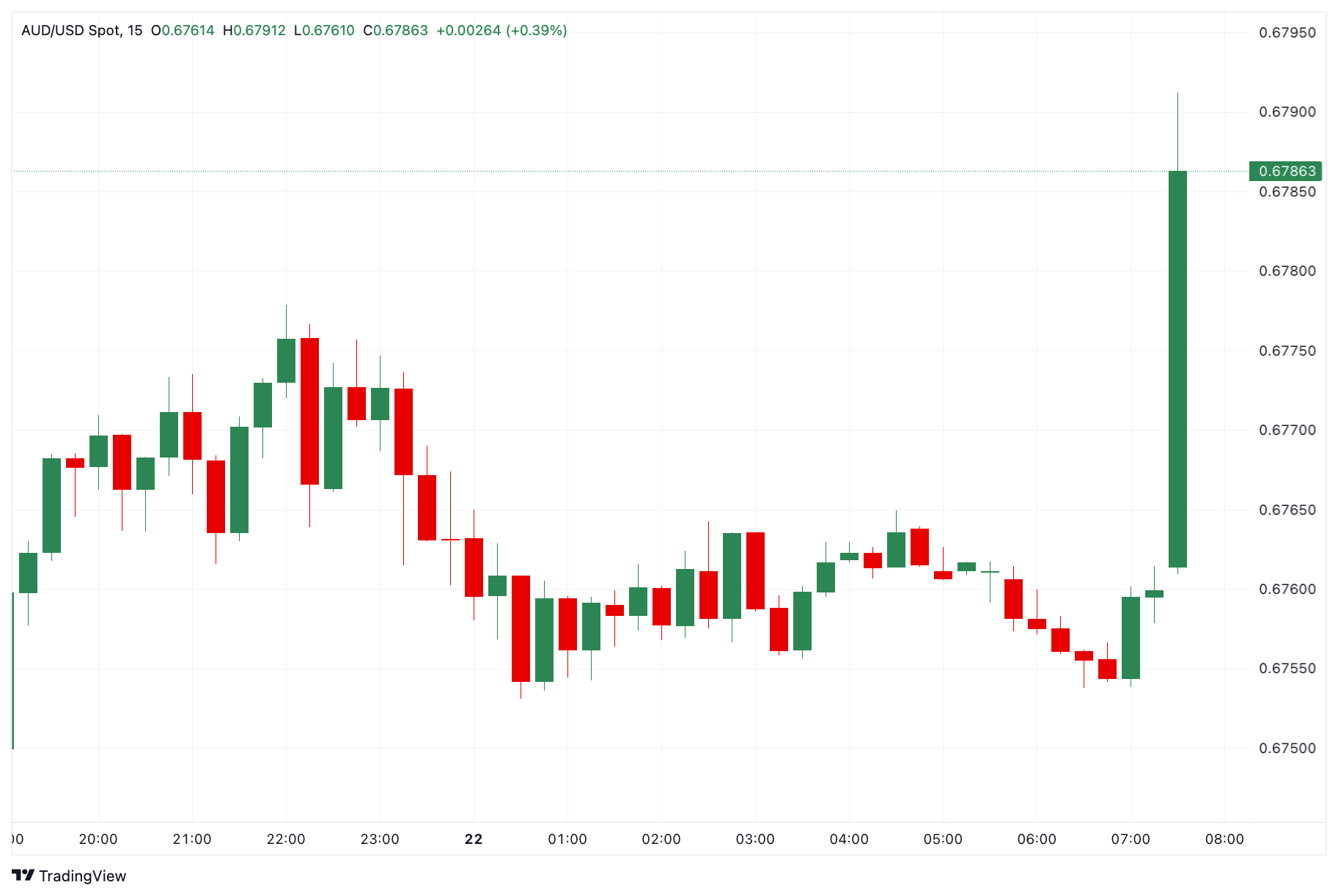
The Australian Dollar (AUD) attracts some buyers following the employment data. At the time of writing, the AUD/USD pair is trading 0.40% higher on the day to trade at 0.6788.
Australian Dollar Price This week
The table below shows the percentage change of Australian Dollar (AUD) against listed major currencies this week. Australian Dollar was the strongest against the Japanese Yen.
| USD | EUR | GBP | JPY | CAD | AUD | NZD | CHF | |
|---|---|---|---|---|---|---|---|---|
| USD | -0.87% | -0.54% | 0.36% | -0.59% | -1.63% | -1.80% | -0.71% | |
| EUR | 0.87% | 0.33% | 1.22% | 0.27% | -0.78% | -0.95% | 0.15% | |
| GBP | 0.54% | -0.33% | 0.66% | -0.06% | -1.11% | -1.27% | -0.18% | |
| JPY | -0.36% | -1.22% | -0.66% | -0.94% | -1.96% | -2.12% | -1.04% | |
| CAD | 0.59% | -0.27% | 0.06% | 0.94% | -1.01% | -1.19% | -0.12% | |
| AUD | 1.63% | 0.78% | 1.11% | 1.96% | 1.01% | -0.16% | 0.94% | |
| NZD | 1.80% | 0.95% | 1.27% | 2.12% | 1.19% | 0.16% | 1.11% | |
| CHF | 0.71% | -0.15% | 0.18% | 1.04% | 0.12% | -0.94% | -1.11% |
The heat map shows percentage changes of major currencies against each other. The base currency is picked from the left column, while the quote currency is picked from the top row. For example, if you pick the Australian Dollar from the left column and move along the horizontal line to the US Dollar, the percentage change displayed in the box will represent AUD (base)/USD (quote).
This section below was published at 20:30 GMT on Wednesday as a preview of the Australia Employment report
- The Australian Unemployment Rate is forecast at 4.4% in December.
- Australia is expected to have added 30,000 jobs in the month, following the 21,300 decrease in November.
- AUD/USD is overbought in the near term, but higher highs remain on the table.
Australia will release the December monthly employment report on Thursday at 0:30 GMT, with market participants anticipating a modest recovery in labor market conditions. The Australian Bureau of Statistics (ABS) is expected to announce that the country added 30,000 new jobs in the month, while the Unemployment Rate is forecast at 4.4%, up from the 4.3% posted in November. The Participation Rate is seen at 66.8%, pretty much unchanged from the previous 66.7%.
The ABS reports both full-time and part-time positions through the monthly Employment Change. Generally speaking, full-time jobs entail working 38 hours or more per week, usually include additional benefits, and typically provide a consistent income. On the other hand, part-time employment generally means higher hourly rates but lacks consistency and benefits. That’s why the economy prefers full-time jobs. In November, Australia gained 35,200 part-time positions but lost a whopping 56,500 full-time positions.
Australian unemployment rate expected to tick higher in December
Financial markets, however, are not about macroeconomic data, but about United States (US) President Donald Trump’s decision. Risk aversion dominates financial boards amid escalating tensions between Trump and Europe over Greenland. The US President wants to take over the Danish territory, even offering to buy it. Trump claims the US needs it for better defense of its territory, but it is worth noting that Greenland is rich in rare-earth elements. Given Denmark's refusal to cede its territory, Trump threatened several Nordic countries with fresh tariffs, adding that they would increase them in time until a deal to buy Greenland is achieved.
He also threatened France with levies, though for a different reason: Trump proposed creating a Board of Peace, a US-led organization meant to “promote stability, restore dependable and lawful governance, and secure enduring peace in areas affected or threatened by conflict.” Countries that wish to join the organization must pay US$1 billion. French leader Emmanuel Macron has doubts about joining it, claiming that it is the North Atlantic Treaty Organization’s (NATO) role to work on peace. As a result, US President Trump threatened to impose tariffs of up to 200% on French wines and champagne.
As a result, Gold price skyrocketed to record levels amid a run to safety, which in turn, underpins demand for the Australian Dollar (AUD).
Meanwhile, the Reserve Bank of Australia (RBA) is scheduled to meet and announce its first monetary policy decision of the year on February 3. The central bank has left the Official Cash Rate (OCR) unchanged at 3.6% since reaching that level in August 2025, with the December statement indicating policymakers are concerned about both employment and inflation.
“Turning to considerations for the monetary policy decision, members highlighted three judgements that were central to their decision at this meeting: first, the extent to which aggregate demand exceeds potential supply, and the implications of this for the persistence of the recent pick-up in inflation; second, the outlook for growth in labour demand and economic activity; and, third, whether financial conditions were still restrictive.”
However, the latest Australian employment figures have been generally disappointing, hinting at a loosening labor market. In that sense, the RBA may find some relief, but inflation remains a concern: the country's annual inflation slowed to 3.4% in November 2025 from 3.8% in October, still above the RBA’s 2–3% target.
Considering this broader picture, the Australian monthly employment report is likely to provide additional legs to the Australian Dollar (AUD) against its American rival, particularly if the report comes in line with or better than expectations.
When will the Australian employment report be released and how could it affect AUD/USD?
The ABS December employment report will be released early on Thursday. As previously noted, the Australian economy is expected to have added 30,000 new jobs in the month, while the Unemployment Rate is forecast at 4.4%. Market participants will also be attentive to the breakdown of full-time and part-time positions.
Valeria Bednarik, Chief Analyst at FXStreet, notes: “The AUD/USD pair trades near its recent peak at levels that were last seen in October 2024, closing up to the 0.6800 mark ahead of the release of Australian employment data, boosted by persistent risk aversion. The pair may seem overbought in the near term, but there is no reason for the USD to strengthen, and hence, slides are likely to keep attracting buyers, as long as the dismal mood persists.”
Bednarik adds: “Relevant resistance comes at 0.6830, en route to the 0.6870 price zone. Gains beyond the latter are unlikely solely because of the employment report, although the pair could rally further if risk sentiment deteriorates. An AUD slide on a dismal employment report should lead to a slide towards the 0.6700 level, where buyers will likely reappear to add longs.”
Employment FAQs
Labor market conditions are a key element to assess the health of an economy and thus a key driver for currency valuation. High employment, or low unemployment, has positive implications for consumer spending and thus economic growth, boosting the value of the local currency. Moreover, a very tight labor market – a situation in which there is a shortage of workers to fill open positions – can also have implications on inflation levels and thus monetary policy as low labor supply and high demand leads to higher wages.
The pace at which salaries are growing in an economy is key for policymakers. High wage growth means that households have more money to spend, usually leading to price increases in consumer goods. In contrast to more volatile sources of inflation such as energy prices, wage growth is seen as a key component of underlying and persisting inflation as salary increases are unlikely to be undone. Central banks around the world pay close attention to wage growth data when deciding on monetary policy.
The weight that each central bank assigns to labor market conditions depends on its objectives. Some central banks explicitly have mandates related to the labor market beyond controlling inflation levels. The US Federal Reserve (Fed), for example, has the dual mandate of promoting maximum employment and stable prices. Meanwhile, the European Central Bank’s (ECB) sole mandate is to keep inflation under control. Still, and despite whatever mandates they have, labor market conditions are an important factor for policymakers given its significance as a gauge of the health of the economy and their direct relationship to inflation.
Author

FXStreet Team
FXStreet
Composed of a group of economic journalists and FX experts, the FXStreet content team produces and oversees all content published on FXStreet. It provides a purely journalistic approach to the Forex market.