Australian Dollar strengthens as investors brace for US PPI data
- The Australian Dollar trades in positive territory for the second consecutive day in Friday’s early European session.
- Reduced bets of deeper Fed rate cuts support the USD and weigh on the pair.
- Investors brace for the US PPI data, which is due on Friday.

The Australian Dollar (AUD) gains ground on Friday. Nonetheless, the lower odds of aggressive interest rate cuts from the US Federal Reserve (Fed) after the hotter-than-expected inflation data might lift the US Dollar (USD) and cap the upside for the pair.
In the absence of top-tier economic data releases from the Australia on Friday, the USD price dynamic will be the main driver for the AUD/USD. Investors will monitor the release of US Producer Price Index (PPI), which is due on Friday. The headline PPI is expected to show an increase of 1.6% YoY in September, while the core PPI is estimated to see a rise of 2.7% YoY during the same period. If the reports shows softer than expected outcome, this could weigh on the USD and acts as a tailwind for AUD/USD. Additionally, the preliminary of the Michigan Consumer Sentiment Index will be released later in the day.
Daily Digest Market Movers: Australian Dollar extends its recovery ahead of another US inflation data
- RBA Minutes from the September meeting showed board members overlooked the warning that there would be no rate cuts in the near future. The Australian central bank wants to keep its options open, watching whether the economy starts to pick up in the second half of the year.
- The US Consumer Price Index (CPI) rose 2.4% YoY in September, compared to 2.5% in August, above the consensus of 2.3%, the US Department of Labor Statistics showed Thursday. The core CPI, excluding food and energy, climbed 3.3% YoY in September, above forecast and the previous reading of 3.2%.
- The US Initial Jobless Claims for the week ending October 4 rose to 258K, up from the previous week's 225K. The figure was above the initial consensus of 230K.
- New York Fed President John Williams said on Thursday that he expects more rate cuts lie ahead as inflation pressures continue to moderate and the economy remains solid.
- Chicago Fed President Austan Goolsbee noted he sees a series of rate reductions over the next year to year and a half, noting that inflation is now near the Fed's 2% target and the economy is about at full employment.
- Atlanta Fed President Raphael Bostic is open to the idea of skipping a rate cut in November if economic data still hasn't aligned with the Fed's target figures in time.
Technical Analysis: Australian Dollar maintains a positive view in the longer term
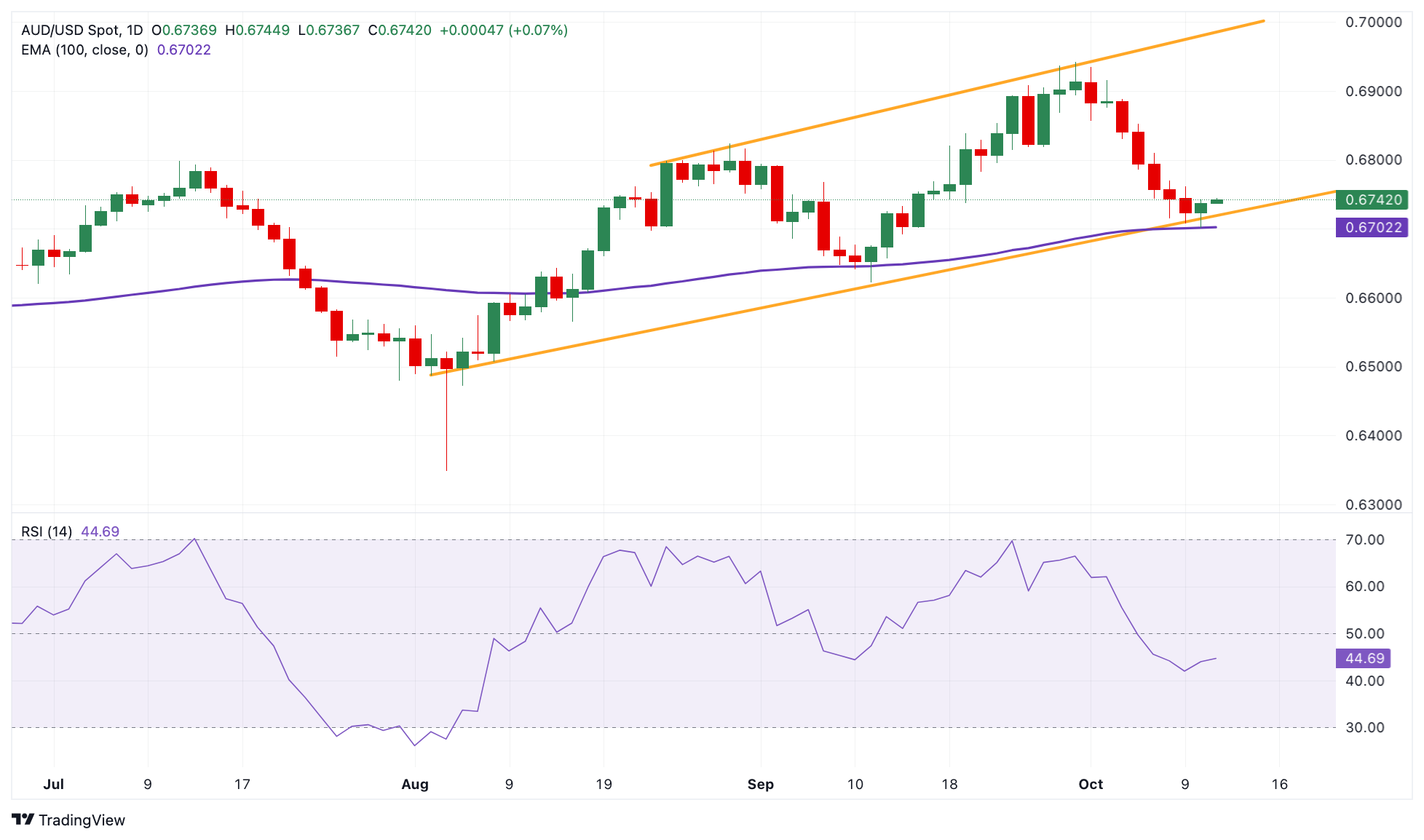
The first upside barrier emerges near the high of September 6 at 0.6767. Extended gains could pave the way to 0.6823, the high of August 29. Any follow-through buying above the mentioned level could see a rally to 0.6942, the high of September 30.
On the flip side, the key support level is seen at 0.6700, representing the lower limit of the trend channel, the 100-day EMA, and the psychological level. A breach of this level could expose 0.6622, the low of September 11.
Australian Dollar FAQs
One of the most significant factors for the Australian Dollar (AUD) is the level of interest rates set by the Reserve Bank of Australia (RBA). Because Australia is a resource-rich country another key driver is the price of its biggest export, Iron Ore. The health of the Chinese economy, its largest trading partner, is a factor, as well as inflation in Australia, its growth rate and Trade Balance. Market sentiment – whether investors are taking on more risky assets (risk-on) or seeking safe-havens (risk-off) – is also a factor, with risk-on positive for AUD.
The Reserve Bank of Australia (RBA) influences the Australian Dollar (AUD) by setting the level of interest rates that Australian banks can lend to each other. This influences the level of interest rates in the economy as a whole. The main goal of the RBA is to maintain a stable inflation rate of 2-3% by adjusting interest rates up or down. Relatively high interest rates compared to other major central banks support the AUD, and the opposite for relatively low. The RBA can also use quantitative easing and tightening to influence credit conditions, with the former AUD-negative and the latter AUD-positive.
China is Australia’s largest trading partner so the health of the Chinese economy is a major influence on the value of the Australian Dollar (AUD). When the Chinese economy is doing well it purchases more raw materials, goods and services from Australia, lifting demand for the AUD, and pushing up its value. The opposite is the case when the Chinese economy is not growing as fast as expected. Positive or negative surprises in Chinese growth data, therefore, often have a direct impact on the Australian Dollar and its pairs.
Iron Ore is Australia’s largest export, accounting for $118 billion a year according to data from 2021, with China as its primary destination. The price of Iron Ore, therefore, can be a driver of the Australian Dollar. Generally, if the price of Iron Ore rises, AUD also goes up, as aggregate demand for the currency increases. The opposite is the case if the price of Iron Ore falls. Higher Iron Ore prices also tend to result in a greater likelihood of a positive Trade Balance for Australia, which is also positive of the AUD.
The Trade Balance, which is the difference between what a country earns from its exports versus what it pays for its imports, is another factor that can influence the value of the Australian Dollar. If Australia produces highly sought after exports, then its currency will gain in value purely from the surplus demand created from foreign buyers seeking to purchase its exports versus what it spends to purchase imports. Therefore, a positive net Trade Balance strengthens the AUD, with the opposite effect if the Trade Balance is negative.
Author

Lallalit Srijandorn
FXStreet
Lallalit Srijandorn is a Parisian at heart. She has lived in France since 2019 and now becomes a digital entrepreneur based in Paris and Bangkok.















