Australian Dollar advances as RBA Bullock delivers hawkish remarks regarding policy
- The Australian Dollar receives support from hawkish comments from RBA Governor Michele Bullock.
- The AUD may struggle as the United States may introduce further AI chip sanctions against China on Monday.
- US bonds appreciate as US President-elect Donald Trump selected the fund manager Scott Bessent as the US Treasury secretary.

The Australian Dollar (AUD) extends its winning streak for the third successive session on Friday following the hawkish comments from Reserve Bank of Australia (RBA) Governor Michele Bullock. However, the AUD/USD pair may face downward pressure as the United States (US) is set to unveil additional measures on Monday aimed at curbing China’s ability to advance in artificial intelligence technology.
ANZ has revised its expectations, now forecasting the Reserve Bank of Australia (RBA) to cut interest rates in May instead of February, following a new warning about inflation remaining elevated for another two years. Adam Boyton, ANZ's head of Australian economics, updated his projections on Friday morning after RBA Governor Michele Bullock stated that inflation is unlikely to "sustainably" return to the central bank's target range before 2026.
RBA Governor Bullock stated on Thursday that Australia’s core inflation remains “too high” to contemplate interest rate cuts in the near future. She emphasized that there is still progress to be made before inflation returns sustainably to the target level, according to Bloomberg.
The downside of the US Dollar (USD) may be limited, as the Federal Reserve (Fed) is expected to remain cautious about cutting interest rates following robust inflation data released on Wednesday. The report revealed strong consumer spending growth in October but also indicated little progress in reducing inflation, prompting the Fed to stay vigilant.
Australian Dollar receives support from hawkish comments by RBA Governor Bullock
- US bonds appreciate as US President-elect Donald Trump selected the fund manager Scott Bessent as the US Treasury secretary, a seasoned Wall Street figure and fiscal conservative.
- Australia's Private Sector Credit increased by 0.6% month-over-month in October, exceeding market expectations of 0.5%, which had been the rate for the past three months. This represents the strongest monthly growth since June. On an annual basis, credit rose by 6.1%, up from the previous 5.8% increase.
- On Thursday, Australia's total new capital expenditure rose by 1.1% quarter-on-quarter in the third quarter, surpassing market expectations of a 0.9% increase and rebounding from a 2.2% decline in the previous quarter.
- The US Personal Consumption Expenditures (PCE) Price Index increased by 2.3% year-over-year in October, up from 2.1% in September. Meanwhile, the core PCE Price Index, which excludes volatile food and energy prices, rose by 2.8%, slightly higher than the 2.7% recorded the previous month. Both figures aligned with market expectations, indicating steady inflationary pressure within the economy.
- The latest Federal Open Market Committee's (FOMC) Meeting Minutes for the policy meeting held on November 7, indicated that policymakers are adopting a cautious stance on cutting interest rates, citing easing inflation and a robust labor market.
- Bloomberg reported that US President-elect Donald Trump is expected to appoint Jamieson Greer as the US Trade Representative on Tuesday. Greer’s nomination highlights the central role of tariffs in Trump’s economic strategy.
- The Australian Dollar faced challenges due to dampened market sentiment following President-elect Donald Trump's announcement of a 10% increase in tariffs on all Chinese goods entering the United States.
- Chicago Fed President Austan Goolsbee indicated on Tuesday that the Fed will likely continue lowering interest rates toward a neutral stance that neither stimulates nor restricts economic activity. Meanwhile, according to Bloomberg, Minneapolis Fed President Neel Kashkari highlighted that it remains appropriate to consider another rate cut at the Fed’s December meeting.
Technical Analysis: Australian Dollar hovers around 0.6500, nine-day EMA
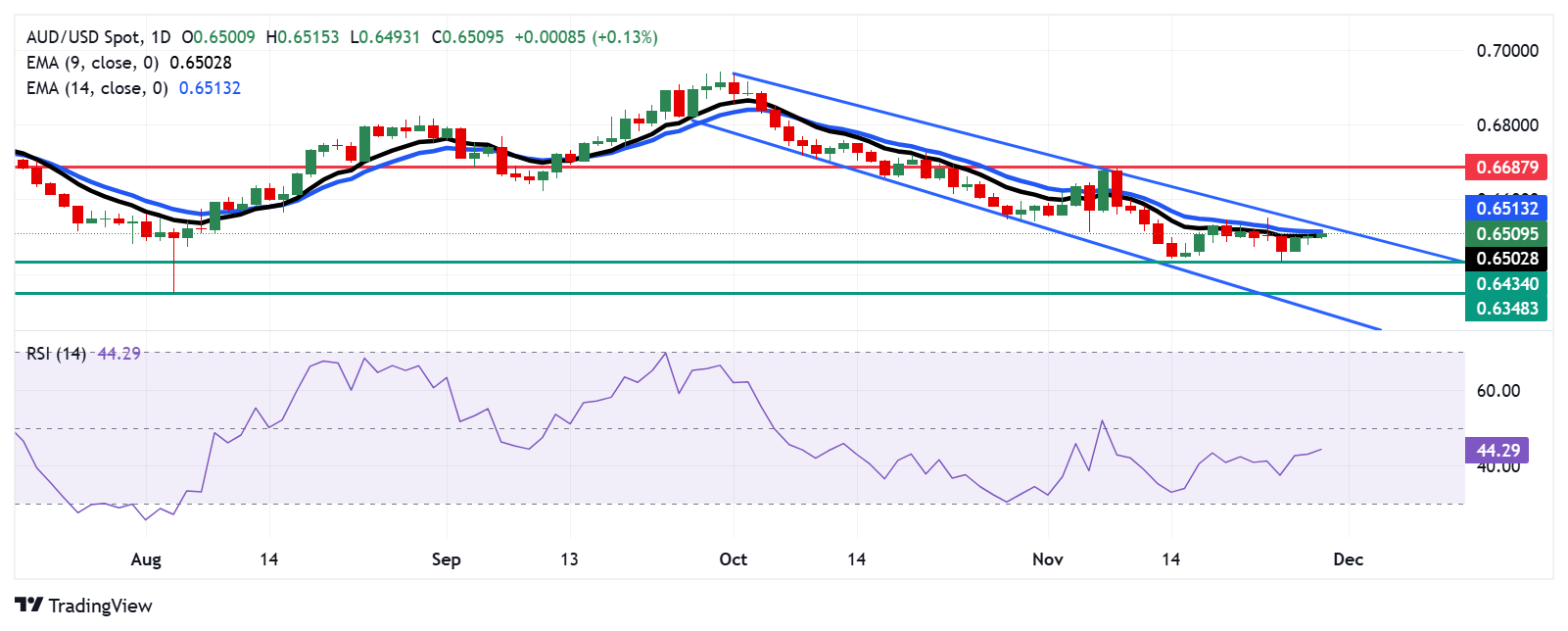
The AUD/USD pair trades near 0.6500 on Friday, with bearish momentum strengthening based on technical analysis. The pair remains within a descending channel, and the 14-day Relative Strength Index (RSI) stays below 50, signaling persistent negative sentiment.
On the downside, the AUD/USD pair may revisit its four-month low of 0.6434, marked on November 26. A breach of this level could pave the way toward the yearly low of 0.6348, last reached on August 5. Additional support is found near the descending channel's lower boundary around 0.6300.
The immediate resistance lies at the nine-day Exponential Moving Average (EMA) at 0.6502, followed by the 14-day EMA at 0.6513. Further resistance is positioned near the channel's upper boundary at 0.6530. A clear breakout above these levels could set the stage for a move toward the four-week high of 0.6687.
AUD/USD: Daily Chart
Australian Dollar PRICE Today
The table below shows the percentage change of Australian Dollar (AUD) against listed major currencies today. Australian Dollar was the strongest against the US Dollar.
| USD | EUR | GBP | JPY | CAD | AUD | NZD | CHF | |
|---|---|---|---|---|---|---|---|---|
| USD | -0.15% | -0.17% | -0.86% | -0.15% | -0.23% | -0.35% | -0.17% | |
| EUR | 0.15% | -0.03% | -0.73% | -0.00% | -0.08% | -0.20% | -0.02% | |
| GBP | 0.17% | 0.03% | -0.73% | 0.02% | -0.06% | -0.17% | 0.00% | |
| JPY | 0.86% | 0.73% | 0.73% | 0.72% | 0.63% | 0.50% | 0.70% | |
| CAD | 0.15% | 0.00% | -0.02% | -0.72% | -0.09% | -0.20% | -0.02% | |
| AUD | 0.23% | 0.08% | 0.06% | -0.63% | 0.09% | -0.12% | 0.07% | |
| NZD | 0.35% | 0.20% | 0.17% | -0.50% | 0.20% | 0.12% | 0.18% | |
| CHF | 0.17% | 0.02% | -0.00% | -0.70% | 0.02% | -0.07% | -0.18% |
The heat map shows percentage changes of major currencies against each other. The base currency is picked from the left column, while the quote currency is picked from the top row. For example, if you pick the Australian Dollar from the left column and move along the horizontal line to the US Dollar, the percentage change displayed in the box will represent AUD (base)/USD (quote).
RBA FAQs
The Reserve Bank of Australia (RBA) sets interest rates and manages monetary policy for Australia. Decisions are made by a board of governors at 11 meetings a year and ad hoc emergency meetings as required. The RBA’s primary mandate is to maintain price stability, which means an inflation rate of 2-3%, but also “..to contribute to the stability of the currency, full employment, and the economic prosperity and welfare of the Australian people.” Its main tool for achieving this is by raising or lowering interest rates. Relatively high interest rates will strengthen the Australian Dollar (AUD) and vice versa. Other RBA tools include quantitative easing and tightening.
While inflation had always traditionally been thought of as a negative factor for currencies since it lowers the value of money in general, the opposite has actually been the case in modern times with the relaxation of cross-border capital controls. Moderately higher inflation now tends to lead central banks to put up their interest rates, which in turn has the effect of attracting more capital inflows from global investors seeking a lucrative place to keep their money. This increases demand for the local currency, which in the case of Australia is the Aussie Dollar.
Macroeconomic data gauges the health of an economy and can have an impact on the value of its currency. Investors prefer to invest their capital in economies that are safe and growing rather than precarious and shrinking. Greater capital inflows increase the aggregate demand and value of the domestic currency. Classic indicators, such as GDP, Manufacturing and Services PMIs, employment, and consumer sentiment surveys can influence AUD. A strong economy may encourage the Reserve Bank of Australia to put up interest rates, also supporting AUD.
Quantitative Easing (QE) is a tool used in extreme situations when lowering interest rates is not enough to restore the flow of credit in the economy. QE is the process by which the Reserve Bank of Australia (RBA) prints Australian Dollars (AUD) for the purpose of buying assets – usually government or corporate bonds – from financial institutions, thereby providing them with much-needed liquidity. QE usually results in a weaker AUD.
Quantitative tightening (QT) is the reverse of QE. It is undertaken after QE when an economic recovery is underway and inflation starts rising. Whilst in QE the Reserve Bank of Australia (RBA) purchases government and corporate bonds from financial institutions to provide them with liquidity, in QT the RBA stops buying more assets, and stops reinvesting the principal maturing on the bonds it already holds. It would be positive (or bullish) for the Australian Dollar.
Author

Akhtar Faruqui
FXStreet
Akhtar Faruqui is a Forex Analyst based in New Delhi, India. With a keen eye for market trends and a passion for dissecting complex financial dynamics, he is dedicated to delivering accurate and insightful Forex news and analysis.