Australian Dollar declines as RBA's Bullock signals further policy adjustments
- The Australian Dollar falls as the Reserve Bank of Australia implements a 25 basis point rate cut.
- The People's Bank of China cut its one-year Loan Prime Rate to 3.00% from 3.10% on Tuesday.
- The US Dollar weakened following Moody’s downgrade of the US credit rating from Aaa to Aa1.

The Australian Dollar (AUD) dips against the US Dollar (USD) on Tuesday, following a gain of over 0.50% in the previous session. The AUD/USD pair remains under pressure after the interest rate decisions from the Reserve Bank of Australia (RBA) and the People's Bank of China (PBoC). The RBA board voted to cut the Official Cash Rate (OCR) by 25 basis points, reducing it from 4.1% to 3.85% at its May monetary policy meeting. The move was largely expected by markets.
RBA Governor Michele Bullock stated, in a press conference post-policy decision, the importance of bringing inflation under control and expressed confidence in the RBA's ability to achieve that goal. Governor Bullock described the rate cut as a proactive, confidence-driven move, stating it is the appropriate step for the current economic conditions. She added that the Board remains prepared to take further action if necessary and signaled that additional adjustments could be made in the future.
The PBoC announced a reduction in its Loan Prime Rates (LPRs) on Tuesday. The one-year LPR was lowered from 3.10% to 3.00%, while the five-year LPR was reduced from 3.60% to 3.50%. Given the close trade relationship between Australia and China, any change in the Chinese markets can significantly impact the Aussie Dollar.
The Australian Dollar continues to weaken due to escalating political turmoil in Australia. The opposition coalition fractured after the National Party withdrew from its alliance with the Liberal Party. Meanwhile, the ruling Labor Party returned to power with a stronger and broader mandate, capitalizing on the disarray within the Opposition.
The AUD/USD pair strengthened on Monday as the US Dollar weakened in the wake of Moody’s Ratings downgrading the US credit rating from Aaa to Aa1. This move aligns with similar downgrades by Fitch Ratings in 2023 and Standard & Poor’s in 2011. Moody’s now projects US federal debt to climb to around 134% of GDP by 2035, up from 98% in 2023, with the budget deficit expected to widen to nearly 9% of GDP. This deterioration is attributed to rising debt-servicing costs, expanding entitlement programs, and falling tax revenues.
Australian Dollar depreciates despite a weaker US Dollar amid a dovish Fed
- The US Dollar Index (DXY), which tracks the US Dollar (USD) against a basket of six major currencies, is remaining subdued and trading lower at around 100.40 at the time of writing.
- Economic data released last week pointed to easing inflation, as both the Consumer Price Index (CPI) and Producer Price Index (PPI) signaled a deceleration in price pressures. This has heightened expectations that the Federal Reserve may implement additional rate cuts in 2025, contributing to further weakness in the US Dollar. Additionally, disappointing US Retail Sales figures have deepened concerns over an extended period of sluggish economic growth.
- US President Donald Trump told Fox News that he is working to gain greater access to China, describing the relationship as excellent and expressing willingness to negotiate directly with President Xi on a potential deal.
- Trump administration plans to add several Chinese chipmakers to its export blacklist, known as the "entity list." According to the Financial Times, Trump administration officials expressed concern late Thursday that imposing export controls on key Chinese firms at this stage could undermine the recently reached trade agreement between China and the US during talks in Geneva over the weekend.
- The National Bureau of Statistics (NBS) reported on Monday that China’s Retail Sales rose by 5.1% year-over-year (YoY) in April, falling short of the 5.5% forecast and down from 5.9% in March. Industrial Production grew by 6.1% YoY during the same period, beating the expected 5.5% but slowing from the previous 7.7% growth.
- The risk-sensitive Australian Dollar gained support from renewed optimism surrounding a 90-day US-China trade truce and hopes for further trade deals with other countries. Meanwhile, US Treasury Secretary Scott Bessent told CNN on Sunday that President Donald Trump intends to implement tariffs at previously threatened levels on trading partners that do not engage in negotiations “in good faith.”
- According to the Australian Bureau of Statistics (ABS), employment surged by 89,000 in April, significantly higher than the 36,400 increase in March and far above the forecasted 20,000. Meanwhile, the Unemployment Rate remained unchanged at 4.1%.
- Australia's seasonally adjusted Wage Price Index rose by 3.4% year-over-year in Q1 2025, up from a 3.2% increase in Q1 2024 and surpassing market forecasts of a 3.2% gain. This marks a recovery from the prior quarter, which recorded the slowest wage growth since Q3 2022. On a quarterly basis, the index climbed 0.9% in Q1, surpassing the projected 0.8% rise.
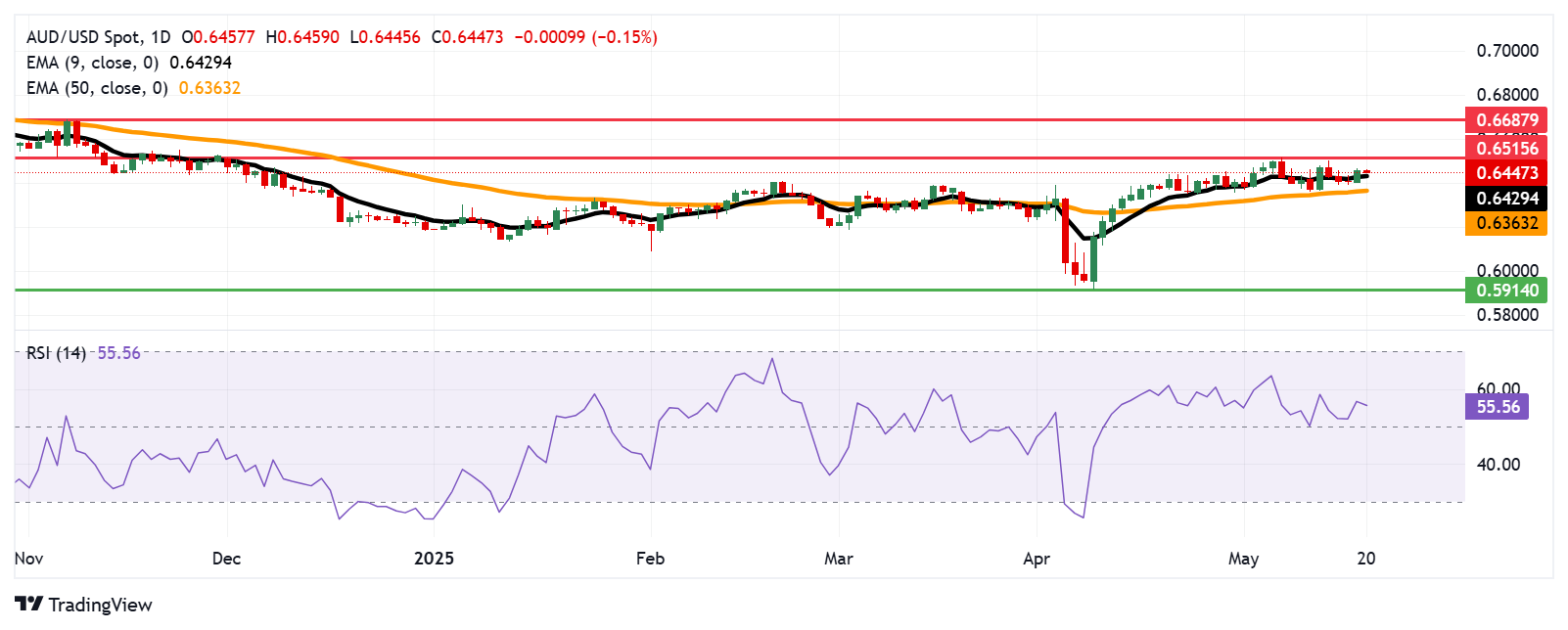
Australian Dollar hovers around 0.6450, support appears at nine-day EMA
AUD/USD is trading near 0.6450 on Tuesday, with technical indicators on the daily chart pointing to a bullish bias. The pair remains above the nine-day Exponential Moving Average (EMA), while the 14-day Relative Strength Index (RSI) holds above the 50 mark, suggesting continued upward momentum.
On the upside, immediate resistance is located at the six-month high of 0.6515, posted on December 2, 2024. A sustained break above this level could open the door to the seven-month high of 0.6687 from November 2024.
Support is initially seen at the nine-day EMA of 0.6429, followed by the 50-day EMA around 0.6363. A clear drop below these levels would likely weaken the short- to medium-term outlook, potentially triggering a deeper decline toward the March 2020 low of 0.5914.
(This story was corrected on May 20 at 09:40 GMT to remove a paragraph that explained RBA's interest-rate decision as a preview.)
AUD/USD: Daily Chart
Australian Dollar PRICE Today
The table below shows the percentage change of Australian Dollar (AUD) against listed major currencies today. Australian Dollar was the weakest against the Japanese Yen.
| USD | EUR | GBP | JPY | CAD | AUD | NZD | CHF | |
|---|---|---|---|---|---|---|---|---|
| USD | -0.07% | -0.07% | -0.27% | 0.08% | 0.72% | 0.24% | -0.17% | |
| EUR | 0.07% | 0.01% | -0.20% | 0.16% | 0.80% | 0.33% | -0.10% | |
| GBP | 0.07% | -0.01% | -0.23% | 0.15% | 0.76% | 0.34% | -0.06% | |
| JPY | 0.27% | 0.20% | 0.23% | 0.36% | 0.99% | 0.51% | 0.16% | |
| CAD | -0.08% | -0.16% | -0.15% | -0.36% | 0.64% | 0.16% | -0.22% | |
| AUD | -0.72% | -0.80% | -0.76% | -0.99% | -0.64% | -0.47% | -0.84% | |
| NZD | -0.24% | -0.33% | -0.34% | -0.51% | -0.16% | 0.47% | -0.38% | |
| CHF | 0.17% | 0.10% | 0.06% | -0.16% | 0.22% | 0.84% | 0.38% |
The heat map shows percentage changes of major currencies against each other. The base currency is picked from the left column, while the quote currency is picked from the top row. For example, if you pick the Australian Dollar from the left column and move along the horizontal line to the US Dollar, the percentage change displayed in the box will represent AUD (base)/USD (quote).
Author

Akhtar Faruqui
FXStreet
Akhtar Faruqui is a Forex Analyst based in New Delhi, India. With a keen eye for market trends and a passion for dissecting complex financial dynamics, he is dedicated to delivering accurate and insightful Forex news and analysis.














