Australian Dollar loses gains despite RBA's cautious outlook
- The Australian Dollar lost its daily gains despite RBA Bullock's cautious remarks.
- RBA Governor Bullock noted that while second-quarter inflation was slightly above expectations, it is trending in the right direction.
- The US Dollar remains weaker after a four-day winning streak amid the ongoing government shutdown.

The Australian Dollar (AUD) offers its intraday gains against the US Dollar (USD) on Friday. The AUD/USD pair gained ground following the cautious remarks from the Reserve Bank of Australia (RBA) Governor Michele Bullock.
RBA Governor Bullock stated on Friday that services inflation remains somewhat sticky. Bullock noted that second-quarter inflation came in slightly above expectations but is moving in the right direction. She emphasized the need for caution, given the volatility of the monthly CPI data, and added that the labor market remains somewhat tight but may be nearing balance.
Australia’s Consumer Inflation Expectations for October rose to 4.8% from 4.7% prior, marking the highest reading since June. The mounting concerns that Australia’s inflation may exceed forecasts in the third quarter support the cautious stance surrounding the Reserve Bank of Australia. Traders expect Australia’s central bank to maintain its interest rates after deciding to keep its Official Cash Rate (OCR) unchanged at 3.6% in September.
Australian Dollar declines despite a weaker US Dollar
- The US Dollar Index (DXY), which measures the value of the US Dollar against six major currencies, is holding losses after a four-day winning streak and trading around 99.30 at the time of writing. The US Senate remained deadlocked on legislation to end the government shutdown on Friday.
- The Federal Open Market Committee (FOMC) Minutes from the September meeting suggested policymakers are leaning toward further rate cuts this year. The majority of policymakers supported the September rate cut and signaled further reduction later this year. However, some members favored a more cautious approach, citing concerns about inflation.
- The CME FedWatch Tool suggests that markets are now pricing in a 95% chance of a Fed rate cut in October and an 82% possibility of another reduction in December.
- Federal Reserve (Fed) Board of Governors member Stephen Miran expressed his belief on Tuesday that inflation itself is simply a cause of "population increases". Monetary policy needs to ease to get ahead of the shift down in the neutral rate, Miran added.
- Minneapolis Fed President Neel Kashkari struck a more reserved tone than some of his Fed counterparts on Tuesday, cautioning that it's still too soon to be able to tell if tariff-led inflation will be "sticky" or not. However, Kashkari noted that he's particularly bullish on the labor market and is expecting a return to form for American job creation, which has sputtered recently.
- Kansas City Fed President Jeffrey Schmid delivered hawkish remarks on Monday, saying that the Fed must maintain its inflation credibility and stressed that inflation is too high. Schmid added that monetary policy is appropriately calibrated.
- China's Commerce Ministry announced on Thursday that the country will tighten rules on rare earth exports, effective December 1. Foreign businesses and individuals must obtain a dual-use items export license for rare earth exports.
- Private house approvals in Australia declined by 2.6% month-over-month (MoM) to 9,027 units in August, as expected, and reversing a 1.3% rise in the previous month. Meanwhile, the seasonally adjusted Building Permits fell by 6% MoM to 14,744 units, following a 10% decrease previously, marking the second consecutive monthly decline.
- University of Melbourne reported on Tuesday that Australia’s Westpac Consumer Confidence declined 3.5% month-over-month (MoM) to 92.1 in October, a sharper decline than the previous 3.1% fall, marking the fastest drop since April. ANZ Job Advertisements slipped 3.3% MoM in September, a much steeper drop than the previous decline of 0.3%.
- TD-MI Inflation Gauge showed a 0.4% increase month-over-month in September, rebounding from a 0.3% fall in the prior month. Meanwhile, the annual inflation gauge rose 3%, following a 2.8% increase in the previous period.
Australian Dollar rebounds toward nine-day EMA within ascending channel
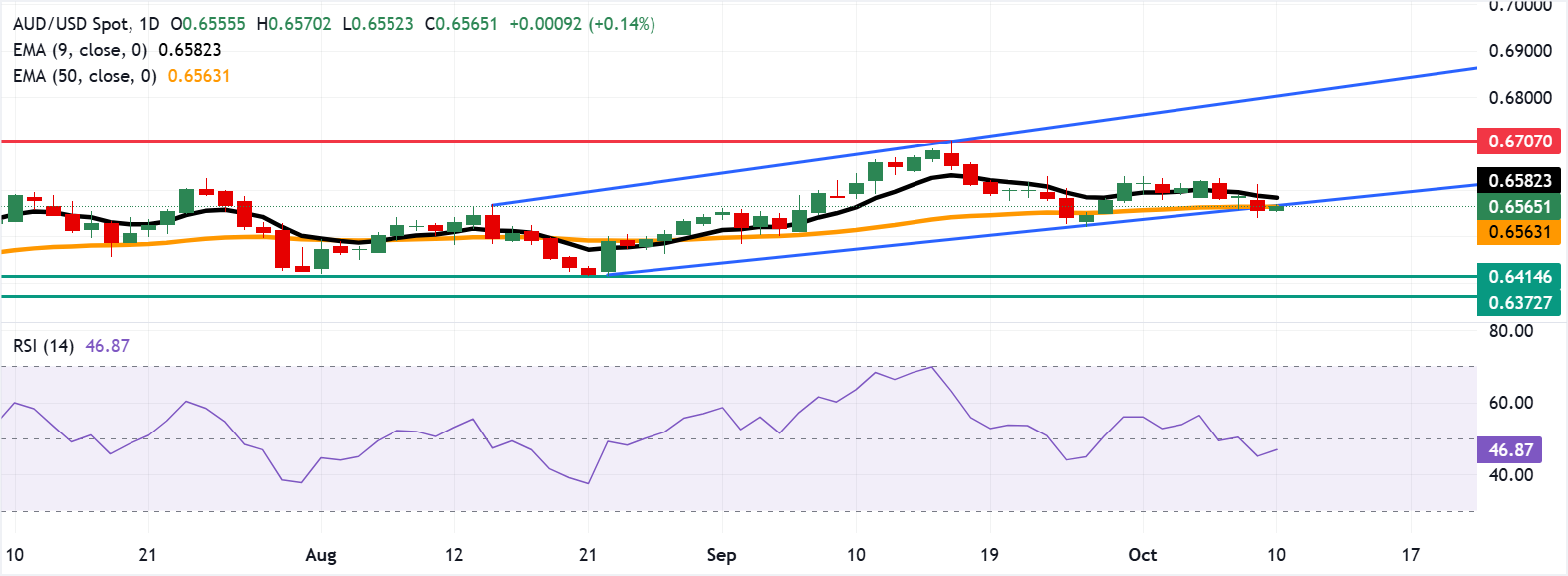
The AUD/USD pair is trading around 0.6570 on Friday. Technical analysis on the daily timeframe suggests that the pair is rebounding toward the ascending channel, indicating a revival of a bullish bias. However, the 14-day Relative Strength Index (RSI) remains below the 50 level, suggesting a bearish bias is in play.
On the downside, the AUD/USD pair is testing the immediate support at the 50-day Exponential Moving Average (EMA) of 0.6563. A break below this level would dampen the medium-term price momentum, which may prompt the pair to navigate the region around the four-month low of 0.6414, recorded on August 21, followed by the five-month low of 0.6372.
A return to the ascending channel would revive the bullish bias and lead the AUD/USD pair to target the initial barrier at the nine-day EMA of 0.6582. Further advances above this level would improve the short-term price momentum and lead the AUD/USD pair to explore the region around the 12-month high of 0.6707, recorded on September 17, followed by the channel’s upper boundary around 0.6810.
AUD/USD: Daily Chart
Australian Dollar Price Today
The table below shows the percentage change of Australian Dollar (AUD) against listed major currencies today. Australian Dollar was the weakest against the Japanese Yen.
| USD | EUR | GBP | JPY | CAD | AUD | NZD | CHF | |
|---|---|---|---|---|---|---|---|---|
| USD | -0.09% | -0.01% | -0.18% | 0.03% | 0.01% | 0.18% | -0.20% | |
| EUR | 0.09% | 0.11% | -0.18% | 0.10% | 0.14% | 0.04% | -0.02% | |
| GBP | 0.00% | -0.11% | -0.26% | -0.04% | 0.03% | 0.14% | -0.18% | |
| JPY | 0.18% | 0.18% | 0.26% | 0.31% | 0.26% | 0.37% | 0.09% | |
| CAD | -0.03% | -0.10% | 0.04% | -0.31% | -0.06% | 0.13% | -0.14% | |
| AUD | -0.01% | -0.14% | -0.03% | -0.26% | 0.06% | 0.13% | -0.21% | |
| NZD | -0.18% | -0.04% | -0.14% | -0.37% | -0.13% | -0.13% | -0.34% | |
| CHF | 0.20% | 0.02% | 0.18% | -0.09% | 0.14% | 0.21% | 0.34% |
The heat map shows percentage changes of major currencies against each other. The base currency is picked from the left column, while the quote currency is picked from the top row. For example, if you pick the Australian Dollar from the left column and move along the horizontal line to the US Dollar, the percentage change displayed in the box will represent AUD (base)/USD (quote).
Australian Dollar FAQs
One of the most significant factors for the Australian Dollar (AUD) is the level of interest rates set by the Reserve Bank of Australia (RBA). Because Australia is a resource-rich country another key driver is the price of its biggest export, Iron Ore. The health of the Chinese economy, its largest trading partner, is a factor, as well as inflation in Australia, its growth rate and Trade Balance. Market sentiment – whether investors are taking on more risky assets (risk-on) or seeking safe-havens (risk-off) – is also a factor, with risk-on positive for AUD.
The Reserve Bank of Australia (RBA) influences the Australian Dollar (AUD) by setting the level of interest rates that Australian banks can lend to each other. This influences the level of interest rates in the economy as a whole. The main goal of the RBA is to maintain a stable inflation rate of 2-3% by adjusting interest rates up or down. Relatively high interest rates compared to other major central banks support the AUD, and the opposite for relatively low. The RBA can also use quantitative easing and tightening to influence credit conditions, with the former AUD-negative and the latter AUD-positive.
China is Australia’s largest trading partner so the health of the Chinese economy is a major influence on the value of the Australian Dollar (AUD). When the Chinese economy is doing well it purchases more raw materials, goods and services from Australia, lifting demand for the AUD, and pushing up its value. The opposite is the case when the Chinese economy is not growing as fast as expected. Positive or negative surprises in Chinese growth data, therefore, often have a direct impact on the Australian Dollar and its pairs.
Iron Ore is Australia’s largest export, accounting for $118 billion a year according to data from 2021, with China as its primary destination. The price of Iron Ore, therefore, can be a driver of the Australian Dollar. Generally, if the price of Iron Ore rises, AUD also goes up, as aggregate demand for the currency increases. The opposite is the case if the price of Iron Ore falls. Higher Iron Ore prices also tend to result in a greater likelihood of a positive Trade Balance for Australia, which is also positive of the AUD.
The Trade Balance, which is the difference between what a country earns from its exports versus what it pays for its imports, is another factor that can influence the value of the Australian Dollar. If Australia produces highly sought after exports, then its currency will gain in value purely from the surplus demand created from foreign buyers seeking to purchase its exports versus what it spends to purchase imports. Therefore, a positive net Trade Balance strengthens the AUD, with the opposite effect if the Trade Balance is negative.
Author

Akhtar Faruqui
FXStreet
Akhtar Faruqui is a Forex Analyst based in New Delhi, India. With a keen eye for market trends and a passion for dissecting complex financial dynamics, he is dedicated to delivering accurate and insightful Forex news and analysis.

















