Australian Dollar consolidates post snapping a winning streak, US NFP eyed
- Australian Dollar experiences downward pressure due to the rebound in the US Dollar.
- Australia's FSR report stated that Australian banks remain well-positioned despite elevated global and domestic risks.
- Investors await the US NFP report, seeking confirmation of a tight labor market.

The Australian Dollar (AUD) snaps a two-day winning streak against the US Dollar (USD) on Friday. The Aussie pair gained support from the correction in the US Dollar (USD) following a decline in US Treasury yields.
Australia’s report for October 2023, Financial Stability Review (FSR) from the Reserve Bank of Australia (RBA) indicates elevated global financial stability risks due to challenging macroeconomic conditions.
The rise in inflation and interest rates since 2021 has strained household and business finances not only in Australia but also globally. Prolonged high levels of inflation and interest rates pose a risk of significant credit quality deterioration, potentially leading lenders to reduce credit provision.
However, the report mentioned that Australian banks remain well-positioned to continue supplying credit to the economy despite elevated global and domestic risks.
Moreover, a November meeting between President Biden and Chinese leader Xi Jinping in San Francisco is in the works, signaling an effort to stabilize relations between the world's top two economies.
This potential summit follows their last meeting in Bali, Indonesia, in November last year, where both leaders stressed the importance of face-to-face diplomacy and expressed hope for the reconstruction of US-China relations.
The US Dollar Index (DXY) retraces the two-day losing streak. The index continued to correct from an 11-month high due to a decline in the US Treasury yields. However, the unemployment data on Thursday showed a tight labor market in the United States (US). The upcoming US Nonfarm Payrolls and Average Hourly Earnings will be eyed on Friday for further confirmation.
Daily Digest Market Movers: Australian Dollar trades lower due to the rebound in US Dollar
- RBA’s FSR report affirms that Australian banks are in a robust position to maintain credit supply to the economy, even amid heightened global and domestic risks.
- Australia's Trade Balance (MoM) showed improvement in August, reaching 9,640 million, surpassing market expectations of 8,725 million. July's reading stood at 8,039 million.
- Australia’s central bank could go for a rate hike, with expectations pointing toward a peak of 4.35% by the end of the year. This projection aligns with the persistent elevation of inflation above the target.
- Michele Bullock, the newly appointed governor of the RBA, in her inaugural monetary policy statement following the interest rate decision, emphasized the need for additional tightening of monetary policy.
- Bullock noted that recent data align with the return of inflation to the target range. While inflation in Australia has peaked, it remains elevated and is expected to persist for a while.
- US Initial Jobless Claims for the week ending September 29, increased to 207K from the previous reading of 205K, beating the market expectation of 210K. This suggests that labor market conditions continue to be tight.
- US Challenger Job Cuts have come down significantly from the previous figure of 75.151K to 47.457K in September.
- The 10-year US Treasury yield stands above 4.70%, close to the highest level since 2007.
- Traders await the upcoming US Nonfarm Payrolls and Average Hourly Earnings on Friday. Upbeat numbers could trigger more USD gains and increase volatility in the bond market.
Technical Analysis: Australian Dollar holds ground above 0.6350, 21-day EMA emerges as the immediate barrier
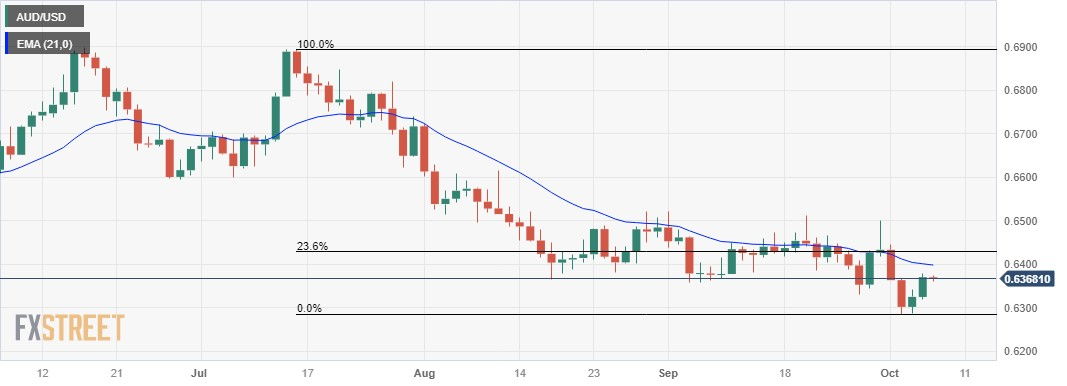
Australian Dollar hovers around 0.6360 against the US Dollar on Friday. The 21-day Exponential Moving Average (EMA) appears to be a key barrier lined up with the 0.6400 psychological level. A firm break above the latter could open the doors for the pair to explore levels around the 23.6% Fibonacci retracement at 0.6429 level. On the downside, the major level at 0.6300 emerges as the immediate support, followed by November's low at 0.6272.
AUD/USD: Daily Chart
Australian Dollar price today
The table below shows the percentage change of Australian Dollar (AUD) against listed major currencies today. Australian Dollar was the weakest against the Pound Sterling.
| USD | EUR | GBP | CAD | AUD | JPY | NZD | CHF | |
| USD | -0.02% | -0.10% | -0.01% | 0.09% | 0.28% | 0.05% | -0.02% | |
| EUR | 0.02% | -0.09% | 0.01% | 0.10% | 0.30% | 0.07% | 0.00% | |
| GBP | 0.09% | 0.09% | 0.10% | 0.21% | 0.37% | 0.17% | 0.09% | |
| CAD | 0.02% | -0.01% | -0.09% | 0.09% | 0.29% | 0.06% | 0.00% | |
| AUD | -0.10% | -0.11% | -0.20% | -0.11% | 0.18% | -0.02% | -0.11% | |
| JPY | -0.28% | -0.30% | -0.36% | -0.29% | -0.19% | -0.24% | -0.28% | |
| NZD | -0.05% | -0.07% | -0.16% | -0.06% | 0.03% | 0.23% | -0.08% | |
| CHF | 0.02% | 0.02% | -0.09% | 0.05% | 0.10% | 0.28% | 0.07% |
The heat map shows percentage changes of major currencies against each other. The base currency is picked from the left column, while the quote currency is picked from the top row. For example, if you pick the Euro from the left column and move along the horizontal line to the Japanese Yen, the percentage change displayed in the box will represent EUR (base)/JPY (quote).
Economic Indicator
United States Nonfarm Payrolls
The Nonfarm Payrolls released by the US Bureau of Labor Statistics presents the number of new jobs created during the previous month in all non-agricultural businesses. The monthly changes in payrolls can be extremely volatile due to their high relation with economic policy decisions made by the Federal Reserve. The number is also subject to strong reviews in the upcoming months, and those reviews also tend to trigger volatility in the Forex board. Generally speaking, a high reading is seen as positive (or bullish) for the USD, while a low reading is seen as negative (or bearish), although previous months' reviews and the unemployment rate are as relevant as the headline figure, and therefore market's reaction depends on how the market assets them all.
Read more.Why it matters to traders
America’s monthly jobs report is considered the most important economic indicator for forex traders. Released on the first Friday following the reported month, the change in the number of positions is closely correlated with the overall performance of the economy and is monitored by policymakers. Full employment is one of the Federal Reserve’s mandates and it considers developments in the labor market when setting its policies, thus impacting currencies. Despite several leading indicators shaping estimates, Nonfarm Payrolls tend to surprise markets and trigger substantial volatility. Actual figures beating the consensus tend to be USD bullish.
Author

Akhtar Faruqui
FXStreet
Akhtar Faruqui is a Forex Analyst based in New Delhi, India. With a keen eye for market trends and a passion for dissecting complex financial dynamics, he is dedicated to delivering accurate and insightful Forex news and analysis.
















