Australian Dollar struggles due to dovish mood surrounding RBA policy
- The Australian Dollar faces challenges as the RBA may deliver a 25 basis point rate cut on Tuesday.
- China’s Consumer Price Index came at 0% YoY in July, against the market consensus of -0.1%.
- The softening in US economic data has led traders to factor in the possibility of two rate cuts this year.

The Australian Dollar (AUD) remains subdued against the US Dollar (USD) on Monday due to market caution ahead of the interest rate decision by the Reserve Bank of Australia due on Tuesday. The AUD/USD pair may face challenges as traders are pricing in that the RBA will deliver a 25 basis point (bps) rate cut, bringing its Official Cash Rate (OCR) to 3.6% from 3.85% at its August meeting.
The RBA is widely anticipated to reduce interest rates as core inflation eased to 2.7% in June, well within the RBA’s 2–3% target, along with rising unemployment and slowing wage growth. However, the Australian central bank adopted a cautious stance in July, pointing to a more balanced view of inflation risks and ongoing labor market strength.
Uncertainty surrounding the RBA decision persists, however, after Governor Michele Bullock stated following the July decision that the central bank would no longer offer forward guidance, stressing that decisions lie solely with the board and cannot be predicted before meetings.
The AUD could also face challenges due to persisting deflation in China, Australia’s close trading partner. The National Bureau of Statistics of China reported on Saturday that China’s Consumer Price Index (CPI) year-over-year was unchanged in July following a 0.1% increase in June. The figure came in above the market consensus of -0.1%. Meanwhile, the Producer Price Index (PPI) declined 3.6% YoY, against the expected decline of 3.3% and the previous 3.6% decline.
Australian Dollar steadies as US Dollar weakens ahead of upcoming CPI data
- The US Dollar Index (DXY), which measures the value of the US Dollar against six major currencies, is retracing its recent gains and trading around 98.10 at the time of writing. The Greenback struggles following the soft US economic data, which prompted traders to price in the possibility of more interest rate cuts this year. Traders will likely await the upcoming US consumer inflation figures due to be published on Tuesday.
- Markets are now pricing in approximately 89% odds of a Fed rate cut at the September meeting, up from 80% a week ago, according to the CME FedWatch tool.
- Fed Governor Michelle Bowman stated on Saturday that three interest rate cuts are likely to be appropriate this year. Bowman added that the apparent weakening in the labor market outweighs the risks of higher inflation to come.
- US President Donald Trump has nominated Stephen Miran, chair of the Council of Economic Advisors, to succeed Adriana Kugler on the Federal Reserve Board of Governors. Traders will also keep their eyes on Trump’s plans to replace Fed Chair Powell. Fed Governor Christopher Waller is emerging as a top candidate to serve as the central bank’s chair among Trump’s advisers, per Bloomberg.
- Federal Reserve Bank of San Francisco President Mary Daly said last week that the Fed still has some ground to cover on its fight with inflation pressures despite overall progress. Daly highlighted that the Fed may be forced to act soon without having the full picture.
- Boston Fed President Susan Collins and Fed Board of Governors member Lisa Cook cautioned that persistent uncertainty remains a major obstacle to effective policy transmission and challenges the central bank’s ability to manage interest rates efficiently.
- According to Reuters, President Trump warned China that he could impose further tariffs similar to the 25% levies announced earlier on India over its Russian Oil purchases, depending on future developments.
Australian Dollar hovers above nine-day EMA, near 0.6500
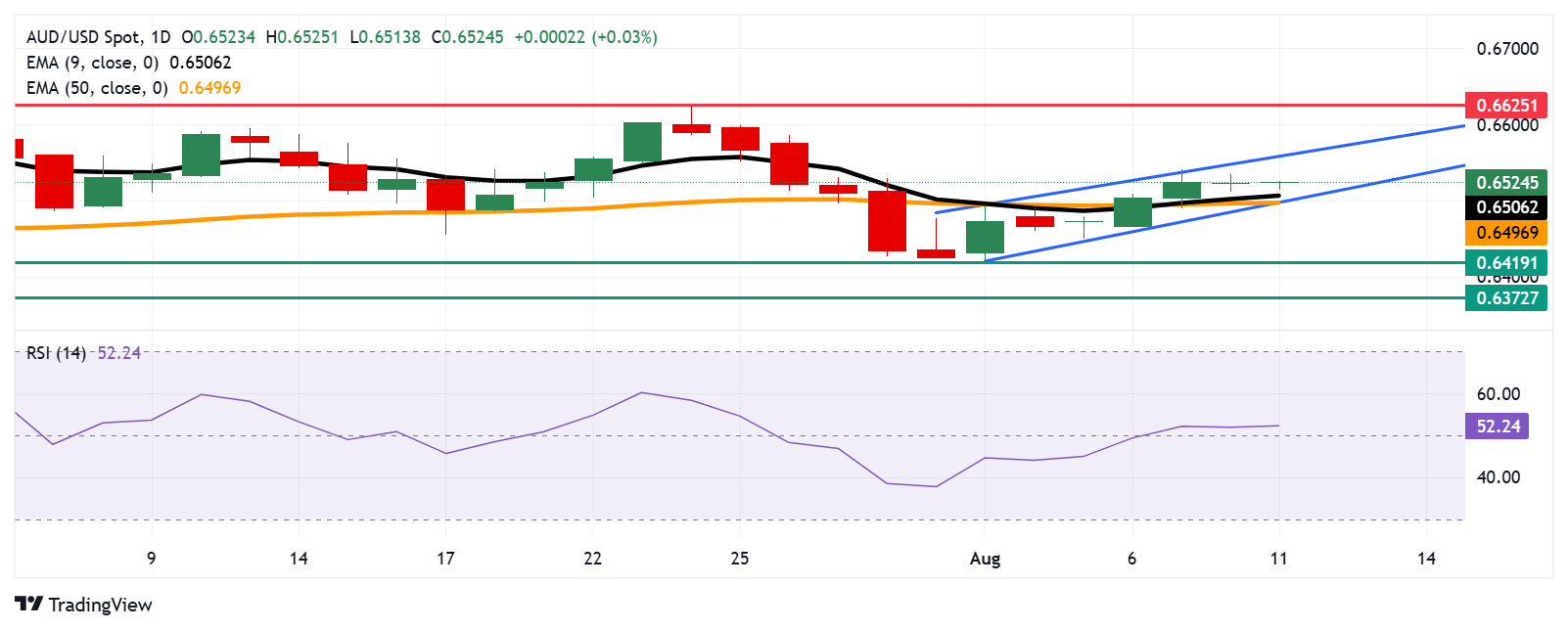
The AUD/USD pair is trading around 0.6520 on Monday. Technical analysis on the daily chart suggests a bullish market sentiment as the pair moves upwards within an ascending channel pattern. Additionally, the 14-day Relative Strength Index (RSI) is positioned above the 50 level, strengthening the bullish bias. The pair also remains above the nine-day Exponential Moving Average (EMA), signaling that short-term momentum is stronger.
On the upside, the AUD/USD pair could target the upper boundary of the ascending channel around 0.6560. A successful breach above this level could strengthen the bullish bias and support the pair to explore the area around the psychological level of 0.6600, followed by the nine-month high at 0.6625, which was recorded on July 24.
The AUD/USD pair may find its immediate support at the nine-day EMA at 0.6506, aligned with the 50-day EMA at 0.6496. A break below these levels would weaken the short- and medium-term price momentum and put downward pressure on the pair to test the two-month low of 0.6419, which was recorded on August 1, followed by a three-month low at 0.6372, recorded on June 23.
AUD/USD: Daily Chart
Australian Dollar PRICE Today
The table below shows the percentage change of Australian Dollar (AUD) against listed major currencies today. Australian Dollar was the strongest against the New Zealand Dollar.
| USD | EUR | GBP | JPY | CAD | AUD | NZD | CHF | |
|---|---|---|---|---|---|---|---|---|
| USD | -0.08% | -0.07% | 0.06% | 0.12% | 0.11% | 0.30% | -0.14% | |
| EUR | 0.08% | 0.00% | 0.15% | 0.21% | 0.20% | 0.34% | -0.06% | |
| GBP | 0.07% | -0.01% | 0.10% | 0.21% | 0.20% | 0.33% | -0.06% | |
| JPY | -0.06% | -0.15% | -0.10% | 0.10% | 0.09% | 0.31% | -0.06% | |
| CAD | -0.12% | -0.21% | -0.21% | -0.10% | 0.00% | 0.13% | -0.29% | |
| AUD | -0.11% | -0.20% | -0.20% | -0.09% | 0.00% | 0.14% | -0.26% | |
| NZD | -0.30% | -0.34% | -0.33% | -0.31% | -0.13% | -0.14% | -0.39% | |
| CHF | 0.14% | 0.06% | 0.06% | 0.06% | 0.29% | 0.26% | 0.39% |
The heat map shows percentage changes of major currencies against each other. The base currency is picked from the left column, while the quote currency is picked from the top row. For example, if you pick the Australian Dollar from the left column and move along the horizontal line to the US Dollar, the percentage change displayed in the box will represent AUD (base)/USD (quote).
Australian Dollar FAQs
One of the most significant factors for the Australian Dollar (AUD) is the level of interest rates set by the Reserve Bank of Australia (RBA). Because Australia is a resource-rich country another key driver is the price of its biggest export, Iron Ore. The health of the Chinese economy, its largest trading partner, is a factor, as well as inflation in Australia, its growth rate and Trade Balance. Market sentiment – whether investors are taking on more risky assets (risk-on) or seeking safe-havens (risk-off) – is also a factor, with risk-on positive for AUD.
The Reserve Bank of Australia (RBA) influences the Australian Dollar (AUD) by setting the level of interest rates that Australian banks can lend to each other. This influences the level of interest rates in the economy as a whole. The main goal of the RBA is to maintain a stable inflation rate of 2-3% by adjusting interest rates up or down. Relatively high interest rates compared to other major central banks support the AUD, and the opposite for relatively low. The RBA can also use quantitative easing and tightening to influence credit conditions, with the former AUD-negative and the latter AUD-positive.
China is Australia’s largest trading partner so the health of the Chinese economy is a major influence on the value of the Australian Dollar (AUD). When the Chinese economy is doing well it purchases more raw materials, goods and services from Australia, lifting demand for the AUD, and pushing up its value. The opposite is the case when the Chinese economy is not growing as fast as expected. Positive or negative surprises in Chinese growth data, therefore, often have a direct impact on the Australian Dollar and its pairs.
Iron Ore is Australia’s largest export, accounting for $118 billion a year according to data from 2021, with China as its primary destination. The price of Iron Ore, therefore, can be a driver of the Australian Dollar. Generally, if the price of Iron Ore rises, AUD also goes up, as aggregate demand for the currency increases. The opposite is the case if the price of Iron Ore falls. Higher Iron Ore prices also tend to result in a greater likelihood of a positive Trade Balance for Australia, which is also positive of the AUD.
The Trade Balance, which is the difference between what a country earns from its exports versus what it pays for its imports, is another factor that can influence the value of the Australian Dollar. If Australia produces highly sought after exports, then its currency will gain in value purely from the surplus demand created from foreign buyers seeking to purchase its exports versus what it spends to purchase imports. Therefore, a positive net Trade Balance strengthens the AUD, with the opposite effect if the Trade Balance is negative.
Author

Akhtar Faruqui
FXStreet
Akhtar Faruqui is a Forex Analyst based in New Delhi, India. With a keen eye for market trends and a passion for dissecting complex financial dynamics, he is dedicated to delivering accurate and insightful Forex news and analysis.