Australian Dollar remains subdued due to increased risk aversion amid cautious Fed
- The Australian Dollar holds losses as the US Dollar appreciates due Fed's caution regarding its rate cuts.
- Australia's total new capital expenditure unexpectedly increased by 1.1% QoQ in Q3, exceeding the expected 0.9% increase.
- The AUD/USD pair struggles as the US is set to introduce further AI chip sanctions against China on Monday.

The Australian Dollar (AUD) remains subdued against the US Dollar (USD) despite the stronger-than-expected Private Capital Expenditure released on Thursday. Australia's total new capital expenditure rose by 1.1% quarter-on-quarter in the third quarter, surpassing market expectations of a 0.9% increase and rebounding from a 2.2% decline in the previous quarter. Markets may witness reduced trading activity due to the US Thanksgiving holiday.
The AUD/USD pair may face downward pressure as the United States (US) is set to unveil additional measures on Monday aimed at curbing China’s ability to advance in artificial intelligence technology. Given the close trade ties between Australia and China, any significant shifts in China’s economy are likely to ripple through Australian markets.
Additionally, the Australian Dollar faced challenges due to dampened market sentiment following President-elect Donald Trump's announcement of a 10% increase in tariffs on all Chinese goods entering the United States.
The downside of the AUD was restrained due to the Reserve Bank of Australia's (RBA) hawkish outlook on future interest rate decisions. Australia's monthly Consumer Price Index (CPI) rose by 2.1% year-over-year in October, unchanged from the previous month but below market expectations of 2.3%. This marked the lowest inflation rate since July 2021 and remained within the central bank's target range of 2-3% for the third consecutive month.
Australian Dollar receives downward pressure due to increased risk aversion
- The US Dollar gains ground as the Federal Reserve (Fed) is likely to remain cautious about cutting interest rates following Wednesday's robust inflation data. The report indicated solid growth in consumer spending for October, but it also highlighted a stagnation in progress toward lowering inflation, keeping the Fed on alert.
- The US Personal Consumption Expenditures (PCE) Price Index increased by 2.3% year-over-year in October, up from 2.1% in September. Meanwhile, the core PCE Price Index, which excludes volatile food and energy prices, rose by 2.8%, slightly higher than the 2.7% recorded the previous month. Both figures aligned with market expectations, indicating steady inflationary pressure within the economy.
- The latest Federal Open Market Committee's (FOMC) Meeting Minutes for the policy meeting held on November 7, indicated that policymakers are adopting a cautious stance on cutting interest rates, citing easing inflation and a robust labor market.
- US President-elect Donald Trump is expected to appoint Jamieson Greer as the US Trade Representative, Bloomberg reported on Tuesday. Greer’s nomination highlights the central role of tariffs in Trump’s economic strategy.
- Chicago Fed President Austan Goolsbee indicated on Tuesday that the Fed will likely continue lowering interest rates toward a neutral stance that neither stimulates nor restricts economic activity. Meanwhile, Minneapolis Fed President Neel Kashkari highlighted that it remains appropriate to consider another rate cut at the Fed’s December meeting, according to Bloomberg.
- The recent preliminary S&P Global US Purchasing Managers’ Index (PMI) data have reinforced expectations that the Federal Reserve (Fed) may slow the pace of rate cuts. Futures traders are now assigning a 57.7% probability to the Federal Reserve cutting rates by a quarter point in December, according to the CME FedWatch Tool.
- Australia's four largest banks predicted the Reserve Bank of Australia's first rate cut. Westpac has revised its forecast for the first cut to May, up from February. National Australia Bank (NAB) also expects the cut in May. Meanwhile, the Commonwealth Bank of Australia (CBA) and ANZ are cautiously forecasting a rate cut in February.
Technical Analysis: Australian Dollar tests nine-day EMA near 0.6500
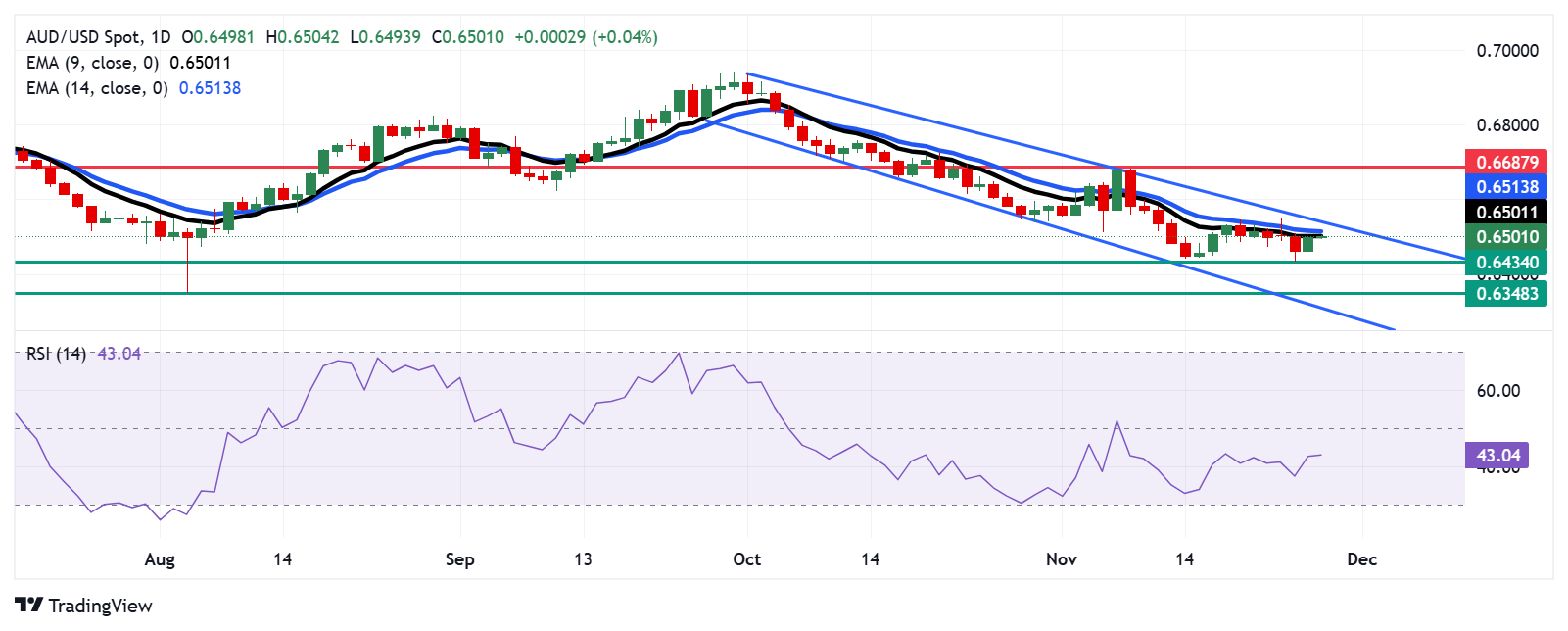
AUD/USD trades near 0.6500 on Thursday, with technical analysis indicating growing short-term bearish momentum. The pair remains within a descending channel, while the 14-day Relative Strength Index (RSI) stays below 50, reflecting sustained negative sentiment.
On the downside, the AUD/USD pair could retest its four-month low of 0.6434, recorded on November 26. A break below this level could expose the yearly low of 0.6348, last seen on August 5, with further support near the descending channel’s lower boundary around 0.6310.
Conversely, the immediate resistance is at the nine-day Exponential Moving Average (EMA) of 0.6501, followed by the 14-day EMA at 0.6513. Additional resistance is seen at the channel's upper boundary near 0.6540. A decisive break above these levels could pave the way for a move toward the four-week high of 0.6687.
AUD/USD: Daily Chart
Australian Dollar PRICE Today
The table below shows the percentage change of Australian Dollar (AUD) against listed major currencies today. Australian Dollar was the weakest against the Canadian Dollar.
| USD | EUR | GBP | JPY | CAD | AUD | NZD | CHF | |
|---|---|---|---|---|---|---|---|---|
| USD | 0.08% | 0.09% | 0.33% | -0.01% | 0.14% | 0.08% | 0.15% | |
| EUR | -0.08% | 0.01% | 0.26% | -0.09% | 0.06% | -0.01% | 0.06% | |
| GBP | -0.09% | -0.01% | 0.23% | -0.10% | 0.04% | -0.02% | 0.05% | |
| JPY | -0.33% | -0.26% | -0.23% | -0.35% | -0.19% | -0.29% | -0.19% | |
| CAD | 0.01% | 0.09% | 0.10% | 0.35% | 0.16% | 0.08% | 0.16% | |
| AUD | -0.14% | -0.06% | -0.04% | 0.19% | -0.16% | -0.07% | 0.00% | |
| NZD | -0.08% | 0.00% | 0.02% | 0.29% | -0.08% | 0.07% | 0.07% | |
| CHF | -0.15% | -0.06% | -0.05% | 0.19% | -0.16% | -0.01% | -0.07% |
The heat map shows percentage changes of major currencies against each other. The base currency is picked from the left column, while the quote currency is picked from the top row. For example, if you pick the Australian Dollar from the left column and move along the horizontal line to the US Dollar, the percentage change displayed in the box will represent AUD (base)/USD (quote).
Fed FAQs
Monetary policy in the US is shaped by the Federal Reserve (Fed). The Fed has two mandates: to achieve price stability and foster full employment. Its primary tool to achieve these goals is by adjusting interest rates. When prices are rising too quickly and inflation is above the Fed’s 2% target, it raises interest rates, increasing borrowing costs throughout the economy. This results in a stronger US Dollar (USD) as it makes the US a more attractive place for international investors to park their money. When inflation falls below 2% or the Unemployment Rate is too high, the Fed may lower interest rates to encourage borrowing, which weighs on the Greenback.
The Federal Reserve (Fed) holds eight policy meetings a year, where the Federal Open Market Committee (FOMC) assesses economic conditions and makes monetary policy decisions. The FOMC is attended by twelve Fed officials – the seven members of the Board of Governors, the president of the Federal Reserve Bank of New York, and four of the remaining eleven regional Reserve Bank presidents, who serve one-year terms on a rotating basis.
In extreme situations, the Federal Reserve may resort to a policy named Quantitative Easing (QE). QE is the process by which the Fed substantially increases the flow of credit in a stuck financial system. It is a non-standard policy measure used during crises or when inflation is extremely low. It was the Fed’s weapon of choice during the Great Financial Crisis in 2008. It involves the Fed printing more Dollars and using them to buy high grade bonds from financial institutions. QE usually weakens the US Dollar.
Quantitative tightening (QT) is the reverse process of QE, whereby the Federal Reserve stops buying bonds from financial institutions and does not reinvest the principal from the bonds it holds maturing, to purchase new bonds. It is usually positive for the value of the US Dollar.
Author

Akhtar Faruqui
FXStreet
Akhtar Faruqui is a Forex Analyst based in New Delhi, India. With a keen eye for market trends and a passion for dissecting complex financial dynamics, he is dedicated to delivering accurate and insightful Forex news and analysis.

















