Australian Dollar declines despite cautious RBA policy stance
- Australian Dollar dips despite a 12.8% surge in Westpac Consumer Confidence for November.
- The AUD could regain its ground amid a cautious RBA policy outlook.
- The US Dollar recovers on increasing hopes of the government shutdown ending.

The Australian Dollar (AUD) loses ground against the US Dollar (USD) on Tuesday after two days of gains. The AUD/USD pair weakened as the US Dollar (USD) received support from growing hopes that the US government shutdown resolution is nearing.
Australia’s Westpac Consumer Confidence jumped 12.8% in November to 103.8, surpassing 100 for the first time since February 2022. The rebound follows a 3.5% decline in October and marks the strongest non-pandemic reading in seven years, driven by improving economic conditions and easing external risks.
National Australia Bank's Business Conditions improved slightly to 9 in October from 8 in September, supported by stronger sales and profitability, while employment remained unchanged. Meanwhile, Business Confidence edged down to 6 in the same month from 7 prior.
AUD received support from cautious comments from Reserve Bank of Australia (RBA) Deputy Governor Andrew Hauser, who highlighted the unusual challenges facing monetary policy and stressed the need to maintain tight conditions to curb inflation. Hauser noted that Australia’s monetary policy is navigating a tricky phase, as the economic recovery began with demand already exceeding potential output, leaving limited room for near-term easing.
US Dollar steadies on growing hopes government shutdown ending
- The US Dollar Index (DXY), which measures the value of the US Dollar (USD) against six major currencies, is gaining ground and trading around 99.70 at the time of writing. The US ADP Employment Change Weekly is due later in the North American session.
- The US Senate passed a funding bill in a 60–40 vote, effectively ending the 41-day shutdown, with eight Democrats joining Republicans to advance the measure, which now moves to the House for approval. House Speaker Mike Johnson said the House plans to vote on the measure this week, but did not specify a date.
- US President Donald Trump, on Monday, backed a bipartisan deal to end the US government shutdown, signaling a likely reopening within days. Senate Majority Leader John Thune said he expects Trump to sign the bill once Congress passes it.
- President Trump issued a premonition that inflation will reach 1.5% "pretty soon", a level of inflation that has evaded the US economy for nearly four years after shooting above that level in February of 2021. 1.5% inflation is also well below the long-run average for US inflation over ten years.
- US Treasury Secretary Scott Bessent said on Monday that the US federal shutdown's impact is getting worse for the economy. Making substantial progress on inflation and expecting prices to come down over the coming months, Bessent added.
- Job losses in October, mainly in the government and retail sectors, and a drop in consumer sentiment to a three-and-a-half-year low in early November have reinforced expectations of policy easing. The CME FedWatch Tool shows markets pricing in a 62% chance of a 25 bps rate cut in December.
- Federal Reserve (Fed) Governor Stephen Miran told CNBC on Monday that inflation is easing and reaffirmed that staying on course with rate cuts is appropriate, suggesting a 50-basis-pointbps reduction in December, or at least 25 bps. Meanwhile, St. Louis Fed President Alberto Musalem noted that inflation remains closer to 3% than the 2% target, adding that policymakers now have sufficient information to guide their decisions.
- China's Ministry of Commerce said that it would temporarily lift its ban on approving exports of “dual-use items” related to gallium, germanium, antimony, and super-hard materials to the US. The suspension takes effect from Sunday until November 27, 2026. Any change in the Chinese economy could impact the AUD as China is a major trading partner for Australia.
- China’s Consumer Price Index (CPI) climbed 0.2% year-over-year in October, recovering after a decline of 0.3% in September. The market consensus was for 0% in the reported period. CPI inflation increased 0.2% MoM in October, against 0.1% prior. Producer Price Index (PPI) dropped 2.1% YoY in October, following a 2.3% fall in September. The data came in above the market consensus of -2.2%.
- Australia’s Trade Surplus widened to 3,938 million month-over-month (MoM) in September, exceeding the 3,850 million expected and 1,111 million (revised from 1,825 million) in the previous reading. Exports rose by 7.9% MoM in September, swinging from a previous decline of 8.7% (revised from -7.8%). Meanwhile, Imports rose by 1.1% MoM, compared to a previous rise of 3.3% (revised from 3.2%).
Australian Dollar pulls back from 50-day EMA
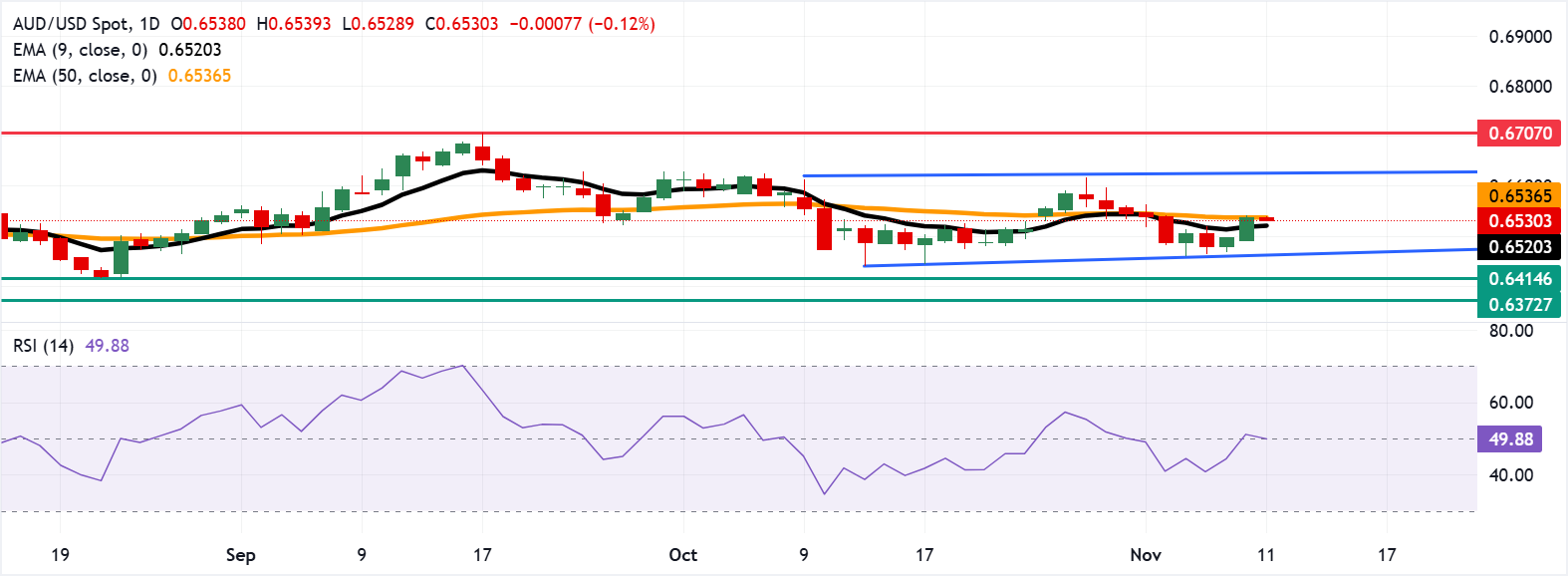
The AUD/USD pair is trading around 0.6530 on Tuesday. Technical analysis of the daily chart shows the pair consolidating within a rectangle pattern, trading sideways. However, the pair remains above the nine-day Exponential Moving Average (EMA), indicating a stronger short-term momentum.
The immediate barrier lies at the 50-day EMA of 0.6536. A break above this level would improve the medium-term price momentum and support the AUD/USD pair to explore the region around the rectangle’s upper boundary, around 0.6630. Further advances would support the pair to approach the 13-month high of 0.6707, recorded on September 17.
On the downside, the AUD/USD pair may find its immediate support at the nine-day EMA of 0.6520, followed by the psychological level of 0.6500. Further support lies at the lower boundary of the rectangle around 0.6470 and the five-month low of 0.6414, which was recorded on August 21.
Australian Dollar Price Today
The table below shows the percentage change of Australian Dollar (AUD) against listed major currencies today. Australian Dollar was the weakest against the Swiss Franc.
| USD | EUR | GBP | JPY | CAD | AUD | NZD | CHF | |
|---|---|---|---|---|---|---|---|---|
| USD | 0.05% | 0.11% | 0.14% | 0.13% | 0.23% | 0.17% | -0.02% | |
| EUR | -0.05% | 0.07% | 0.09% | 0.09% | 0.18% | 0.13% | -0.06% | |
| GBP | -0.11% | -0.07% | 0.04% | 0.03% | 0.10% | 0.06% | -0.13% | |
| JPY | -0.14% | -0.09% | -0.04% | -0.01% | 0.08% | 0.01% | -0.17% | |
| CAD | -0.13% | -0.09% | -0.03% | 0.01% | 0.10% | 0.04% | -0.15% | |
| AUD | -0.23% | -0.18% | -0.10% | -0.08% | -0.10% | -0.06% | -0.29% | |
| NZD | -0.17% | -0.13% | -0.06% | -0.01% | -0.04% | 0.06% | -0.19% | |
| CHF | 0.02% | 0.06% | 0.13% | 0.17% | 0.15% | 0.29% | 0.19% |
The heat map shows percentage changes of major currencies against each other. The base currency is picked from the left column, while the quote currency is picked from the top row. For example, if you pick the Australian Dollar from the left column and move along the horizontal line to the US Dollar, the percentage change displayed in the box will represent AUD (base)/USD (quote).
Australian Dollar FAQs
One of the most significant factors for the Australian Dollar (AUD) is the level of interest rates set by the Reserve Bank of Australia (RBA). Because Australia is a resource-rich country another key driver is the price of its biggest export, Iron Ore. The health of the Chinese economy, its largest trading partner, is a factor, as well as inflation in Australia, its growth rate and Trade Balance. Market sentiment – whether investors are taking on more risky assets (risk-on) or seeking safe-havens (risk-off) – is also a factor, with risk-on positive for AUD.
The Reserve Bank of Australia (RBA) influences the Australian Dollar (AUD) by setting the level of interest rates that Australian banks can lend to each other. This influences the level of interest rates in the economy as a whole. The main goal of the RBA is to maintain a stable inflation rate of 2-3% by adjusting interest rates up or down. Relatively high interest rates compared to other major central banks support the AUD, and the opposite for relatively low. The RBA can also use quantitative easing and tightening to influence credit conditions, with the former AUD-negative and the latter AUD-positive.
China is Australia’s largest trading partner so the health of the Chinese economy is a major influence on the value of the Australian Dollar (AUD). When the Chinese economy is doing well it purchases more raw materials, goods and services from Australia, lifting demand for the AUD, and pushing up its value. The opposite is the case when the Chinese economy is not growing as fast as expected. Positive or negative surprises in Chinese growth data, therefore, often have a direct impact on the Australian Dollar and its pairs.
Iron Ore is Australia’s largest export, accounting for $118 billion a year according to data from 2021, with China as its primary destination. The price of Iron Ore, therefore, can be a driver of the Australian Dollar. Generally, if the price of Iron Ore rises, AUD also goes up, as aggregate demand for the currency increases. The opposite is the case if the price of Iron Ore falls. Higher Iron Ore prices also tend to result in a greater likelihood of a positive Trade Balance for Australia, which is also positive of the AUD.
The Trade Balance, which is the difference between what a country earns from its exports versus what it pays for its imports, is another factor that can influence the value of the Australian Dollar. If Australia produces highly sought after exports, then its currency will gain in value purely from the surplus demand created from foreign buyers seeking to purchase its exports versus what it spends to purchase imports. Therefore, a positive net Trade Balance strengthens the AUD, with the opposite effect if the Trade Balance is negative.
Author

Akhtar Faruqui
FXStreet
Akhtar Faruqui is a Forex Analyst based in New Delhi, India. With a keen eye for market trends and a passion for dissecting complex financial dynamics, he is dedicated to delivering accurate and insightful Forex news and analysis.