Australian Dollar slips to two-month lows as US Dollar advances ahead of PMIs
- The Australian Dollar marked a two-month low at 0.6414 on Thursday.
- Australia’s Consumer Inflation Expectations rose 3.9% in August, down from 4.7% previously.
- FOMC Meeting Minutes suggested that most members considered the decision appropriate to maintain the interest rates.

The Australian Dollar (AUD) depreciates against the US Dollar (USD) on Thursday, extending its losses for the fourth successive day. The AUD/USD pair loses ground as the Australian Dollar (AUD) receives downward pressure, as Consumer Inflation Expectations rose 3.9% in August, coming in below the previous increase of 4.7%. Furthermore, the preliminary S&P Global US Purchasing Managers Index (PMI) reports will be eyed later in the day.
The AUD failed to gain any support from the improved preliminary data of S&P Global Australia’s Purchasing Managers Index (PMI). Australia's S&P Global Manufacturing PMI came in at 52.9 in August, against 51.3 prior. Meanwhile, Services PMI rose to 55.1 from the previous reading of 54.1. The Composite PMI improved to 54.9 from 53.8 previously. However, Australia’s Consumer Inflation Expectations rose 3.9% in August, against the previous rise of 4.7%.
The Reserve Bank of Australia (RBA) is expected to remain cautious after last week’s rate cut. Traders anticipate that the central bank to resume easing with a larger 50 basis-point rate cut, likely in November.
The Federal Open Market Committee’s (FOMC) Minutes for the July 29-30 meeting indicated that most Federal Reserve (Fed) officials emphasized that inflation risks outweighed labor market concerns during last month’s meeting, as tariffs deepened divisions among policymakers. Most policymakers considered it appropriate to maintain the benchmark interest rate in the 4.25%–4.50% range.
Australian Dollar loses ground, eyes on Powell’s upcoming speech
- The US Dollar Index (DXY), which measures the value of the US Dollar against six major currencies, is holding ground and trading around 98.20 at the time of writing. Traders are awaiting Fed Chair Jerome Powell’s speech at the Jackson Hole Symposium in Wyoming on Friday, which may provide clues about the September policy decision.
- White House press secretary Karoline Leavitt announced on Tuesday that plans for a bilateral meeting between Russian President Vladimir Putin and Ukrainian President Volodymyr Zelenskyy are now underway, according to CNN.
- US President Donald Trump said on Tuesday that there won’t be American troops on the ground to help enforce a potential peace deal in Ukraine. The terms of security guarantees are still being negotiated between the US, European partners, and Ukraine.
- The Trump administration has broadened its 50% tariffs on steel and aluminum imports, taking effect on August 18. Friday’s notification included 407 new product codes in the US Harmonized Tariff Schedule. US President Donald Trump also told reporters he intends to issue further announcements on steel tariffs, along with new levies aimed at semiconductor imports.
- The People’s Bank of China (PBOC) announced on Wednesday that it would leave its one- and five-year Loan Prime Rates (LPRs) unchanged at 3.00% and 3.50%, respectively.
- US Treasury Secretary Scott Bessent said late Monday that the talks between the United States (US) and China are going well, adding that he expects US growth to pick up in the fourth quarter (Q4). Bessent further noted that the current arrangement with China is highly effective, as the country remains the largest contributor to tariff revenue.
- Australia’s Westpac Consumer Confidence surged 5.7% in August to 98.5, following a 0.6% increase in July. The sentiment has reached a high since February 2022, as the Reserve Bank of Australia (RBA) has delivered rate cuts totaling 75 basis points since January. Matthew Hassan, Head of Australian Macro-Forecasting, said the prolonged period of consumer pessimism may be coming to an end, although maintaining momentum could require additional easing. However, he emphasized that policymakers are under no immediate pressure to deliver further cuts.
- The Reserve Bank of Australia (RBA) delivered a 25 basis points (bps) interest rate cut on Tuesday, as widely expected, bringing the Official Cash Rate (OCR) to 3.6% from 3.85% at the August policy meeting.
Australian Dollar tests two-month lows near 0.6400
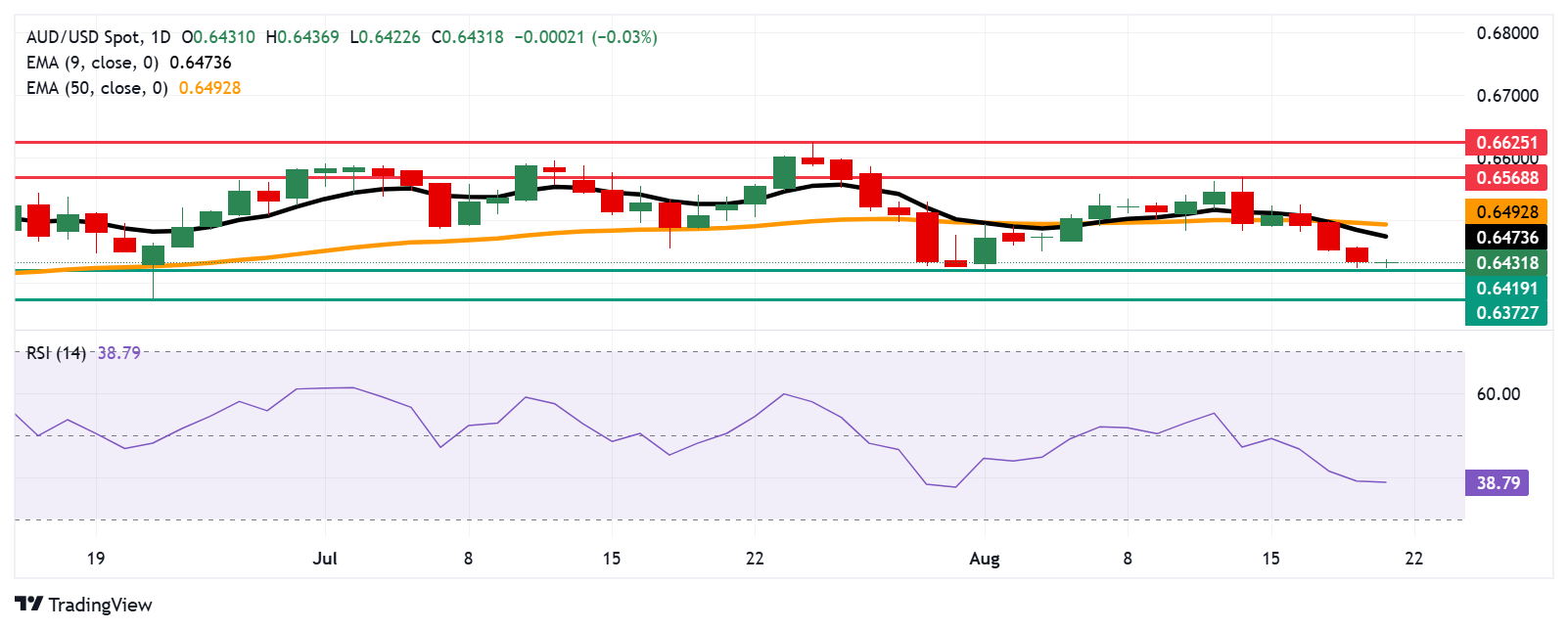
AUD/USD is trading around 0.6430 on Thursday. The technical analysis on the daily chart indicates that short-term price momentum is weakening as the pair remains below the nine-day Exponential Moving Average (EMA). Additionally, the 14-day Relative Strength Index (RSI) is positioned below the 50 level, indicating a bearish market bias.
On the downside, the AUD/USD pair could target the two-month low of 0.6419, recorded on August 1, followed by the three-month low of 0.6372, reached on June 23.
The primary barrier appears at the nine-day EMA of 0.6473, followed by the 50-day EMA at 0.6492. A break above this crucial resistance zone could improve the short- and medium-term price momentum and prompt the AUD/USD pair to target the monthly high at 0.6568, reached on August 14, followed by the nine-month high of 0.6625, which was recorded on July 24.
AUD/USD: Daily Chart
Australian Dollar PRICE Today
The table below shows the percentage change of Australian Dollar (AUD) against listed major currencies today. Australian Dollar was the weakest against the British Pound.
| USD | EUR | GBP | JPY | CAD | AUD | NZD | CHF | |
|---|---|---|---|---|---|---|---|---|
| USD | 0.18% | 0.08% | 0.16% | 0.03% | 0.14% | -0.04% | 0.24% | |
| EUR | -0.18% | -0.12% | -0.02% | -0.16% | 0.02% | -0.17% | 0.05% | |
| GBP | -0.08% | 0.12% | 0.06% | -0.04% | 0.14% | -0.03% | 0.17% | |
| JPY | -0.16% | 0.02% | -0.06% | -0.12% | -0.00% | -0.15% | 0.12% | |
| CAD | -0.03% | 0.16% | 0.04% | 0.12% | 0.08% | -0.09% | 0.21% | |
| AUD | -0.14% | -0.02% | -0.14% | 0.00% | -0.08% | -0.11% | 0.11% | |
| NZD | 0.04% | 0.17% | 0.03% | 0.15% | 0.09% | 0.11% | 0.22% | |
| CHF | -0.24% | -0.05% | -0.17% | -0.12% | -0.21% | -0.11% | -0.22% |
The heat map shows percentage changes of major currencies against each other. The base currency is picked from the left column, while the quote currency is picked from the top row. For example, if you pick the Australian Dollar from the left column and move along the horizontal line to the US Dollar, the percentage change displayed in the box will represent AUD (base)/USD (quote).
Economic Indicator
S&P Global Composite PMI
The S&P Global Composite Purchasing Managers Index (PMI), released on a monthly basis, is a leading indicator gauging US private-business activity in the manufacturing and services sector. The data is derived from surveys to senior executives. Each response is weighted according to the size of the company and its contribution to total manufacturing or services output accounted for by the sub-sector to which that company belongs. Survey responses reflect the change, if any, in the current month compared to the previous month and can anticipate changing trends in official data series such as Gross Domestic Product (GDP), industrial production, employment and inflation. The index varies between 0 and 100, with levels of 50.0 signaling no change over the previous month. A reading above 50 indicates that the private economy is generally expanding, a bullish sign for the US Dollar (USD). Meanwhile, a reading below 50 signals that activity is generally declining, which is seen as bearish for USD.
Read more.Next release: Thu Aug 21, 2025 13:45 (Prel)
Frequency: Monthly
Consensus: -
Previous: 55.1
Source: S&P Global
Author

Akhtar Faruqui
FXStreet
Akhtar Faruqui is a Forex Analyst based in New Delhi, India. With a keen eye for market trends and a passion for dissecting complex financial dynamics, he is dedicated to delivering accurate and insightful Forex news and analysis.