Australian Dollar advances despite a stronger US Dollar amid Fed caution
- Australian Dollar advances after the release of the Monthly Consumer Price Index on Wednesday.
- Australia’s Monthly Consumer Price Index climbed by 3.0% YoY in August, following the previous increase of 2.8%.
- Fed Chair Jerome Powell signaled that additional rate cuts remain possible if the FOMC determines more accommodation is necessary.

The Australian Dollar (AUD) appreciates against the US Dollar (USD) on Wednesday, following the release of Australia’s Monthly Consumer Price Index (CPI), which climbed by 3.0% year-over-year in August, following a 2.8% increase reported in July.
Australia’s preliminary S&P Global Composite PMI fell to 52.1 in September, from 55.5 prior, marking the lowest reading in three months. Manufacturing and services both noted slowing growth amid weaker new business inflows and lower goods orders at the fastest pace in eight months. The preliminary S&P Global Services PMI showed a modest slowdown to 52 in September, from 55.8 in August. Meanwhile, the Manufacturing PMI fell to 51.6 from 53.0 previously.
The White House announced that Australian Prime Minister Anthony Albanese and US President Donald Trump will hold their first in-person meeting in Washington, D.C. on October 20 to discuss the Aukus nuclear submarine pact.
Reserve Bank of Australia (RBA) Governor Michele Bullock told parliament on Monday that labor market conditions have eased slightly, with unemployment ticking higher. Bullock noted that recent rate cuts should support household and business spending, while stressing that the RBA must stay vigilant to changing conditions and be ready to respond if needed.
Australian Dollar advances despite a stable US Dollar
- The US Dollar Index (DXY), which measures the value of the US Dollar against six major currencies, is gaining ground and trading around 97.30 at the time of writing. However, the Greenback faced challenges following the release of US S&P Global PMI figures for September on Tuesday.
- US S&P Global Composite PMI ticked down to 53.6 from 54.6 in August, pointing to a private sector that seems to be struggling to strengthen further. Manufacturing PMI eased to 52.0 from 53, signalling waning momentum in the sector. Services PMI slipped to 53.9 from 54.5, suggesting demand there may be easing.
- Fed Chair Jerome Powell said on Tuesday that a weaker labor market is outweighing concerns about stubborn inflation, leading to an interest rate cut at its September meeting last week. However, Powell further stated that he is comfortable with the current policy path, though he indicated the possibility of further cuts should the FOMC see the need to be more accommodative.
- Fed Bank of Cleveland President Beth Hammack warned on Monday that inflation pressures will likely persist for the time being, noting challenges on both sides of the Fed's mandate to both control inflation and support the labor market.
- Richmond Fed President Thomas Barkin noted on Monday that tariff policies tend to result in higher prices for consumers, noting that the primary point of concern for businesses remains cloudy trade policy, rather than high interest rates.
- The White House announced that US companies will take control of TikTok’s algorithm, while Americans will occupy six of the seven board seats for its US operations. White House Press Secretary Karoline Leavitt said the agreement could be finalized “in the coming days,” though Beijing has not yet commented.
- The Reserve Bank of Australia (RBA) rate cuts. Markets now price just a 20% chance of a September cut, while odds for November stand at 70%, with above-target inflation keeping policymakers cautious.
Australian Dollar moves above 0.6600 to test nine-day EMA barrier
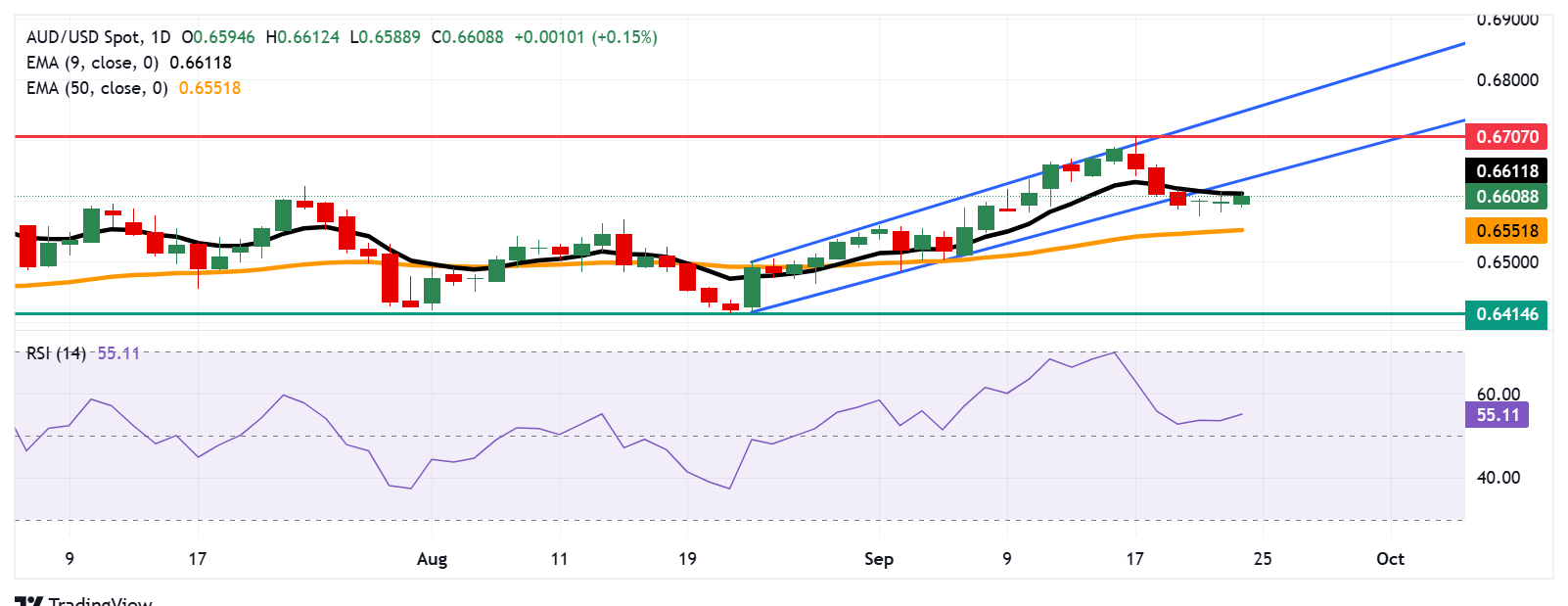
AUD/USD is trading around 0.6610 on Wednesday. Technical analysis on the daily chart shows that the pair remains slightly below the ascending channel pattern, indicating a weakening of a bullish bias. However, the 14-day Relative Strength Index (RSI) maintains its position slightly above the 50 level, suggesting that bullish sentiment still has play.
The AUD/USD pair is testing its immediate barrier at the nine-day Exponential Moving Average (EMA) of 0.6611, followed by the lower boundary of the ascending channel around 0.6640. A rebound to the channel would support the short-term price momentum and lead the AUD/USD pair to approach the 11-month high of 0.6707, recorded on September 17, followed by the ascending channel’s upper boundary around 0.6730.
On the downside, the AUD/USD pair may find its initial support at the crucial level of 0.6600, aligned with the 50-day Exponential Moving Average (EMA) at 0.6551. A break below the support zone would weaken the medium-term price momentum and put downward pressure on the pair to navigate the region around the three-month low at 0.6414, which was recorded on August 21.
AUD/USD: Daily Chart
Australian Dollar Price Today
The table below shows the percentage change of Australian Dollar (AUD) against listed major currencies today. Australian Dollar was the strongest against the Japanese Yen.
| USD | EUR | GBP | JPY | CAD | AUD | NZD | CHF | |
|---|---|---|---|---|---|---|---|---|
| USD | 0.17% | 0.20% | 0.30% | 0.11% | -0.43% | 0.05% | 0.14% | |
| EUR | -0.17% | 0.02% | 0.12% | -0.06% | -0.60% | -0.12% | -0.04% | |
| GBP | -0.20% | -0.02% | 0.06% | -0.09% | -0.56% | -0.15% | -0.10% | |
| JPY | -0.30% | -0.12% | -0.06% | -0.19% | -0.71% | -0.32% | -0.17% | |
| CAD | -0.11% | 0.06% | 0.09% | 0.19% | -0.51% | -0.06% | 0.03% | |
| AUD | 0.43% | 0.60% | 0.56% | 0.71% | 0.51% | 0.48% | 0.58% | |
| NZD | -0.05% | 0.12% | 0.15% | 0.32% | 0.06% | -0.48% | 0.11% | |
| CHF | -0.14% | 0.04% | 0.10% | 0.17% | -0.03% | -0.58% | -0.11% |
The heat map shows percentage changes of major currencies against each other. The base currency is picked from the left column, while the quote currency is picked from the top row. For example, if you pick the Australian Dollar from the left column and move along the horizontal line to the US Dollar, the percentage change displayed in the box will represent AUD (base)/USD (quote).
Australian Dollar FAQs
One of the most significant factors for the Australian Dollar (AUD) is the level of interest rates set by the Reserve Bank of Australia (RBA). Because Australia is a resource-rich country another key driver is the price of its biggest export, Iron Ore. The health of the Chinese economy, its largest trading partner, is a factor, as well as inflation in Australia, its growth rate and Trade Balance. Market sentiment – whether investors are taking on more risky assets (risk-on) or seeking safe-havens (risk-off) – is also a factor, with risk-on positive for AUD.
The Reserve Bank of Australia (RBA) influences the Australian Dollar (AUD) by setting the level of interest rates that Australian banks can lend to each other. This influences the level of interest rates in the economy as a whole. The main goal of the RBA is to maintain a stable inflation rate of 2-3% by adjusting interest rates up or down. Relatively high interest rates compared to other major central banks support the AUD, and the opposite for relatively low. The RBA can also use quantitative easing and tightening to influence credit conditions, with the former AUD-negative and the latter AUD-positive.
China is Australia’s largest trading partner so the health of the Chinese economy is a major influence on the value of the Australian Dollar (AUD). When the Chinese economy is doing well it purchases more raw materials, goods and services from Australia, lifting demand for the AUD, and pushing up its value. The opposite is the case when the Chinese economy is not growing as fast as expected. Positive or negative surprises in Chinese growth data, therefore, often have a direct impact on the Australian Dollar and its pairs.
Iron Ore is Australia’s largest export, accounting for $118 billion a year according to data from 2021, with China as its primary destination. The price of Iron Ore, therefore, can be a driver of the Australian Dollar. Generally, if the price of Iron Ore rises, AUD also goes up, as aggregate demand for the currency increases. The opposite is the case if the price of Iron Ore falls. Higher Iron Ore prices also tend to result in a greater likelihood of a positive Trade Balance for Australia, which is also positive of the AUD.
The Trade Balance, which is the difference between what a country earns from its exports versus what it pays for its imports, is another factor that can influence the value of the Australian Dollar. If Australia produces highly sought after exports, then its currency will gain in value purely from the surplus demand created from foreign buyers seeking to purchase its exports versus what it spends to purchase imports. Therefore, a positive net Trade Balance strengthens the AUD, with the opposite effect if the Trade Balance is negative.
Author

Akhtar Faruqui
FXStreet
Akhtar Faruqui is a Forex Analyst based in New Delhi, India. With a keen eye for market trends and a passion for dissecting complex financial dynamics, he is dedicated to delivering accurate and insightful Forex news and analysis.

















