Australian Dollar remains subdued as US Dollar steadies ahead of US GDP
- The Australian Dollar extended losses following downbeat CPI data released on Wednesday.
- The monthly Australian CPI rose by 2.1% YoY in September, against the expected 2.3% and previous 2.7% readings.
- The US Dollar may appreciate due to market caution persisting amid uncertainty surrounding the US presidential election and US data.

The Australian Dollar (AUD) extends its losing streak against the US Dollar (USD) for the fourth successive day, following lower-than-expected Australia's third-quarter Consumer Price Index (CPI) data released on Wednesday. However, the downside of the AUD could be restrained due to the hawkish sentiment surrounding the Reserve Bank of Australia's (RBA) regarding its policy outlook.
The Australian Bureau of Statistics reported that the Consumer Price Index (CPI) rose just 0.2% quarter-over-quarter in the third quarter, down from 1.0% in the previous quarter and slightly below the anticipated 0.3%. The monthly CPI rose by 2.1% year-over-year in September, coming in below market expectations of 2.3% and down from August's reading of 2.7%.
The US Dollar saw a slight downward correction as US Treasury yields edged lower. However, the USD’s downside may be limited, with market caution persisting due to uncertainty surrounding the upcoming US presidential election and anticipation of key US economic data releases.
Traders will likely watch the upcoming release of preliminary US Q3 Gross Domestic Product (GDP) figures and October’s ADP Employment Change, as these could offer important insights into the timing and pace of the Federal Reserve’s (Fed) expected rate cuts.
Daily Digest Market Movers: Australian Dollar loses ground following downbeat inflation data
- The positive US economic data from last week indicates continued resilience in the economy. This supports the sentiment of nominal interest rate cuts by the Federal Reserve (Fed) in November. According to the CME FedWatch Tool, there is a 98.4% probability of a 25-basis-point rate cut by the Fed in November, with no expectation of a more substantial 50-basis-point cut.
- Australia’s CPI fell to 2.8% year-over-year from the prior 3.8%, marking the lowest level since Q1 2021 and coming in below market forecasts of 2.9%.
- The US Bureau of Labor Statistics (BLS) reported on Tuesday that JOLTS Job Openings reached 7.443 million in September, down from 7.861 million in August and falling short of the market expectation of 7.99 million.
- The Reserve Bank of Australia signaled that the current cash rate of 4.35% is sufficiently restrictive to guide inflation back to the target range of 2%-3% while continuing to support employment. As a result, a rate cut in November appears unlikely.
- ANZ-Roy Morgan Australia Consumer Confidence dropped to 86.4 this week, down from 87.5 the previous week.
- Last week, Federal Reserve Bank of San Francisco President Mary Daly stated in a post on the social media platform X that the economy is clearly in a better position, with inflation having fallen significantly and the labor market returning to a more sustainable path.
- RBA Deputy Governor Andrew Hauser highlighted the country's strong labor participation rate last week and stressed that although the RBA relies on data, it is not overly fixated on it.
Technical Analysis: Australian Dollar remains above 0.6550 within the descending channel
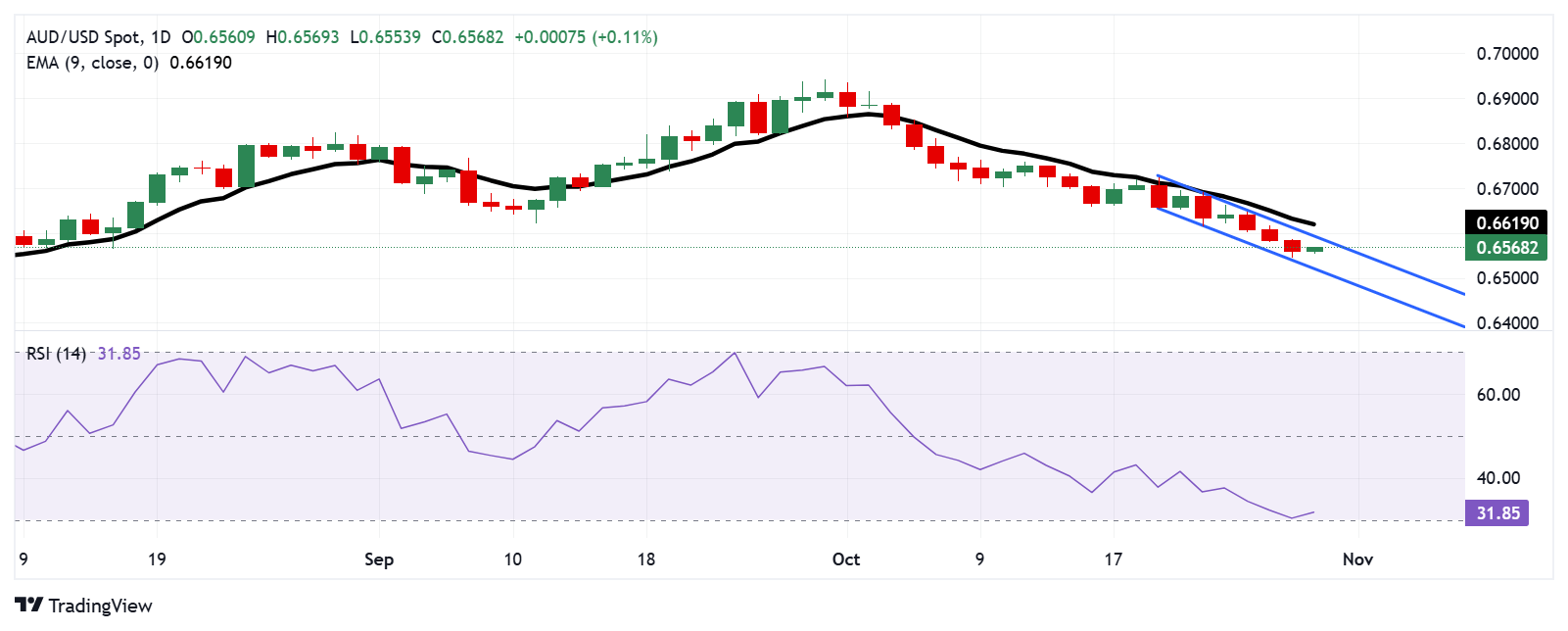
AUD/USD trades near 0.6560 on Wednesday, with daily chart analysis indicating a short-term bearish bias as the pair remains within a descending channel. However, the 14-day Relative Strength Index (RSI) sits at 30, signaling an oversold condition that may lead to an upward correction.
On the support side, the AUD/USD pair could test the descending channel's lower boundary around 0.6520, followed by the psychological level of 0.6500.
For resistance, the first hurdle lies at the upper boundary of the descending channel near 0.6590, with a psychological level of 0.6600 above that. A breakout above the latter could pave the way for the AUD/USD pair to reach the nine-day Exponential Moving Average (EMA) at 0.6619.
AUD/USD: Daily Chart
Australian Dollar PRICE Today
The table below shows the percentage change of Australian Dollar (AUD) against listed major currencies today. Australian Dollar was the weakest against the Japanese Yen.
| USD | EUR | GBP | JPY | CAD | AUD | NZD | CHF | |
|---|---|---|---|---|---|---|---|---|
| USD | 0.00% | 0.11% | -0.08% | 0.03% | 0.30% | 0.27% | 0.00% | |
| EUR | -0.01% | 0.11% | -0.07% | 0.02% | 0.28% | 0.26% | -0.01% | |
| GBP | -0.11% | -0.11% | -0.18% | -0.09% | 0.17% | 0.16% | -0.09% | |
| JPY | 0.08% | 0.07% | 0.18% | 0.10% | 0.36% | 0.33% | 0.07% | |
| CAD | -0.03% | -0.02% | 0.09% | -0.10% | 0.26% | 0.24% | -0.01% | |
| AUD | -0.30% | -0.28% | -0.17% | -0.36% | -0.26% | -0.01% | -0.28% | |
| NZD | -0.27% | -0.26% | -0.16% | -0.33% | -0.24% | 0.01% | -0.25% | |
| CHF | -0.00% | 0.00% | 0.09% | -0.07% | 0.01% | 0.28% | 0.25% |
The heat map shows percentage changes of major currencies against each other. The base currency is picked from the left column, while the quote currency is picked from the top row. For example, if you pick the Australian Dollar from the left column and move along the horizontal line to the US Dollar, the percentage change displayed in the box will represent AUD (base)/USD (quote).
Economic Indicator
Gross Domestic Product Annualized
The real Gross Domestic Product (GDP) Annualized, released quarterly by the US Bureau of Economic Analysis, measures the value of the final goods and services produced in the United States in a given period of time. Changes in GDP are the most popular indicator of the nation’s overall economic health. The data is expressed at an annualized rate, which means that the rate has been adjusted to reflect the amount GDP would have changed over a year’s time, had it continued to grow at that specific rate. Generally speaking, a high reading is seen as bullish for the US Dollar (USD), while a low reading is seen as bearish.
Read more.Next release: Wed Oct 30, 2024 12:30 (Prel)
Frequency: Quarterly
Consensus: 3%
Previous: 3%
Source: US Bureau of Economic Analysis
The US Bureau of Economic Analysis (BEA) releases the Gross Domestic Product (GDP) growth on an annualized basis for each quarter. After publishing the first estimate, the BEA revises the data two more times, with the third release representing the final reading. Usually, the first estimate is the main market mover and a positive surprise is seen as a USD-positive development while a disappointing print is likely to weigh on the greenback. Market participants usually dismiss the second and third releases as they are generally not significant enough to meaningfully alter the growth picture.
Author

Akhtar Faruqui
FXStreet
Akhtar Faruqui is a Forex Analyst based in New Delhi, India. With a keen eye for market trends and a passion for dissecting complex financial dynamics, he is dedicated to delivering accurate and insightful Forex news and analysis.