Australian Dollar remains tepid as US Dollar rises due to trade war threats
- The Australian Dollar faces pressure after President Trump announced that his administration is considering a 10% tariff on Chinese imports.
- Chinese Vice Premier Ding Xuexiang warned about the consequences of a trade war.
- Trump issued a memorandum directing federal agencies to investigate and address the ongoing trade deficits.

The Australian Dollar (AUD) remains subdued against the US Dollar (USD) on Wednesday. The AUD/USD pair faces challenges as US President Donald Trump announced that his administration is considering imposing a 10% tariff on Chinese imports starting February 1. The move is reportedly linked to concerns over fentanyl shipments from China to Mexico and Canada, according to Reuters.
Trump mentioned earlier, "If we make a TikTok deal and China doesn’t approve it, we could maybe put tariffs on China." This comment follows his signing of an executive order delaying the enforcement of the TikTok ban by 75 days. Given the close trading relationship between China and Australia, any developments affecting China's economy could significantly influence Australian markets.
Chinese Vice Premier Ding Xuexiang issued a warning on Tuesday about the repercussions of a trade war, emphasizing that "there are no winners" in such conflicts as China faces the possibility of tariffs under Donald Trump's newly elected government, according to CNBC.
The S&P/ASX 200 Index climbed to around 8,450 on Wednesday, marking its highest level in nearly seven weeks. The rally was supported by a positive lead from Wall Street, driven by US President Donald Trump’s decision to delay implementing tariff threats, which provided relief to global markets.
Australian Dollar could gain ground as Trump opts not to impose new tariffs
- The US Dollar Index (DXY), which tracks the performance of the US Dollar against six major currencies, holds ground around 108.00 at the time of writing. However, the Greenback faced headwinds as President Donald Trump opted not to impose new tariffs on his first day in office. However, Trump issued a memorandum instructing federal agencies to investigate and address ongoing trade deficits. Trump also warned Mexico, Canada, China, and the EU about potential tariffs over a range of trade-related concerns.
- The US Federal Reserve (Fed) is expected to keep its benchmark overnight rate steady in the 4.25%-4.50% range at its January meeting. However, investors believe Trump’s policies could drive inflationary pressures, potentially limiting the Fed to just one more rate cut. This could help cushion the USD against significant losses in the near term.
- US Retail Sales rose by 0.4% MoM in December, reaching $729.2 billion. This reading was weaker than the market expectations of a 0.6% rise and lower than the previous reading of a 0.8% increase (revised from 0.7%).
- The US Consumer Price Index increased by 2.9% year-over-year in December, up from 2.7% in November, aligning with market expectations. Monthly, CPI rose 0.4%, following a 0.3% increase in the previous month. US Core CPI, which excludes volatile food and energy prices, rose 3.2% annually in December, slightly below November's figure and analysts' forecasts of 3.3%.
- Australia's Westpac Leading Index held steady in December 2024, showing no change from the previous month, which had recorded a 0.1% increase. Meanwhile, the six-month annualized growth rate—a measure of the expected pace of economic activity compared to the trend over the next three to nine months—dipped to 0.25% in December, down from 0.33% in November, but remained positive for the second consecutive month.
- Traders are increasingly expecting the Reserve Bank of Australia (RBA) to start cutting interest rates as soon as next month. This outlook is fueled by weaker core inflation data, which has fallen to its lowest level since Q4 2021, nearing the RBA's target range of 2% to 3%. All eyes are now on Australia's upcoming quarterly inflation report, set for release next week, as it could offer additional clues about the future direction of interest rates.
Australian Dollar stays below 0.6300 but is poised to test upper ascending channel’s boundary
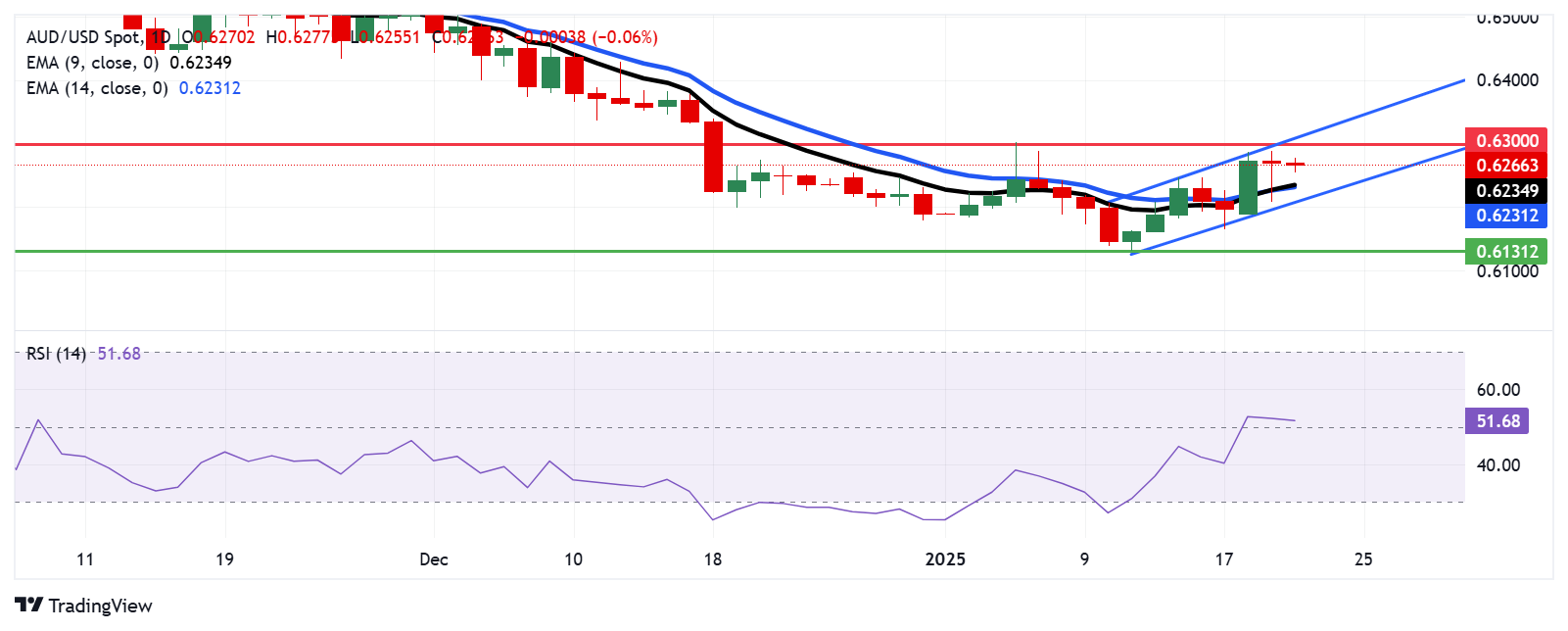
AUD/USD trades near 0.6270 on Wednesday. A daily chart analysis suggests that the pair is moving within an ascending channel pattern, indicating the potential development of a bullish bias. Furthermore, the 14-day Relative Strength Index (RSI) is slightly above the 50 mark, reinforcing the presence of bullish sentiment in the market.
On the upside, the AUD/USD pair could test the psychological resistance level at 0.6300, with the next target being the upper boundary of the ascending channel near 0.6320.
The initial support is seen around the nine-day Exponential Moving Average (EMA) at 0.6235, followed by the 14-day EMA at 0.6231. A stronger support level lies at the ascending channel’s lower boundary around 0.6210, with additional support at the psychological level of 0.6200.
AUD/USD: Daily Chart
Australian Dollar PRICE Today
The table below shows the percentage change of Australian Dollar (AUD) against listed major currencies today. Australian Dollar was the weakest against the US Dollar.
| USD | EUR | GBP | JPY | CAD | AUD | NZD | CHF | |
|---|---|---|---|---|---|---|---|---|
| USD | 0.18% | 0.17% | 0.20% | 0.10% | 0.26% | 0.37% | 0.11% | |
| EUR | -0.18% | -0.01% | 0.05% | -0.08% | 0.07% | 0.19% | -0.06% | |
| GBP | -0.17% | 0.01% | 0.04% | -0.07% | 0.09% | 0.20% | -0.06% | |
| JPY | -0.20% | -0.05% | -0.04% | -0.11% | 0.04% | 0.14% | -0.12% | |
| CAD | -0.10% | 0.08% | 0.07% | 0.11% | 0.15% | 0.27% | -0.00% | |
| AUD | -0.26% | -0.07% | -0.09% | -0.04% | -0.15% | 0.12% | -0.15% | |
| NZD | -0.37% | -0.19% | -0.20% | -0.14% | -0.27% | -0.12% | -0.27% | |
| CHF | -0.11% | 0.06% | 0.06% | 0.12% | 0.00% | 0.15% | 0.27% |
The heat map shows percentage changes of major currencies against each other. The base currency is picked from the left column, while the quote currency is picked from the top row. For example, if you pick the Australian Dollar from the left column and move along the horizontal line to the US Dollar, the percentage change displayed in the box will represent AUD (base)/USD (quote).
Australian Dollar FAQs
One of the most significant factors for the Australian Dollar (AUD) is the level of interest rates set by the Reserve Bank of Australia (RBA). Because Australia is a resource-rich country another key driver is the price of its biggest export, Iron Ore. The health of the Chinese economy, its largest trading partner, is a factor, as well as inflation in Australia, its growth rate and Trade Balance. Market sentiment – whether investors are taking on more risky assets (risk-on) or seeking safe-havens (risk-off) – is also a factor, with risk-on positive for AUD.
The Reserve Bank of Australia (RBA) influences the Australian Dollar (AUD) by setting the level of interest rates that Australian banks can lend to each other. This influences the level of interest rates in the economy as a whole. The main goal of the RBA is to maintain a stable inflation rate of 2-3% by adjusting interest rates up or down. Relatively high interest rates compared to other major central banks support the AUD, and the opposite for relatively low. The RBA can also use quantitative easing and tightening to influence credit conditions, with the former AUD-negative and the latter AUD-positive.
China is Australia’s largest trading partner so the health of the Chinese economy is a major influence on the value of the Australian Dollar (AUD). When the Chinese economy is doing well it purchases more raw materials, goods and services from Australia, lifting demand for the AUD, and pushing up its value. The opposite is the case when the Chinese economy is not growing as fast as expected. Positive or negative surprises in Chinese growth data, therefore, often have a direct impact on the Australian Dollar and its pairs.
Iron Ore is Australia’s largest export, accounting for $118 billion a year according to data from 2021, with China as its primary destination. The price of Iron Ore, therefore, can be a driver of the Australian Dollar. Generally, if the price of Iron Ore rises, AUD also goes up, as aggregate demand for the currency increases. The opposite is the case if the price of Iron Ore falls. Higher Iron Ore prices also tend to result in a greater likelihood of a positive Trade Balance for Australia, which is also positive of the AUD.
The Trade Balance, which is the difference between what a country earns from its exports versus what it pays for its imports, is another factor that can influence the value of the Australian Dollar. If Australia produces highly sought after exports, then its currency will gain in value purely from the surplus demand created from foreign buyers seeking to purchase its exports versus what it spends to purchase imports. Therefore, a positive net Trade Balance strengthens the AUD, with the opposite effect if the Trade Balance is negative.
Author

Akhtar Faruqui
FXStreet
Akhtar Faruqui is a Forex Analyst based in New Delhi, India. With a keen eye for market trends and a passion for dissecting complex financial dynamics, he is dedicated to delivering accurate and insightful Forex news and analysis.

















