Australian Dollar remains tepid after mixed Chinese data, Fedspeak awaited
- The Australian Dollar extends its losses after mixed economic data from China on Friday.
- The Australian Dollar struggles as Australia’s 10-year bond yield has dropped to a monthly low of 4.2%.
- China’s Retail Sales increased for the consecutive 15th month but the softest gain in this sequence.
- The US Dollar has rebounded as the Fed remains cautious about inflation and potential rate cuts in 2024.

The Australian Dollar (AUD) continues to experience a decline for the second consecutive session, largely influenced by recent mixed economic data from China released on Friday. Any economic change in the Chinese economy could catalyze the Australian market as both nations are close trade partners. The Aussie Dollar had already been under pressure after Australia's employment figures released on Thursday presented a mixed picture.
The Australian Dollar’s decline is bolstered as the yield on Australia’s 10-year government bond has dropped to around 4.2%, marking its lowest level in a month. This decline in bond yields is a reaction to the domestic jobs report, which showed an unexpected slowing in wage growth during the first quarter. The slowing wage growth has led markets to discount the possibility of any interest rate hikes by the Reserve Bank of Australia (RBA).
The US Dollar Index (DXY), which gauges the performance of the US Dollar (USD) against six major currencies, has rebounded from a multi-week low of 104.08 marked on Thursday. The Federal Reserve (Fed) maintains a cautious stance regarding inflation and the potential for rate cuts in 2024. Investors will take more cues from the Minneapolis Fed President Neel Kashkari and San Francisco Fed President Mary Daly's speeches later in the day.
Daily Digest Market Movers: Australian Dollar depreciates after mixed Chinese data
- China's Retail Sales increased 2.3% year-over-year in April, down from March's 3.1% and falling short of the expected 3.8%. This marks the 15th consecutive month of growth in retail activity but represents the slowest uptick in this trend. Meanwhile, Industrial Production improved 6.7% YoY, surpassing the anticipated 5.5% and the previous recording of 4.5%.
- The US Department of Labor released the US Initial Jobless Claims on Thursday. The number of Americans filing new claims for jobless benefits rose to 222,000 for the week ending May 10, surpassing the market consensus of 220,000 but below the previous week's figure of 232,000.
- On Thursday, Federal Reserve Bank of Atlanta President Raphael Bostic emphasized the need for patience with interest rates, noting that substantial pricing pressure persists in the US economy. Additionally, Cleveland Fed President Loretta Mester indicated that it might take longer than anticipated to confidently ascertain the inflation trajectory, suggesting that the Fed should maintain its restrictive stance for an extended period.
- Australia’s Wage Price Index (QoQ) increased by 0.8% in the first quarter, falling short of the market's forecast of a 0.9% rise. This quarter's increase is the smallest since late 2022. Additionally, annual pay growth slowed slightly to 4.1%, down from the previous 4.2%, and below market expectations.
- Sarah Hunter, Chief Economist and Assistant Governor (Economic) at the Reserve Bank of Australia (RBA), delivered a speech at the REIA Centennial Congress on Thursday. During her address, Hunter explored various potential strategies to address the imbalance between housing supply and demand growth. This issue looms large in Australia, with escalating prices, rents, and homelessness posing significant challenges.
- US Consumer Price Index (CPI) decelerated to 0.3% month-over-month in April and came in at a lower than expected 0.4% reading. While Retail Sales flattened, falling short of the expected increase of 0.4%.
- On Tuesday, the Australian Budget for 2024-25 returned to a deficit after recording a surplus of $9.3 billion in 2023-24. The Australian government aims to tackle headline inflation and alleviate the cost of living pressures by allocating billions to reduce energy bills and rent, alongside initiatives to lower income taxes.
- A Reuters report cited Treasurer of Australia Jim Chalmers, expressing his expectation that the current headline inflation rate of 3.6% will return to the Reserve Bank of Australia’s target range of 2-3% by the end of the year. If this scenario unfolds, the central bank will likely consider cutting interest rates earlier than markets had anticipated.
- Federal Reserve Chair Jerome Powell has anticipated a continued decline in inflation on Tuesday. Powell expressed less confidence in the disinflation outlook compared to previous assessments. He also highlighted that Gross Domestic Product (GDP) growth is expected to reach 2% or higher, attributing this positive forecast to the strength of the labor market.
Technical Analysis: Australian Dollar falls toward 0.6650
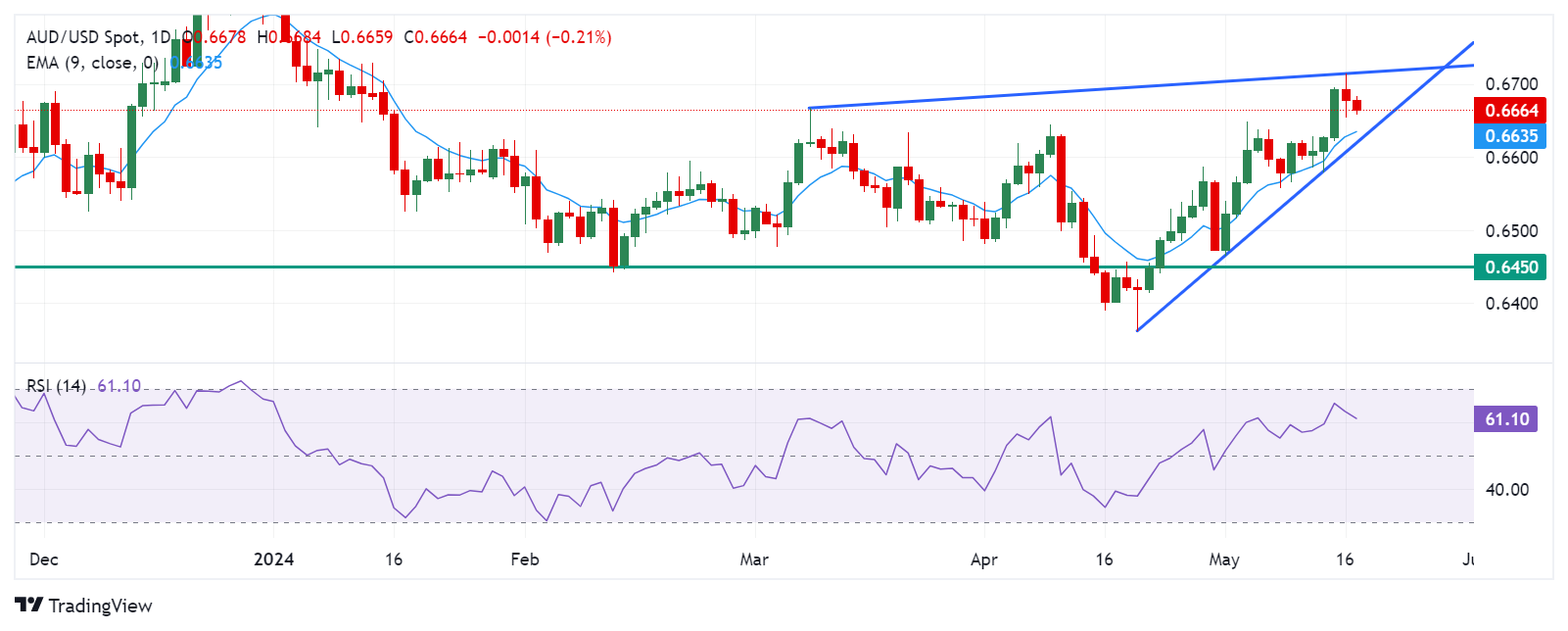
The Australian Dollar trades around 0.6660 on Friday. Observing the daily chart for AUD/USD showed an ascending triangle formation. Additionally, the 14-day Relative Strength Index (RSI) suggests a bullish sentiment, holding above the 50 mark.
The AUD/USD pair could challenge the upper threshold of the ascending triangle, resting near the four-month peak of 0.6714. A breach above this level might prompt exploration toward the significant barrier at 0.6750.
Conversely, potential support stands at the nine-day Exponential Moving Average (EMA) at 0.6634, followed by the lower boundary of the ascending triangle around 0.6610. A breakdown below this level could exert downward pressure, directing attention toward the throwback support at 0.6550.
AUD/USD: Daily Chart
Australian Dollar price today
The table below shows the percentage change of the Australian Dollar (AUD) against listed major currencies today. The Australian Dollar was the weakest against the US Dollar.
| USD | EUR | GBP | CAD | AUD | JPY | NZD | CHF | |
| USD | 0.07% | 0.07% | 0.10% | 0.19% | 0.27% | 0.12% | 0.19% | |
| EUR | -0.07% | 0.02% | 0.03% | 0.14% | 0.21% | 0.07% | 0.11% | |
| GBP | -0.08% | -0.01% | 0.02% | 0.13% | 0.19% | 0.03% | 0.10% | |
| CAD | -0.10% | -0.04% | -0.02% | 0.10% | 0.17% | 0.02% | 0.09% | |
| AUD | -0.20% | -0.13% | -0.11% | -0.10% | 0.07% | -0.07% | -0.01% | |
| JPY | -0.27% | -0.20% | -0.20% | -0.17% | -0.08% | -0.14% | -0.09% | |
| NZD | -0.12% | -0.06% | -0.05% | -0.02% | 0.07% | 0.14% | 0.05% | |
| CHF | -0.19% | -0.12% | -0.10% | -0.08% | 0.02% | 0.08% | -0.05% |
The heat map shows percentage changes of major currencies against each other. The base currency is picked from the left column, while the quote currency is picked from the top row. For example, if you pick the Euro from the left column and move along the horizontal line to the Japanese Yen, the percentage change displayed in the box will represent EUR (base)/JPY (quote).
Australian Dollar FAQs
One of the most significant factors for the Australian Dollar (AUD) is the level of interest rates set by the Reserve Bank of Australia (RBA). Because Australia is a resource-rich country another key driver is the price of its biggest export, Iron Ore. The health of the Chinese economy, its largest trading partner, is a factor, as well as inflation in Australia, its growth rate and Trade Balance. Market sentiment – whether investors are taking on more risky assets (risk-on) or seeking safe-havens (risk-off) – is also a factor, with risk-on positive for AUD.
The Reserve Bank of Australia (RBA) influences the Australian Dollar (AUD) by setting the level of interest rates that Australian banks can lend to each other. This influences the level of interest rates in the economy as a whole. The main goal of the RBA is to maintain a stable inflation rate of 2-3% by adjusting interest rates up or down. Relatively high interest rates compared to other major central banks support the AUD, and the opposite for relatively low. The RBA can also use quantitative easing and tightening to influence credit conditions, with the former AUD-negative and the latter AUD-positive.
China is Australia’s largest trading partner so the health of the Chinese economy is a major influence on the value of the Australian Dollar (AUD). When the Chinese economy is doing well it purchases more raw materials, goods and services from Australia, lifting demand for the AUD, and pushing up its value. The opposite is the case when the Chinese economy is not growing as fast as expected. Positive or negative surprises in Chinese growth data, therefore, often have a direct impact on the Australian Dollar and its pairs.
Iron Ore is Australia’s largest export, accounting for $118 billion a year according to data from 2021, with China as its primary destination. The price of Iron Ore, therefore, can be a driver of the Australian Dollar. Generally, if the price of Iron Ore rises, AUD also goes up, as aggregate demand for the currency increases. The opposite is the case if the price of Iron Ore falls. Higher Iron Ore prices also tend to result in a greater likelihood of a positive Trade Balance for Australia, which is also positive of the AUD.
The Trade Balance, which is the difference between what a country earns from its exports versus what it pays for its imports, is another factor that can influence the value of the Australian Dollar. If Australia produces highly sought after exports, then its currency will gain in value purely from the surplus demand created from foreign buyers seeking to purchase its exports versus what it spends to purchase imports. Therefore, a positive net Trade Balance strengthens the AUD, with the opposite effect if the Trade Balance is negative.
Author

Akhtar Faruqui
FXStreet
Akhtar Faruqui is a Forex Analyst based in New Delhi, India. With a keen eye for market trends and a passion for dissecting complex financial dynamics, he is dedicated to delivering accurate and insightful Forex news and analysis.

















