Australian Dollar hovers above monthly low after hot inflation data
- Australian Dollar weakens despite hot monthly inflation.
- Australia’s inflation accelerated to 5.2% as expected, up from the 4.9% prior.
- US Dollar floats below the highest level since December.
- Upbeat US Treasury yields could contribute support for the Greenback.

The Australian Dollar (AUD) looks to approach the monthly low against the US Dollar (USD) despite solid Australia’s inflation data. The AUD/USD pair failed to capitalize on the upbeat Australian Consumer Price Index (CPI) figures due to risk aversion. The decline in commodity prices is capping the upside in the AUD.
Reserve Bank of Australia's (RBA) Minutes from the September monetary policy meeting suggested that if inflation proves to be more enduring than expected, there may be a need for further tightening. Higher inflation could influence the RBA's decision to end the rate-hike cycle.
However, the argument for keeping the current policy unchanged appeared to be more compelling. As a result, this could also potentially limit the upside potential of the AUD/USD pair.
The US Dollar Index (DXY) trades around its highest level since December. This strength in the US Dollar is supported by the upbeat US Treasury yields. The yield on the 10-year US bond note has risen to a level not seen since October 2007.
United States (US) moderate data released on Tuesday could reinforce the strength of the Dollar. The US Housing Price Index improved, while Consumer Confidence along with Building Permits fell.
Moreover, most members of the US Federal Reserve (Fed) still anticipate further interest rate increases later in the year, which could be attributed to robust economic activities in the US. The Fed recently made the decision to keep the interest rate within the range of 5.25% to 5.50%, maintaining the status quo.
Daily Digest Market Movers: Australian Dollar drops due to market caution
- AUD/USD trades lower around 0.6380, extending losses toward the monthly low during the early European hours on Wednesday.
- Australia’s Monthly Consumer Price Index (CPI) year-over-year for August rose 5.2% as expected, up from the previous rate of 4.9%.
- The upcoming October 3 meeting, which will be Michele Bullock's first as a Governor of RBA, is not currently anticipated by the market to result in a rate hike.
- Expectations for a rate increase are on the rise for the November and December meetings by RBA.
- According to Bloomberg's World Interest Rate Probability (WIRP), the likelihood of another rate hike increases to 85% for the first quarter of the following year.
- Market participants will focus on Australia’s Retail Sales for August on Thursday, which is expected to grow by 0.3% lower than the previous rate of 0.5%.
- Bloomberg has reported, citing unnamed sources, that Hui Ka Yan, the billionaire chairman and founder of China Evergrande Group, has been placed under police control. According to these sources, he was taken into custody earlier this month and is currently being monitored at a specified location.
- The hawkish remarks from Fed officials have led to a broad-based strengthening of the US Dollar (USD) and have acted as a headwind for the AUD/USD pair.
- US Consumer Confidence released on Tuesday for September decreased to 103.0, down from the previous reading of 108.7 in August.
- Building Permits improved to 1.541M in August, up from the 1.443M prior. The House Price Index (MoM) for July rose 0.8%, compared to the market expectations of 0.5% growth, up from the previous growth of 0.4%.
- Minneapolis Fed President Neel Kashkari stated on Tuesday that one more rate hike is expected through the end of this year 2023.
- Traders await the US Durable Goods Orders report to be released on Wednesday. Additionally, the Core Personal Consumption Expenditure (PCE) Price Index, the Fed's preferred measure of consumer inflation, is due on Friday. The annual rate is expected to reduce from 4.2% to 3.9%.
Technical Analysis: Australian Dollar moves sideways below the 0.6400 psychological level
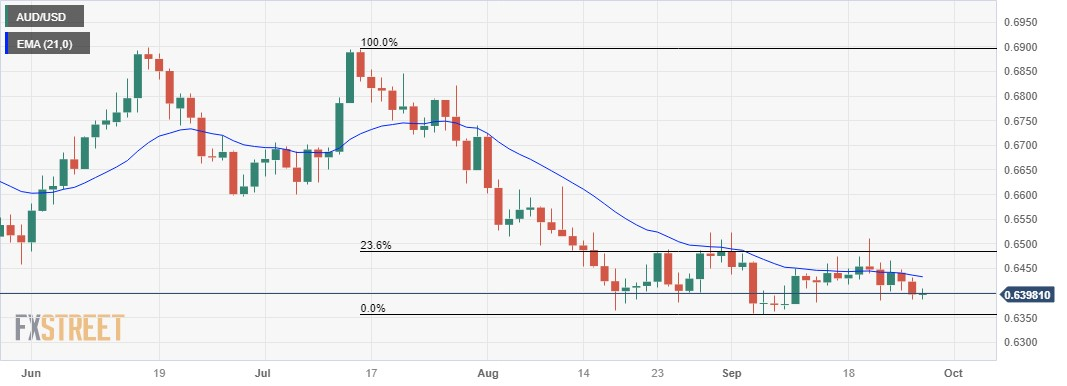
Australian Dollar trades higher around 0.6400 psychological level during the Asian session on Wednesday. AUD/USD pair could find a barrier around the 21-day Exponential Moving Average (EMA) at 0.6433, followed by the 0.6450 psychological level. A firm break above the latter could support the Aussie Dollar (AUD) to explore the region around 26.6% Fibonacci retracement at 0.6484 level. On the downside, the AUD/USD pair could find the key support around the monthly low at 0.6357 aligned to the 0.6350 psychological level.
AUD/USD: Daily Chart
RBA FAQs
What is the Reserve Bank of Australia and how does it influence the Australian Dollar?
The Reserve Bank of Australia (RBA) sets interest rates and manages monetary policy for Australia. Decisions are made by a board of governors at 11 meetings a year and ad hoc emergency meetings as required. The RBA’s primary mandate is to maintain price stability, which means an inflation rate of 2-3%, but also “..to contribute to the stability of the currency, full employment, and the economic prosperity and welfare of the Australian people.” Its main tool for achieving this is by raising or lowering interest rates. Relatively high-interest rates will strengthen the Australian Dollar (AUD) and vice versa. Other RBA tools include quantitative easing and tightening.
How does inflation data impact the value of the Australian Dollar?
While inflation had always traditionally been thought of as a negative factor for currencies since it lowers the value of money in general, the opposite has actually been the case in modern times with the relaxation of cross-border capital controls. Moderately higher inflation now tends to lead central banks to put up their interest rates, which in turn has the effect of attracting more capital inflows from global investors seeking a lucrative place to keep their money. This increases demand for the local currency, which in the case of Australia is the Aussie Dollar.
How does economic data influence the value of the Australian Dollar?
Macroeconomic data gauges the health of an economy and can have an impact on the value of its currency. Investors prefer to invest their capital in economies that are safe and growing rather than precarious and shrinking. Greater capital inflows increase the aggregate demand and value of the domestic currency. Classic indicators, such as GDP, Manufacturing and Services PMIs, employment, and consumer sentiment surveys can influence AUD. A strong economy may encourage the Reserve Bank of Australia to put up interest rates, also supporting AUD.
What is Quantitative Easing (QE) and how does it affect the Australian Dollar?
Quantitative Easing (QE) is a tool used in extreme situations when lowering interest rates is not enough to restore the flow of credit in the economy. QE is the process by which the Reserve Bank of Australia (RBA) prints Australian Dollars (AUD) for the purpose of buying assets – usually government or corporate bonds – from financial institutions, thereby providing them with much-needed liquidity. QE usually results in a weaker AUD.
What is Quantitative tightening (QT) and how does it affect the Australian Dollar?
Quantitative tightening (QT) is the reverse of QE. It is undertaken after QE when an economic recovery is underway and inflation starts rising. Whilst in QE the Reserve Bank of Australia (RBA) purchases government and corporate bonds from financial institutions to provide them with liquidity, in QT the RBA stops buying more assets and stops reinvesting the principal maturing on the bonds it already holds. It would be positive (or bullish) for the Australian Dollar.
Author

Akhtar Faruqui
FXStreet
Akhtar Faruqui is a Forex Analyst based in New Delhi, India. With a keen eye for market trends and a passion for dissecting complex financial dynamics, he is dedicated to delivering accurate and insightful Forex news and analysis.