Australian Dollar extends losses as US Dollar recovers ahead of economic data
- Australian Dollar faced challenges due to the modestly hawkish tone of FOMC minutes.
- Australia’s Dollar received upward support following the rather hawkish RBA minutes.
- Fed members agreed that policy should remain restrictive until inflation goes down toward the target.

The Australian Dollar (AUD) extends losses after pulling back from a three-month high following a corrective move by the US Dollar (USD) after the Federal Open Market Committee (FOMC) meeting minutes on Tuesday.
Australia's dollar (AUD) saw upward support following the Reserve Bank of Australia (RBA) Governor Michele Bullock's remarks and the rather hawkish RBA meeting minutes from November. She said that Australia's labor market is doing well and the job trend can continue.
Governor Bullock adds that the inflation problem is a major concern for the next year or two since it is a result of underlying demand rather than just supply problems. She will speak again on Wednesday, but no surprises are expected.
According to the FOMC meeting minutes, members would consider tightening monetary policy further if "incoming information indicated that progress towards the Committee's inflation objective was insufficient." Policymakers also agreed that policy should remain restrictive for some time until inflation is clearly and sustainably going down towards the Committee's target.
The US Dollar Index (DXY) continues to gain ground as US Treasury rates increase on Wednesday. The 10-year and 2-year US bond rates stayed higher at 4.41% and 4.88%, respectively, by the press time. Investors await data from the United States (US), which includes weekly jobless claims, and the University of Michigan Consumer Sentiment survey.
Daily Digest Market Movers: Australian Dollar experiences strength on hawkish RBA tone
- Australia’s Westpac Leading Index (MoM) for October contracted by 0.03% against the previous 0.07% rise.
- RBA's meeting minutes revealed that the board acknowledged a "credible case" against an immediate rate hike but considered the case for tightening stronger due to increased inflation risks. The decision on further tightening would hinge on data and risk assessment.
- RBA’s minutes also stressed the importance of preventing even a modest rise in inflation expectations. Board forecasts assumed one or two more rate rises, and rising house prices suggested policy might not be overly restrictive.
- The People’s Bank of China (PBoC) kept its loan prime rate (LPR) unchanged at 3.45% as expected.
- Chinese authorities are expected to take measures to support the real estate sector by drafting a list of 50 eligible developers, both private and state-owned. This list is expected to guide financial institutions in providing support through various means such as bank loans, debt, and equity financing.
- US Existing Home Sales Change (MoM) for October declined by 4.1% as compared to the previous fall of 2.2%.
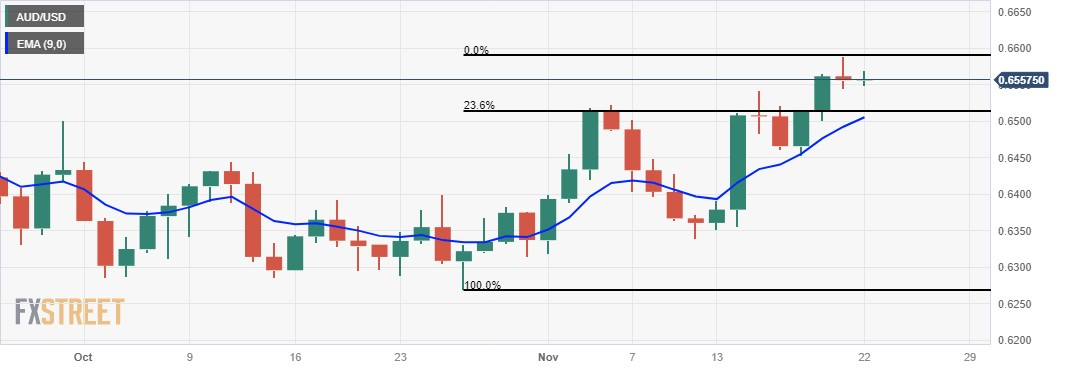
Technical Analysis: Australian Dollar moves below 0.6550 toward the 23.6% Fibonacci retracement
The Australian Dollar trades around the 0.6530 level on Wednesday. The key support could be the 23.6% Fibonacci retracement at 0.6514. If a break occurs below the level, the nine-day Exponential Moving Average (EMA) at 0.6505 could be the next support aligned with the major level at 0.6500. On the upside, the AUD/USD pair may breach the barrier at 0.6550 major level, which could support the pair to revisit the three-month high at 0.6589 aligned with the resistance area around the psychological level of 0.6600.
AUD/USD: Daily Chart
Australian Dollar price today
The table below shows the percentage change of Australian Dollar (AUD) against listed major currencies today. Australian Dollar was the weakest against the US Dollar.
| USD | EUR | GBP | CAD | AUD | JPY | NZD | CHF | |
| USD | 0.14% | 0.20% | 0.14% | 0.35% | 0.53% | 0.48% | 0.10% | |
| EUR | -0.14% | 0.06% | 0.01% | 0.22% | 0.38% | 0.34% | -0.05% | |
| GBP | -0.19% | -0.04% | -0.04% | 0.18% | 0.34% | 0.29% | -0.10% | |
| CAD | -0.15% | -0.01% | 0.04% | 0.20% | 0.37% | 0.33% | -0.06% | |
| AUD | -0.35% | -0.20% | -0.14% | -0.20% | 0.18% | 0.13% | -0.25% | |
| JPY | -0.53% | -0.38% | -0.35% | -0.36% | -0.19% | -0.08% | -0.43% | |
| NZD | -0.48% | -0.34% | -0.28% | -0.33% | -0.12% | 0.06% | -0.39% | |
| CHF | -0.09% | 0.06% | 0.10% | 0.06% | 0.26% | 0.43% | 0.39% |
The heat map shows percentage changes of major currencies against each other. The base currency is picked from the left column, while the quote currency is picked from the top row. For example, if you pick the Euro from the left column and move along the horizontal line to the Japanese Yen, the percentage change displayed in the box will represent EUR (base)/JPY (quote).
Australian Dollar FAQs
What key factors drive the Australian Dollar?
One of the most significant factors for the Australian Dollar (AUD) is the level of interest rates set by the Reserve Bank of Australia (RBA). Because Australia is a resource-rich country another key driver is the price of its biggest export, Iron Ore. The health of the Chinese economy, its largest trading partner, is a factor, as well as inflation in Australia, its growth rate and Trade Balance. Market sentiment – whether investors are taking on more risky assets (risk-on) or seeking safe-havens (risk-off) – is also a factor, with risk-on positive for AUD.
How do the decisions of the Reserve Bank of Australia impact the Australian Dollar?
The Reserve Bank of Australia (RBA) influences the Australian Dollar (AUD) by setting the level of interest rates that Australian banks can lend to each other. This influences the level of interest rates in the economy as a whole. The main goal of the RBA is to maintain a stable inflation rate of 2-3% by adjusting interest rates up or down. Relatively high interest rates compared to other major central banks support the AUD, and the opposite for relatively low. The RBA can also use quantitative easing and tightening to influence credit conditions, with the former AUD-negative and the latter AUD-positive.
How does the health of the Chinese Economy impact the Australian Dollar?
China is Australia’s largest trading partner so the health of the Chinese economy is a major influence on the value of the Australian Dollar (AUD). When the Chinese economy is doing well it purchases more raw materials, goods and services from Australia, lifting demand for the AUD, and pushing up its value. The opposite is the case when the Chinese economy is not growing as fast as expected. Positive or negative surprises in Chinese growth data, therefore, often have a direct impact on the Australian Dollar and its pairs.
How does the price of Iron Ore impact the Australian Dollar?
Iron Ore is Australia’s largest export, accounting for $118 billion a year according to data from 2021, with China as its primary destination. The price of Iron Ore, therefore, can be a driver of the Australian Dollar. Generally, if the price of Iron Ore rises, AUD also goes up, as aggregate demand for the currency increases. The opposite is the case if the price of Iron Ore falls. Higher Iron Ore prices also tend to result in a greater likelihood of a positive Trade Balance for Australia, which is also positive of the AUD.
How does the Trade Balance impact the Australian Dollar?
The Trade Balance, which is the difference between what a country earns from its exports versus what it pays for its imports, is another factor that can influence the value of the Australian Dollar. If Australia produces highly sought after exports, then its currency will gain in value purely from the surplus demand created from foreign buyers seeking to purchase its exports versus what it spends to purchase imports. Therefore, a positive net Trade Balance strengthens the AUD, with the opposite effect if the Trade Balance is negative.
Author

Akhtar Faruqui
FXStreet
Akhtar Faruqui is a Forex Analyst based in New Delhi, India. With a keen eye for market trends and a passion for dissecting complex financial dynamics, he is dedicated to delivering accurate and insightful Forex news and analysis.