Australian Dollar extends its upside as traders expect a bumper Fed interest rate cut
- The Australian Dollar extends its upside due to improved risk sentiment ahead of the US Federal Reserve's decision.
- The Reserve Bank of Australia’s hawkish stance supports the Aussie Dollar.
- The US Dollar struggles due to rising odds of a 50 basis point Fed interest rate cut on Wednesday.

The Australian Dollar (AUD) extends its upside for the third successive day against the US Dollar (USD) on Wednesday. Investors await the Federal Reserve (Fed) interest rate decision later in the day, although rising expectations of a 50 basis points cut should support risk-sensitive currencies like AUD.
The AUD/USD pair may advance further as the Australian Dollar remains supported by the Reserve Bank of Australia's (RBA) hawkish stance. RBA Governor Michele Bullock stated that it is premature to consider rate cuts due to persistently high inflation. Additionally, RBA Assistant Governor Sarah Hunter noted that while the labor market remains tight, wage growth appears to have peaked and is expected to slow further.
The Federal Reserve is expected to lower interest rates at its September meeting, following a steady rate range of 5.25% to 5.5% since July 2023. The CME FedWatch Tool indicates that markets are assigning a 33.0% probability to a 25-basis-point rate cut, while the likelihood of a 50-basis-point cut has risen to 67.0%, up from 62.0% just the previous day.
Daily Digest Market Movers: Australian Dollar gains ground due to a dovish Fed policy outlook
- JP Morgan CEO Jamie Dimon stated on Tuesday that whether the Federal Reserve cuts interest rates by 25 or 50 basis points, the impact will be “not earth-shattering.” Dimon emphasized, “They need to do it,” but noted that such moves are relatively minor in the grand scheme of things, as "there's a real economy" operating beneath the Fed’s rate changes, according to Bloomberg.
- US Retail Sales rose by 0.1% month-over-month in August, following a revised 1.1% increase in July, surpassing expectations of a 0.2% decline and indicating resilient consumer spending. Meanwhile, the Retail Sales Control Group increased by 0.3%, slightly below the previous month's 0.4% rise.
- ANZ-Roy Morgan Consumer Confidence climbed 1.8 points, reaching an eight-week high of 84.1. While ANZ notes that the rise was broad-based, confidence remains firmly in pessimistic territory.
- Economists at Goldman Sachs and Citi have reduced their 2024 GDP growth forecasts for China to 4.7%, falling short of Beijing's target of around 5.0%. SocGen describes the situation as a "downward spiral," while Barclays calls it "from bad to worse" and a "vicious cycle." Morgan Stanley also cautions that "things could get worse before they get better," according to a Reuters report.
- The University of Michigan’s Consumer Sentiment Index rose to 69.0 in September, exceeding the market expectations of 68.0 reading and marking a four-month high. This increase reflects a gradual improvement in consumers' outlook on the US economy after months of declining economic expectations.
- China's economy weakened in August, with a continued slowdown in industrial activity and declining real estate prices, as Beijing faces growing pressure to increase spending to boost demand. According to Business Standard, this was reported by the National Bureau of Statistics on Saturday.
- Australia’s Consumer Inflation Expectations eased to 4.4% in September, down slightly from August's four-month high of 4.5%. This decline highlights the central bank's efforts to balance bringing inflation down within a reasonable timeframe and maintaining gains in the labor market.
Technical Analysis: Australian Dollar remains above 0.6750; next barrier appears at seven-month highs
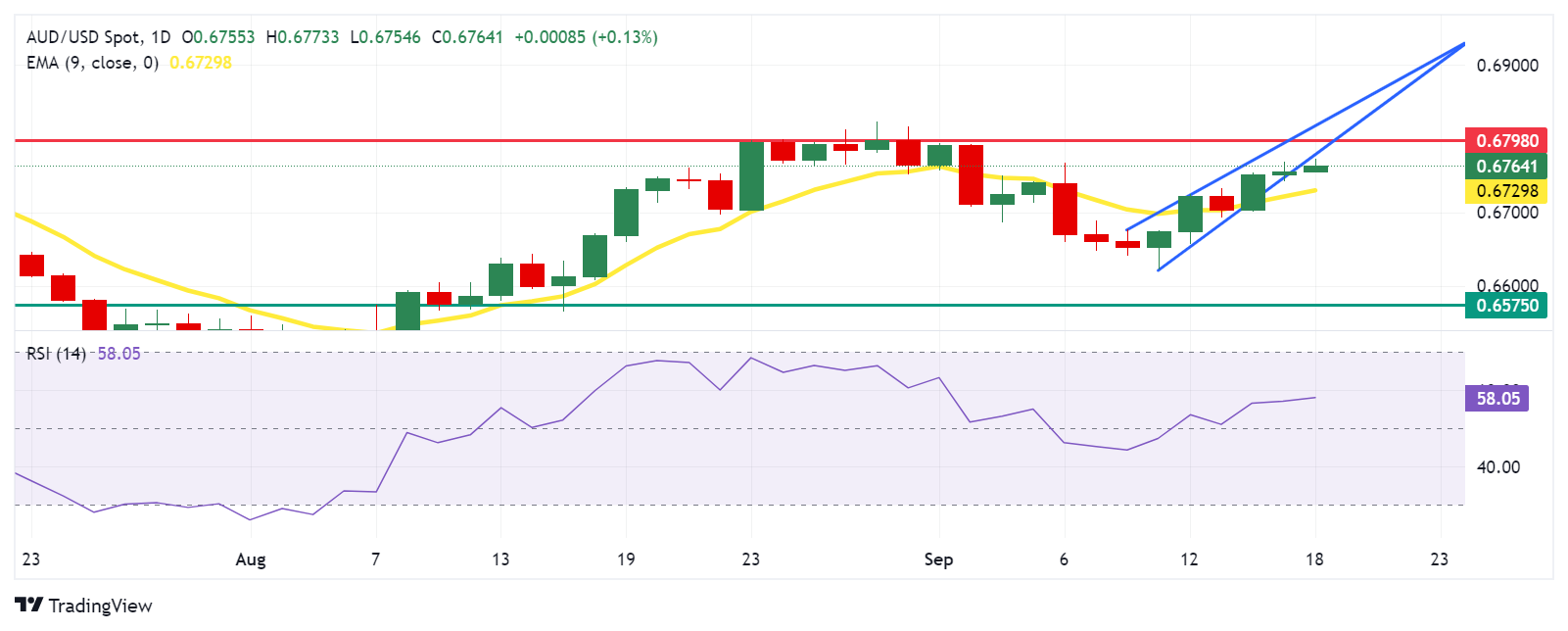
The AUD/USD pair trades near 0.6760 on Wednesday. Technical analysis of the daily chart indicates that the pair is positioned below the lower boundary of the rising wedge pattern (more visible on the lower time frame), indicating a potential bearish reversal. However, the 14-day Relative Strength Index (RSI) remains above the 50 level, suggesting an ongoing bullish trend.
Regarding the upside, a return to the rising wedge would reinforce the bullish bias and push the AUD/USD pair to test a seven-month high of 0.6798, followed by the 0.6800 level. Further resistance appears at the upper boundary of the rising wedge at the 0.6820 level.
On the downside, the AUD/USD pair could find immediate support around the nine-day Exponential Moving Average (EMA) at the 0.6730 level, followed by the psychological level of 0.6700. A break below the latter could lead the pair to navigate the region around the throwback support zone near 0.6575.
AUD/USD: Daily Chart
Australian Dollar PRICE Today
The table below shows the percentage change of Australian Dollar (AUD) against listed major currencies today. Australian Dollar was the strongest against the US Dollar.
| USD | EUR | GBP | JPY | CAD | AUD | NZD | CHF | |
|---|---|---|---|---|---|---|---|---|
| USD | -0.07% | -0.09% | -0.62% | -0.09% | -0.14% | -0.35% | -0.23% | |
| EUR | 0.07% | -0.03% | -0.57% | -0.02% | -0.06% | -0.29% | -0.16% | |
| GBP | 0.09% | 0.03% | -0.54% | 0.00% | -0.03% | -0.27% | -0.11% | |
| JPY | 0.62% | 0.57% | 0.54% | 0.54% | 0.50% | 0.29% | 0.43% | |
| CAD | 0.09% | 0.02% | -0.00% | -0.54% | -0.05% | -0.27% | -0.11% | |
| AUD | 0.14% | 0.06% | 0.03% | -0.50% | 0.05% | -0.20% | -0.07% | |
| NZD | 0.35% | 0.29% | 0.27% | -0.29% | 0.27% | 0.20% | 0.13% | |
| CHF | 0.23% | 0.16% | 0.11% | -0.43% | 0.11% | 0.07% | -0.13% |
The heat map shows percentage changes of major currencies against each other. The base currency is picked from the left column, while the quote currency is picked from the top row. For example, if you pick the Australian Dollar from the left column and move along the horizontal line to the US Dollar, the percentage change displayed in the box will represent AUD (base)/USD (quote).
Interest rates FAQs
Interest rates are charged by financial institutions on loans to borrowers and are paid as interest to savers and depositors. They are influenced by base lending rates, which are set by central banks in response to changes in the economy. Central banks normally have a mandate to ensure price stability, which in most cases means targeting a core inflation rate of around 2%. If inflation falls below target the central bank may cut base lending rates, with a view to stimulating lending and boosting the economy. If inflation rises substantially above 2% it normally results in the central bank raising base lending rates in an attempt to lower inflation.
Higher interest rates generally help strengthen a country’s currency as they make it a more attractive place for global investors to park their money.
Higher interest rates overall weigh on the price of Gold because they increase the opportunity cost of holding Gold instead of investing in an interest-bearing asset or placing cash in the bank. If interest rates are high that usually pushes up the price of the US Dollar (USD), and since Gold is priced in Dollars, this has the effect of lowering the price of Gold.
The Fed funds rate is the overnight rate at which US banks lend to each other. It is the oft-quoted headline rate set by the Federal Reserve at its FOMC meetings. It is set as a range, for example 4.75%-5.00%, though the upper limit (in that case 5.00%) is the quoted figure. Market expectations for future Fed funds rate are tracked by the CME FedWatch tool, which shapes how many financial markets behave in anticipation of future Federal Reserve monetary policy decisions.
Author

Akhtar Faruqui
FXStreet
Akhtar Faruqui is a Forex Analyst based in New Delhi, India. With a keen eye for market trends and a passion for dissecting complex financial dynamics, he is dedicated to delivering accurate and insightful Forex news and analysis.