Australian Dollar rises amid subdued US Dollar ahead of looming US PCE
- The Australian Dollar continues to gain ground due to improved risk appetite.
- Australia’s Retail Sales grew 0.1% in April, against the expected 0.2% and the previous decline of 0.4%.
- The US Dollar depreciates due to lower US Treasury yields.

The Australian Dollar (AUD) continues to strengthen against the US Dollar (USD) for the third consecutive session on Tuesday, despite the softer Australia's Retail Sales (MoM), which rose by 0.1% in April, reversing the previous 0.4% decline. This growth fell short of market expectations of 0.2%.
The AUD's strength is also reinforced by an improved risk appetite. Furthermore, the latest Reserve Bank of Australia (RBA) meeting minutes suggested that the board found it challenging to predict future changes in the cash rate, noting that recent data increase the likelihood of inflation remaining above the 2-3% target for an extended period.
The US Dollar (USD) continues to lose ground following the decline in the US Treasury yields. The US Dollar Index (DXY), which measures the value of the US Dollar against the six other major currencies, trades around 104.50 with 2-year and 10-year yields on US Treasury bonds standing at 4.94% and 4.46%, respectively, by the press time.
According to the CME FedWatch Tool, the probability of the Federal Reserve implementing a 25 basis-point rate cut in September has decreased to 44.9%, down from 49.6% a week earlier. On Tuesday, several US Federal Reserve (Fed) officials are scheduled to speak, including Fed Governor Michelle Bowman, Cleveland Fed President Loretta Mester, and Minneapolis Fed President Neel Kashkari.
Daily Digest Market Movers: Australian Dollar appreciates due to risk-on sentiment
- At the 2024 BOJ-IMES Conference on Tuesday, Cleveland Federal Reserve President Loretta Mester emphasized the need for FOMC statements to provide a detailed description of the current economic assessment, its impact on the outlook, and the associated risks. Mester anticipates that the Fed will consider improving its communications as part of the next monetary policy framework review.
- Meanwhile, Federal Reserve (Fed) Governor Michelle Bowman stressed the importance of continuing to reduce the balance sheet size to achieve ample reserves as soon as possible, especially while the economy is strong. Bowman underlined the necessity of clearly communicating that any changes to the run-off rate do not indicate a shift in the Fed's monetary policy stance.
- China's Shanghai has announced measures to support the property sector, including reducing down payment requirements and lowering minimum mortgage rates. Additionally, China launched a US$47 billion state-backed fund on Friday to strengthen its semiconductor industry. Any economic changes in China could significantly impact the Australian market due to the close trade relationship between the two countries.
- University of Michigan's 5-year Consumer Inflation Expectations for May on Friday, eased slightly to 3.0%, below the forecasted 3.1%. Despite the upward revision of the Consumer Sentiment Index to 69.1 from a preliminary reading of 67.4, it still marked the lowest level in six months.
- The US Census Bureau released Durable Goods Orders on Friday, showing a solid recovery in April with a 0.7% month-over-month increase, compared to the forecasted 0.8% decline. However, March’s figure was revised down to 0.8% from the initial estimate of 2.6%.
Technical Analysis: Australian Dollar moves above the major level of 0.6650
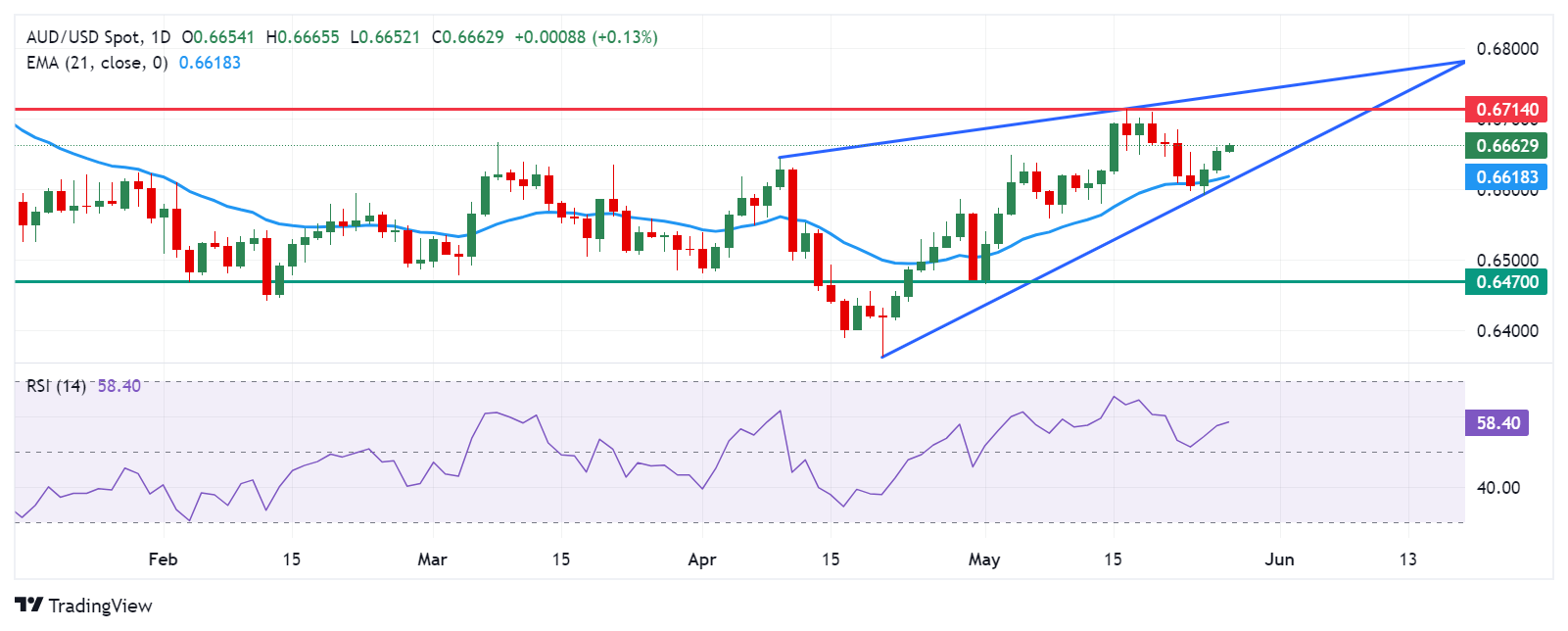
The Australian Dollar trades around 0.6660 on Tuesday. Analysis of the daily chart indicates a bullish bias for the AUD/USD pair, as it is positioned within a rising wedge. The 14-day Relative Strength Index (RSI) is slightly above the 50 level, further confirming this bullish bias.
The AUD/USD pair could potentially reach a four-month high of 0.6714, followed by the upper limit of the ascending triangle around 0.6730.
On the downside, the 21-day Exponential Moving Average (EMA) at 0.6618 serves as key support, followed by the psychological level of 0.6600. A further decline could put downward pressure on the AUD/USD pair, potentially driving it toward the throwback support region at 0.6470.
AUD/USD: Daily Chart
Australian Dollar price today
The table below shows the percentage change of the Australian Dollar (AUD) against listed major currencies today. The Australian Dollar was the strongest against the US Dollar.
| USD | EUR | GBP | CAD | AUD | JPY | NZD | CHF | |
| USD | -0.15% | -0.02% | -0.04% | -0.13% | -0.02% | -0.14% | -0.19% | |
| EUR | 0.15% | 0.13% | 0.11% | 0.03% | 0.14% | 0.01% | -0.01% | |
| GBP | 0.02% | -0.14% | -0.02% | -0.11% | -0.01% | -0.12% | -0.15% | |
| CAD | 0.04% | -0.12% | 0.02% | -0.09% | 0.02% | -0.10% | -0.13% | |
| AUD | 0.12% | -0.02% | 0.11% | 0.08% | 0.11% | -0.01% | -0.04% | |
| JPY | 0.02% | -0.14% | 0.00% | -0.03% | -0.09% | -0.12% | -0.15% | |
| NZD | 0.14% | -0.01% | 0.12% | 0.10% | 0.00% | 0.13% | -0.03% | |
| CHF | 0.16% | 0.02% | 0.15% | 0.13% | 0.06% | 0.15% | 0.03% |
The heat map shows percentage changes of major currencies against each other. The base currency is picked from the left column, while the quote currency is picked from the top row. For example, if you pick the Euro from the left column and move along the horizontal line to the Japanese Yen, the percentage change displayed in the box will represent EUR (base)/JPY (quote).
Australian Dollar FAQs
One of the most significant factors for the Australian Dollar (AUD) is the level of interest rates set by the Reserve Bank of Australia (RBA). Because Australia is a resource-rich country another key driver is the price of its biggest export, Iron Ore. The health of the Chinese economy, its largest trading partner, is a factor, as well as inflation in Australia, its growth rate and Trade Balance. Market sentiment – whether investors are taking on more risky assets (risk-on) or seeking safe-havens (risk-off) – is also a factor, with risk-on positive for AUD.
The Reserve Bank of Australia (RBA) influences the Australian Dollar (AUD) by setting the level of interest rates that Australian banks can lend to each other. This influences the level of interest rates in the economy as a whole. The main goal of the RBA is to maintain a stable inflation rate of 2-3% by adjusting interest rates up or down. Relatively high interest rates compared to other major central banks support the AUD, and the opposite for relatively low. The RBA can also use quantitative easing and tightening to influence credit conditions, with the former AUD-negative and the latter AUD-positive.
China is Australia’s largest trading partner so the health of the Chinese economy is a major influence on the value of the Australian Dollar (AUD). When the Chinese economy is doing well it purchases more raw materials, goods and services from Australia, lifting demand for the AUD, and pushing up its value. The opposite is the case when the Chinese economy is not growing as fast as expected. Positive or negative surprises in Chinese growth data, therefore, often have a direct impact on the Australian Dollar and its pairs.
Iron Ore is Australia’s largest export, accounting for $118 billion a year according to data from 2021, with China as its primary destination. The price of Iron Ore, therefore, can be a driver of the Australian Dollar. Generally, if the price of Iron Ore rises, AUD also goes up, as aggregate demand for the currency increases. The opposite is the case if the price of Iron Ore falls. Higher Iron Ore prices also tend to result in a greater likelihood of a positive Trade Balance for Australia, which is also positive of the AUD.
The Trade Balance, which is the difference between what a country earns from its exports versus what it pays for its imports, is another factor that can influence the value of the Australian Dollar. If Australia produces highly sought after exports, then its currency will gain in value purely from the surplus demand created from foreign buyers seeking to purchase its exports versus what it spends to purchase imports. Therefore, a positive net Trade Balance strengthens the AUD, with the opposite effect if the Trade Balance is negative.
Author

Akhtar Faruqui
FXStreet
Akhtar Faruqui is a Forex Analyst based in New Delhi, India. With a keen eye for market trends and a passion for dissecting complex financial dynamics, he is dedicated to delivering accurate and insightful Forex news and analysis.

















