Australia Forex Today: Australian Dollar extends gains ahead of Consumer Confidence

The Australian Dollar (AUD) starts the week on a positive note against the US Dollar (USD), with AUD/USD trading around 0.6590, up approximately 0.5% over the session, following upbeat Chinese trade data and a weakening of the Greenback due to softer employment indicators and rising expectations of a Federal Reserve (Fed) interest rate cut in September.
In Australia on Tuesday, the focus is on the Westpac-Melbourne Institute Consumer Confidence Index for September, which is due to be released at 10:30 AEST (00:30 GMT). In August, the index jumped 5.7% to 98.5, according to the Faculty of Economics and Commerce Melbourne Institute, reaching a three-year high and raising hopes that the long cycle of pessimism for Australian households is coming to an end.
AUD traders on Forex today are therefore keeping an eye on gradually improving domestic dynamics ahead of the next Reserve Bank of Australia (RBA) meeting at the end of the month.
Technical analysis of AUD/USD: Bullish momentum strengthens
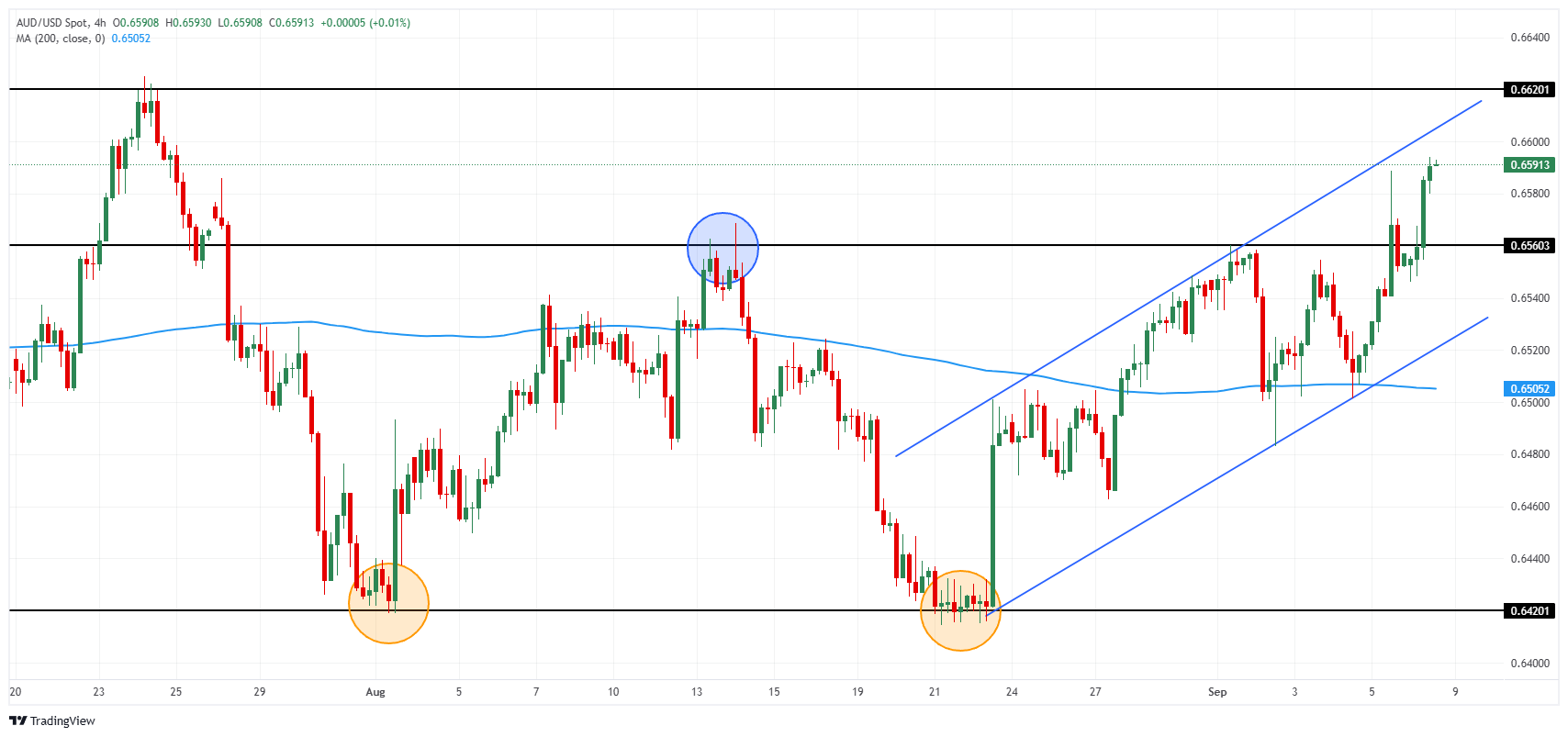
AUD/USD 4-hour chart. Source: FXStreet
The AUD/USD pair is still benefiting this Monday from the bullish momentum that followed the release of US Nonfarm employment data, which weighed on the US Dollar.
The breach of the 0.6560 blow line confirms the double bottom in the 0.6420 zone, reinforcing the short-term bullish scenario.
The next potential bullish targets are at 0.6600, where the current short-term uptrend channel passes, before the August peak zone at around 0.6620.
On the downside, a return below 0.6560 would severely weaken the current upward bias, and could lead to a fall towards the bottom of the channel towards 0.6530-0.6540.
Australian Dollar Price Today
The table below shows the percentage change of Australian Dollar (AUD) against listed major currencies today. Australian Dollar was the strongest against the US Dollar.
| USD | EUR | GBP | JPY | CAD | AUD | NZD | CHF | |
|---|---|---|---|---|---|---|---|---|
| USD | -0.32% | -0.25% | -0.40% | -0.06% | -0.52% | -0.73% | -0.59% | |
| EUR | 0.32% | 0.05% | 0.02% | 0.25% | -0.20% | -0.37% | -0.27% | |
| GBP | 0.25% | -0.05% | -0.14% | 0.20% | -0.25% | -0.42% | -0.32% | |
| JPY | 0.40% | -0.02% | 0.14% | 0.25% | -0.17% | -0.50% | -0.19% | |
| CAD | 0.06% | -0.25% | -0.20% | -0.25% | -0.37% | -0.62% | -0.53% | |
| AUD | 0.52% | 0.20% | 0.25% | 0.17% | 0.37% | -0.17% | -0.08% | |
| NZD | 0.73% | 0.37% | 0.42% | 0.50% | 0.62% | 0.17% | 0.09% | |
| CHF | 0.59% | 0.27% | 0.32% | 0.19% | 0.53% | 0.08% | -0.09% |
The heat map shows percentage changes of major currencies against each other. The base currency is picked from the left column, while the quote currency is picked from the top row. For example, if you pick the Australian Dollar from the left column and move along the horizontal line to the US Dollar, the percentage change displayed in the box will represent AUD (base)/USD (quote).
Growth and confidence: Consumers back on track
Australian GDP grew by 0.6% over the quarter and by 1.8% year-on-year in Q2, a better-than-expected figure that showed a rebound in economic activity after a more subdued start to the year disrupted by bad weather.
Household spending was the main driver, contributing 0.4 points to growth, while the savings rate fell back to 4.2%.
"Year-end sales and the proximity of the vacation season boosted discretionary purchases," noted Tom Lay, the Australian Bureau of Statistics head of national accounts, quoted by ABC News Australia.
By contrast, public investment contracted by 3.9%, marking the end of several infrastructure projects, while private investment remained timid.
As for Consumer Confidence, the 5.7% jump in August changed the psychological picture.
"This long period of consumer pessimism may finally be coming to an end", observed Matthew Hassan of Westpac.
If the September survey confirms the improvement, the message would be twofold: on the one hand, immediate support for the AUD via domestic risk appetite, and on the other, a macro scenario of transition to more private-led growth, as fiscal support normalizes.
Conversely, a sharp downturn in sentiment would point to persistent bottlenecks: Sluggish productivity, high unit labor costs and a labor market showing the first signs of running out of steam.
RBA stalls, Fed weakens the US Dollar
The sequence of more robust data has recalibrated the RBA's monetary easing expectations. Rabobank noted that the market was now pricing in just under a 20% probability of a cut at the September 30 meeting, following the better-than-expected growth performance in Q2.
At IG, Tony Sycamore doesn’t anticipate an interest rate cut in September, but a 25 bp cut in November, followed by another in March 2026 (terminal rate around 3.10%), while JP Morgan's Tom Kennedy similarly doesn’t expect a cut in September, and sees only one last easing in November (terminal 3.35%), according to ABC News.
The central argument for a rate cut is that inflation has returned to the 2%-3% target, but productivity remains weak and the private investment cycle lacks depth.
In addition, the US Dollar's recent weakness is due to the moderation in the US labor market and the prospect of Fed easing in the short term.
This monetary policy differential – Fed closer to an interest rate cut, RBA on watchful pause – offers the Greenback less carry and mechanically supports cyclical currencies, including the AUD.
(This story was corrected on September 8 at 15:06 GMT to say that the bottom of the channel in the AUD/USD chart is at 0.6530-0.6540, not 1.6530-1.6540)
Author

Ghiles Guezout
FXStreet
Ghiles Guezout is a Market Analyst with a strong background in stock market investments, trading, and cryptocurrencies. He combines fundamental and technical analysis skills to identify market opportunities.

















