Australia’s CPI inflation climbs to 0.9% QoQ in Q1 vs. 0.8% expected

Australia’s Consumer Price Index (CPI) rose 0.9% QoQ in the first quarter (Q1) of 2025, compared with the 0.2% increase seen in the fourth quarter, according to the latest data published by the Australian Bureau of Statistics (ABS) on Wednesday. The market consensus was for a growth of 0.8% in the reported period.
Annually, Australia’s CPI inflation steadies at 2.4% in Q1 versus 2.4% prior and above the market consensus of 2.2%.
The RBA Trimmed Mean CPI for Q1 rose 0.7% and 2.9% on a quarterly and annual basis, respectively. Markets estimated an increase of 0.7% QoQ and 2.9% YoY in the quarter to March.
The monthly Consumer Price Index steadies at 2.4% YoY in March, compared to the previous reading of 2.4% increase.
AUD/USD reaction to Australia's Consumer Price Index data
The Australian Dollar (AUD) caught a slight bid following the inflation data from Australia. The AUD/USD pair is adding 0.30% on the day to trade at 0.6402, at the press time.
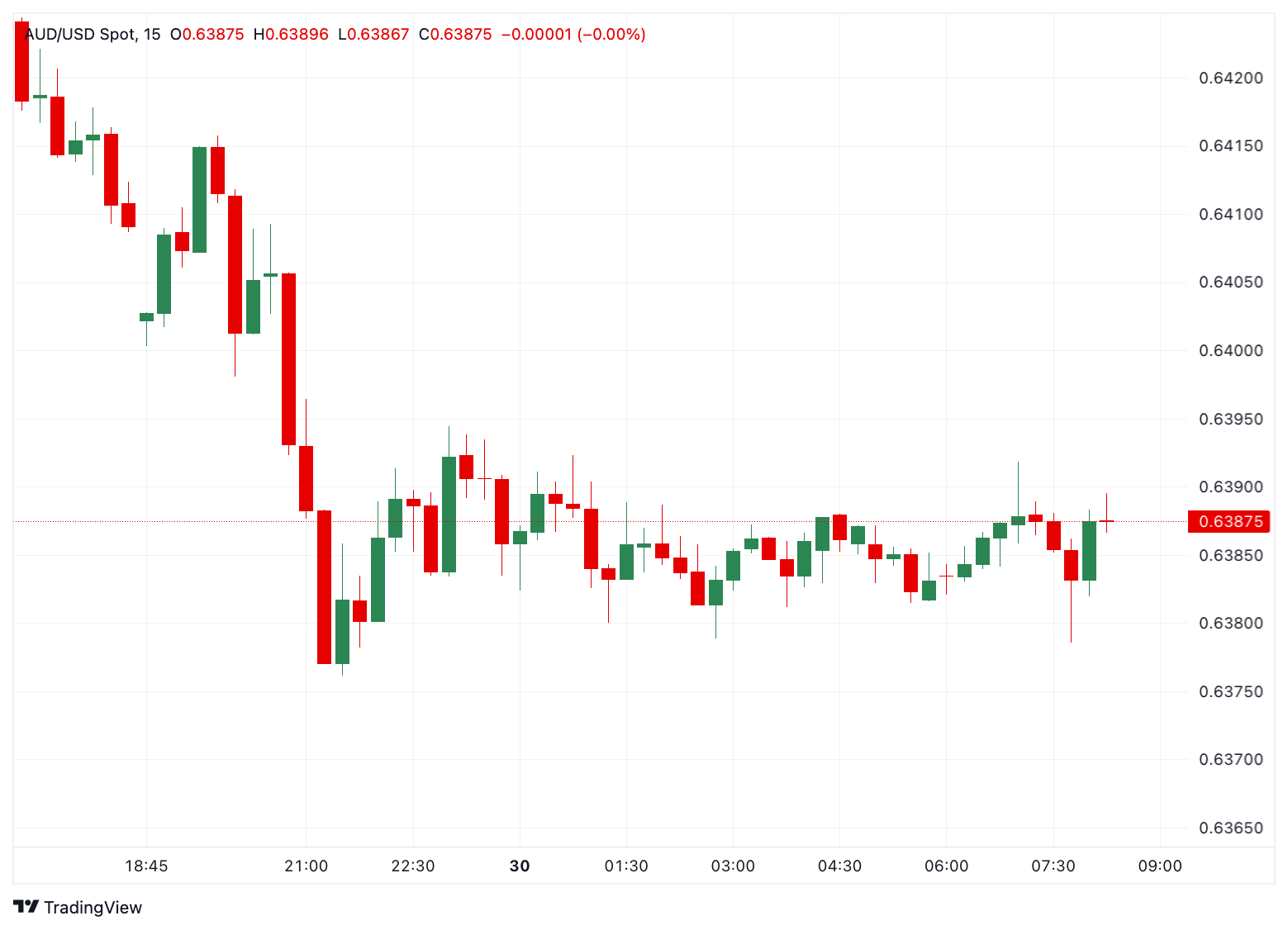
AUD/USD 15-min chart
Australian Dollar PRICE This week
The table below shows the percentage change of Australian Dollar (AUD) against listed major currencies this week. Australian Dollar was the strongest against the New Zealand Dollar.
| USD | EUR | GBP | JPY | CAD | AUD | NZD | CHF | |
|---|---|---|---|---|---|---|---|---|
| USD | -0.07% | -0.64% | -0.90% | -0.28% | -0.01% | 0.37% | -0.72% | |
| EUR | 0.07% | -0.63% | -0.84% | -0.23% | -0.04% | 0.43% | -0.67% | |
| GBP | 0.64% | 0.63% | -0.21% | 0.42% | 0.58% | 1.07% | -0.03% | |
| JPY | 0.90% | 0.84% | 0.21% | 0.66% | 0.93% | -0.13% | 0.49% | |
| CAD | 0.28% | 0.23% | -0.42% | -0.66% | 0.15% | 0.66% | -0.43% | |
| AUD | 0.01% | 0.04% | -0.58% | -0.93% | -0.15% | 0.48% | -0.62% | |
| NZD | -0.37% | -0.43% | -1.07% | 0.13% | -0.66% | -0.48% | -1.09% | |
| CHF | 0.72% | 0.67% | 0.03% | -0.49% | 0.43% | 0.62% | 1.09% |
The heat map shows percentage changes of major currencies against each other. The base currency is picked from the left column, while the quote currency is picked from the top row. For example, if you pick the Australian Dollar from the left column and move along the horizontal line to the US Dollar, the percentage change displayed in the box will represent AUD (base)/USD (quote).
This section below was published at 21:30 GMT as a preview of the Australian inflation data.
- The Australian monthly Consumer Price Index is foreseen at 2.3% in March.
- Quarterly CPI inflation expected to ease further below 3%, with core figures meeting RBA’s goal.
- The Reserve Bank of Australia will meet in mid-May to decide on monetary policy.
- The Australian Dollar eases vs its American rival after reaching a fresh 2025 high.
Australia will release multiple inflation figures on Wednesday and financial markets anticipate price pressures easing further at the beginning of 2025, paving the way for additional Reserve Bank of Australia (RBA) interest rate cuts. The central bank is meant to meet to decide on monetary policy on May 19-20.
Back to data, the Australian Bureau of Statistics (ABS) will publish two different inflation gauges: the quarterly Consumer Price Index (CPI) for the first quarter of 2025 and the March monthly CPI, which measures annual price pressures over the past twelve months. The quarterly report includes the RBA Trimmed Mean CPI, policymakers’ favorite inflation gauge.
The RBA has maintained the Official Cash Rate (OCR) on hold at 4.10% when it met early April, after delivering a 25 basis points (bps) rate cut in February, the first one after the hiking cycle that began in 2022.
What to expect from Australia’s inflation rate numbers?
The ABS is expected to report that the monthly CPI rose by 2.3% in the year to March, easing from the 2.4% posted in February. The quarterly CPI is foreseen to increase by 0.8% quarter-on-quarter (QoQ) and by 2.2% year-on-year (YoY) in the first quarter of 2025. Additionally, the central bank’s preferred gauge, the RBA Trimmed Mean CPI, is expected to rise by 2.9% YoY in Q4, easing from the 3.2% advance posted in the previous quarter.
Finally, the RBA Trimmed Mean CPI is forecast to increase by 0.7% QoQ, higher than the 0.5% previously posted. Still, the figures will fall within the RBA’s goal to keep inflation between 2 and 3%, which means the central bank could deliver additional interest rate cuts in the foreseeable future.
Meanwhile, economic activity in the country, as measured by the Gross Domestic Product (GDP), picked up modestly in the last quarter of 2025, with GDP growing by 0.6% in real terms, surpassing the market expectations of 0.5% and marking the strongest performance since December 2022. The annual growth rate of 1.3% also exceeded the consensus forecast of 1.2%. The modest advance spooked the ghost of recession, albeit the economy is not yet out of the woods.
Finally, it's worth adding that Australia’s GDP growth is projected to reach approximately 2.2% in 2025, according to the most recent forecasts from the RBA. Beyond the central banks’ inflation goal, tepid growth has been part of policymakers’ decision to trim interest rates, to help avoid a steeper economic setback.
Meanwhile, the United States (US) President Donald Trump started a global trade war. After announcing tariffs on neighbouring countries, Trump launched “reciprocal tariffs” on most trading partners. Australia fell into the 10% baseline levy while facing a 25% tariff on all steel and aluminium exports into the US. However, most tensions lay between China and the US, with tariffs in the hundreds. China is Australia's major trading partner, and the local economy may suffer the echoes of tensions between the world’s largest economies.
Additionally, concerns related to the trade war's impact on the US economy keep the US Dollar (USD) on the back foot. The USD fell to fresh 2025 lows against most major rivals in April and retains its soft tone regardless of the market’s sentiment.
RBA Governor Michelle Bullock noted, “If there are large tariffs on China, Chinese trade will probably try to find other ways to find an outlet. Australia might even be a beneficiary of that. So we might, in fact, find some deflationary impacts for Australia if it rolls out that way.”
How could the Consumer Price Index report affect AUD/USD?
Inflation figures are, as usual, crucial. Easing inflationary pressures should fuel bets on an RBA rate cut in May.
Generally speaking, higher CPI figures would be bullish for the AUD amid expectations of a hawkish RBA. However, the opposite scenario is also valid: easing inflation could push policymakers towards a more dovish stance.
Heading into the CPI release, the AUD/USD pair trades around the 0.6400 mark, retreating from a fresh yearly high of 0.6450.
Valeria Bednarik, FXStreet Chief Analyst, says: “The AUD/USD pair is consolidating gains and despite intraday back and forth, the bullish case remains firm in place. Technical readings in the daily chart suggest the pair may correct lower, as technical indicators ease from their recent peaks near overbought readings. Still, the case for a bearish breakout remains far away.”
Bednarik adds: “The AUD/USD pair should find initial near-term support in the 0.6340 region, with further slides exposing the 0.6280 price zone, where a bullish 20 Simple Moving Average (SMA) converges with a flat 100 SMA. It would take a break below this area to anticipate a steeper slide towards the 0.6200 mark. A bullish extension beyond the year high should result in AUD/USD testing sellers’ determination around the 0.6500 figure.”
Economic Indicator
RBA Trimmed Mean CPI (YoY)
The Consumer Price Index (CPI), released by the Australian Bureau of Statistics on a quarterly basis, measures the changes in the price of a fixed basket of goods and services acquired by household consumers The YoY reading compares prices in the reference quarter to the same quarter a year earlier. The trimmed mean, which is a measure of underlying inflation, is calculated as the weighted average of the central 70% of the quarterly price change distribution of all CPI components in order to smooth the data from the more-volatile components.Generally, a high reading is seen as bullish for the Australian Dollar (AUD), while a low reading is seen as bearish.
Read more.Next release: Wed Apr 30, 2025 01:30
Frequency: Quarterly
Consensus: 2.9%
Previous: 3.2%
Source: Australian Bureau of Statistics
The quarterly Consumer Price Index (CPI) published by the Australian Bureau of Statistics (ABS) has a significant impact on the market and the AUD valuation. The gauge is closely watched by the Reserve Bank of Australia (RBA), in order to achieve its inflation mandate, which has major monetary policy implications. Rising consumer prices tend to be AUD bullish, as the RBA could hike interest rates to maintain its inflation target. The data is released nearly 25 days after the quarter ends.
Inflation FAQs
Inflation measures the rise in the price of a representative basket of goods and services. Headline inflation is usually expressed as a percentage change on a month-on-month (MoM) and year-on-year (YoY) basis. Core inflation excludes more volatile elements such as food and fuel which can fluctuate because of geopolitical and seasonal factors. Core inflation is the figure economists focus on and is the level targeted by central banks, which are mandated to keep inflation at a manageable level, usually around 2%.
The Consumer Price Index (CPI) measures the change in prices of a basket of goods and services over a period of time. It is usually expressed as a percentage change on a month-on-month (MoM) and year-on-year (YoY) basis. Core CPI is the figure targeted by central banks as it excludes volatile food and fuel inputs. When Core CPI rises above 2% it usually results in higher interest rates and vice versa when it falls below 2%. Since higher interest rates are positive for a currency, higher inflation usually results in a stronger currency. The opposite is true when inflation falls.
Although it may seem counter-intuitive, high inflation in a country pushes up the value of its currency and vice versa for lower inflation. This is because the central bank will normally raise interest rates to combat the higher inflation, which attract more global capital inflows from investors looking for a lucrative place to park their money.
Formerly, Gold was the asset investors turned to in times of high inflation because it preserved its value, and whilst investors will often still buy Gold for its safe-haven properties in times of extreme market turmoil, this is not the case most of the time. This is because when inflation is high, central banks will put up interest rates to combat it. Higher interest rates are negative for Gold because they increase the opportunity-cost of holding Gold vis-a-vis an interest-bearing asset or placing the money in a cash deposit account. On the flipside, lower inflation tends to be positive for Gold as it brings interest rates down, making the bright metal a more viable investment alternative.
Author

FXStreet Team
FXStreet
Composed of a group of economic journalists and FX experts, the FXStreet content team produces and oversees all content published on FXStreet. It provides a purely journalistic approach to the Forex market.